Films · Genetics and Molecular Biology
Two Copies, One Coin Toss
Read the transcript of “Two Copies, One Coin Toss”
Film transcript: Two Copies, One Coin Toss
Where can a trait hide for a whole generation? Mendel asked that of garden peas. He started with lines that always bred true. One line always gave round seeds. The other always gave wrinkled seeds. Then he crossed them by hand. He opened a young flower, removed its stamens, which make pollen, and brushed on pollen from the other line. Every hybrid seed was round, like the round parent. Not halfway between. Wrinkled seemed to be gone. He planted those round hybrid seeds and let each plant pollinate itself. Their pods held round and wrinkled peas, side by side. Wrinkled was back, unchanged. He counted thousands of these seeds. Round beat wrinkled by about 3 to 1.
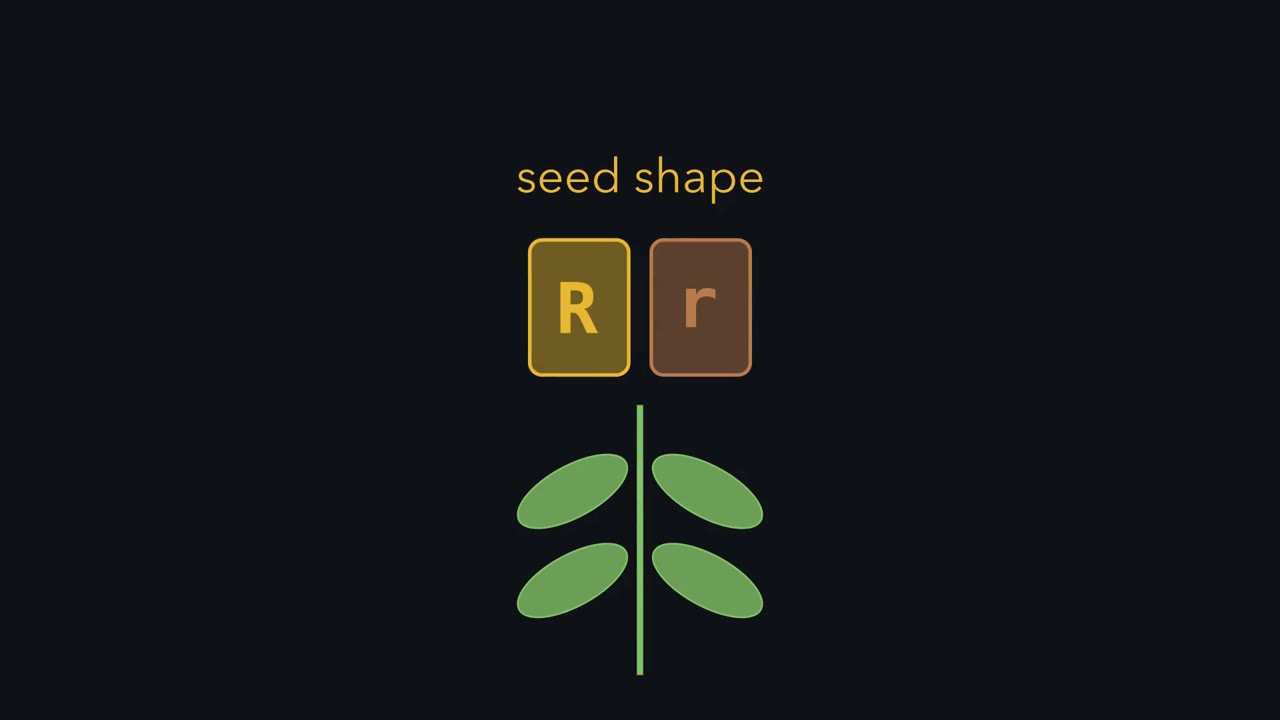
So where was wrinkled hiding, and why one in four? Here is the answer in modern terms. Each pea plant carries two copies of the gene for seed shape. One copy came from each parent. Picture the copies as cards. A round line holds two round cards. A wrinkled line holds two wrinkled cards. The hybrid holds one of each. When the hybrid makes an egg or a pollen grain, it puts in just one card. Which card is decided like a fair coin toss. So half its eggs carry a round copy, and half carry a wrinkled copy. The same is true of its pollen. Now the hybrid pollinates itself.
Eggs meet pollen at random, so four unions are equally likely. One box gets two round copies. Two get one of each. One gets two wrinkled copies. Remember, every hybrid seed was round, with one copy of each. So which of these four boxes will look round?
Three of them. One round copy is enough for a round seed. Mendel called round the dominant form, the one the hybrid shows. Wrinkled is the recessive form. It hides in the hybrid, and shows only with two wrinkled copies. So the hidden mix is 1 : 2 : 1. What you see is 3 round to 1 wrinkled. Back to Mendel's count. It came close to 3 to 1, but not exactly.
Real counts scatter around what the coin toss predicts. So here is the idea. Every pea plant has two copies. Every egg and pollen grain gets one, by a coin toss. One round copy is enough to look round. If that is right, the round seeds are not all the same. Some hide a wrinkled copy. How could you find out which?
Mendel crossed round peas with wrinkled ones and every hybrid seed came out round. A generation later he counted 5,474 round seeds and 1,850 wrinkled. Where had wrinkled been hiding, and why one in four?
Continue in the lesson: Mendel's Peas: Segregation and Independent Assortment →
3:15 · Free, with captions and a transcript. The lesson has the full text, the questions and the sources.
More films from this lesson
How this film was made. Narration: written from this lesson's text and read by an AI narrator voice (Kokoro, af_heart). Animation: AI-generated in code (Manim) by Claude, a schematic with no drawn molecular structures. Captions come from the narration script. See something wrong? Report it.