Biochemistry · Skim version
Introduction to Biochemistry and Cell Biology: Compartments Create Control
Read the full lesson → Skim the whole course →
The guiding idea
Why can one missing enzyme kill a child, when her parents, with half as much, are fine? The answer is a room with no way out.
Why can one missing enzyme kill a child, when her parents, with half as much, are fine?
From the film
- GM2 cannot cross the lysosome's membrane, so in its simplest form its level is a balance: delivery in, against clearance out by HexA.
- Tay-Sachs carriers make about half the normal HexA, which still clears GM2 faster than it arrives.
- GM2 storage starts only when HexA-dependent clearance can no longer match delivery; measurements put that cut-off near 10 to 15% of normal.
- In infantile Tay-Sachs there is almost no working HexA, so GM2 piles up from before birth in an intact lysosome.
- In Tay-Sachs, nerve cells are hit hardest: their membranes are rich in gangliosides, and stored GM2 is not diluted between daughter cells.
-
What a cell is made of
-
A wall makes a room
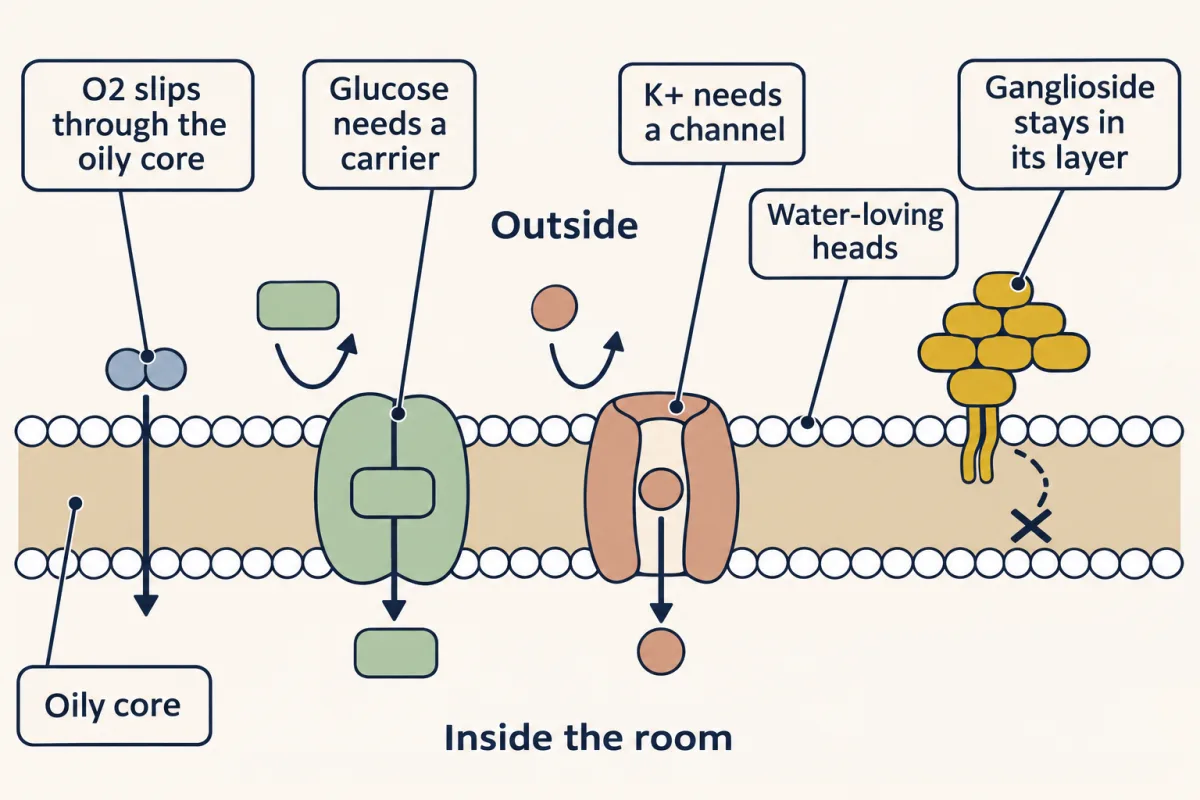
A wall makes a room. Small nonpolar molecules such as O₂ cross a bare bilayer; glucose and ions need proteins the cell builds, and a big sugar-headed lipid stays in the layer where it was put. AI-generated illustration -
The first room: the nucleus and the central dogma
-
Why big cells need inner walls
-
The sealed conveyor belt, and how we know
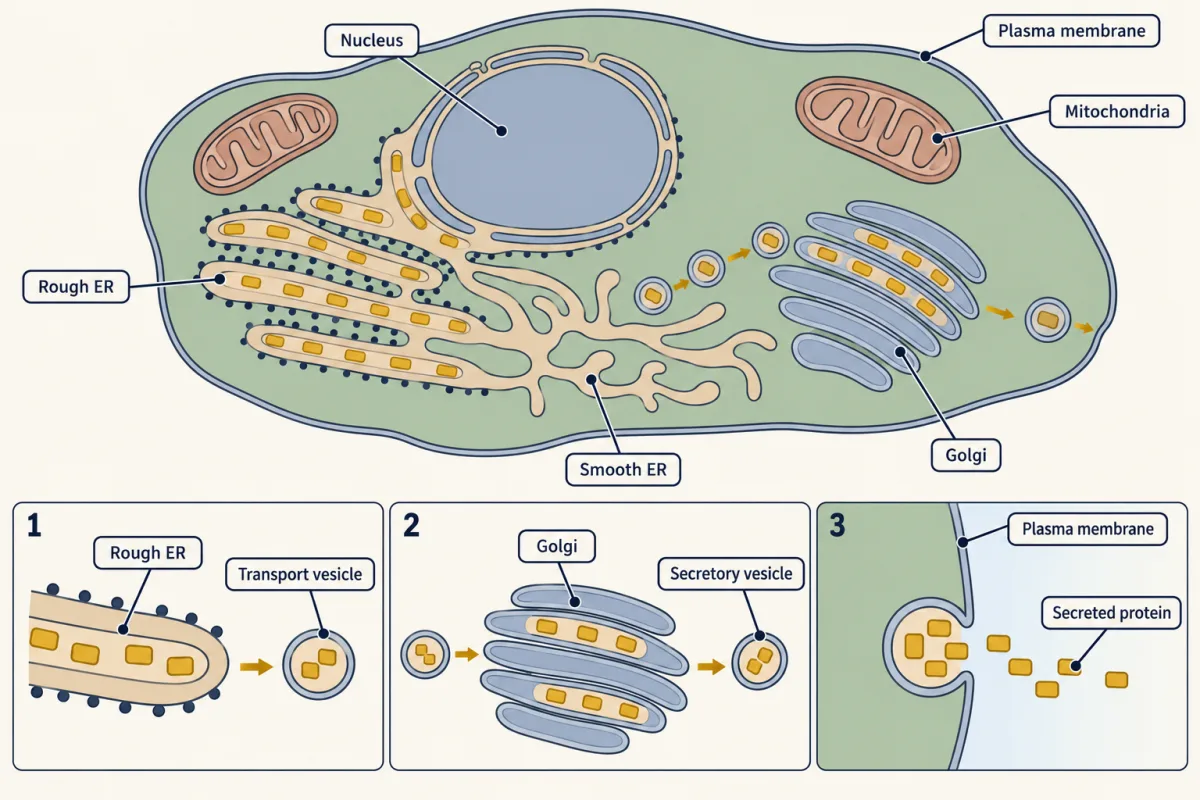
A building of walled offices: each organelle has its own main jobs behind its own membrane, and a secreted protein travels from rough ER to Golgi to membrane without passing through the general workspace. AI-generated illustration -
The recycling room
-
When one room lacks one enzyme
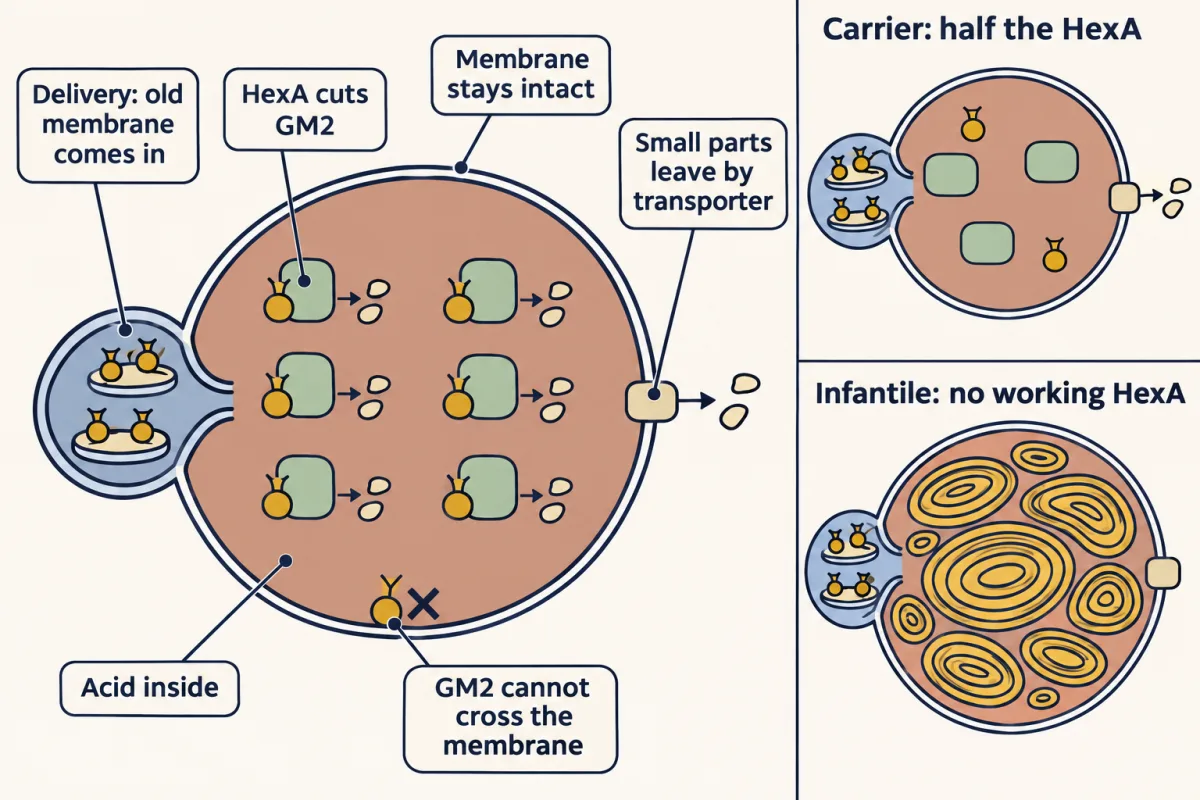
A sealed room holds a balance. GM2 arrives with old membrane and cannot cross the lysosome's membrane, so it leaves only as small parts after HexA cuts it. With half the enzyme (carrier) clearance still keeps up with delivery; with none (infantile Tay-Sachs) GM2 piles up in an intact lysosome. AI-generated illustration -
Going deeper
Where this lesson fits
Before thisReview first
- Vitalism: How Chemistry Captured LifeThis course · Lesson 1
It shows how life's chemistry came to be treated as ordinary chemistry, the starting point this lesson assumes.
After thisStudy next
- Water, Weak Bonds, and the Generation of OrderThis course · Lesson 3
It takes the idea of water-compatible chemistry and weak bonds further to explain how molecules fold and assemble.
- Membranes: The Impermeable Sheet That Builds ItselfThis course · Lesson 12
It takes the bilayer wall idea further, showing how the sheet builds itself and which proteins choose what crosses.
- Digestion and Absorption: Turning a Meal into Molecules Your Cells Can UseThis course · Lesson 14
It uses the idea of hydrolytic enzymes cutting big molecules into small pieces that transporters carry across a membrane.
Elsewhere on the siteFilms, simulations and method films in other courses
- Forward Is the DefaultFilm · Cell Biology
It shows Palade's pulse-chase evidence for the secretory pathway that this lesson cites.
- Two Pushes, One HillFilm · Cell Biology
It shows how a membrane that cannot be crossed makes each room's contents depend on transport.
- A Loop and a One-Way TripFilm · Cell Biology
It follows cargo into the lysosome, the room where GM2 piles up here.
- A Tap, a Hole, a LevelFilm · Cell Biology
It shows how pumps balance leaks to keep a room's conditions steady, like the lysosome's.
Suggested by an AI model from the lessons themselves, then checked. How we use AI