A Loop and a One-Way Trip
Read the transcript of “A Loop and a One-Way Trip”
Film transcript: A Loop and a One-Way Trip
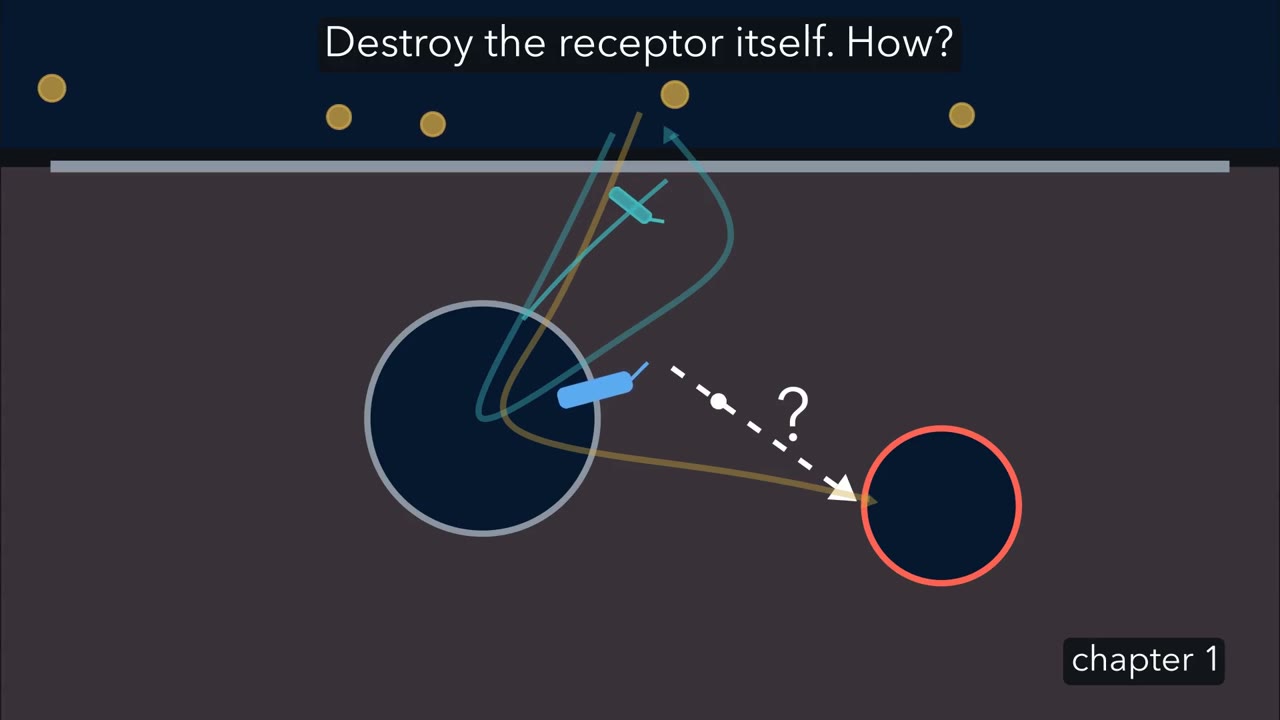
This receptor brings LDL particles into the cell, where they are normally broken down. So how does the receptor hand its cargo to destruction, and escape, over and over? LDL, in gold, carries cholesterol in the blood. Its receptor, in teal, spans the membrane and grips it from outside. Gripping, though, is not entering. The receptor's tail, inside the cell, must be gathered into a pit. Adaptors, in violet, do the gathering. They hold the receptor tails and the inner face of the membrane. Then clathrin builds a cage of three-legged pieces beneath them. Clathrin holds neither membrane nor cargo; the adaptors do. As the cage grows, the membrane curves inward into a pit.
Dynamin, in orange, wraps the narrow neck like a collar and, using energy from GTP, cuts it. The vesicle pinches free, and the cage falls away to be used again. Look inside the vesicle. It still has the colour of the outside. The cargo is inside the cell, but no membrane has been crossed yet. Biologists say it is topologically outside.
The vesicle fuses with an early endosome, the cell's sorting station. Receptor and LDL arrived together, still bound. If the receptor is to escape, they must part here. What is different about this compartment? Think about it.
Its inside, the lumen, is mildly acid, kept that way by proton pumps. For LDL, at least, acid is the signal to let go of its receptor. This is the fork. Here the paths split. Empty receptors slide into a thin tubule. It pinches off and carries them back to the surface, ready to grip again. The LDL stays behind. The endosome matures and passes it to a lysosome, the cell's digestion compartment.
There, enzymes break it down and release its cholesterol. So the receptor runs a loop: bind, enter, release, return. Its LDL makes a one-way trip to the lysosome. The two part at one place, the acid early endosome. In this simplest picture, binding and entry happen in order. Follow one batch of receptors, and a complete block of either stops its later handling. Release defects can reduce return rather than abolish it, so test each transition directly. That is how the carrier escapes: it lets go in acid, and leaves before the end. But in a patient's cells, which step has broken, and how could you tell?
Why can a patient's cells grip cholesterol-carrying LDL normally and still leave most of it on the surface?
Continue in the lesson: Endocytosis, Recycling and Degradation →
3:19 · Free, with captions and a transcript. The lesson has the full text, the questions and the sources.
More films from this lesson
How this film was made. Narration: written from this lesson's text and read by an AI narrator voice (Kokoro, af_heart). Animation: AI-generated in code (Manim) by Claude, a schematic with no drawn molecular structures. Captions come from the narration script. See something wrong? Report it.