Forward Is the Default
Read the transcript of “Forward Is the Default”
Film transcript: Forward Is the Default
Label the new proteins a pancreas cell makes in a few minutes. An hour later, where are they? Could the proteins themselves tell you how far they have come? A pulse-chase gives a brief pulse of radioactive amino acid, then a flood of the unlabelled one. Only the batch made during the pulse is labelled: the cohort. Caro and Palade did this in the guinea-pig pancreas.
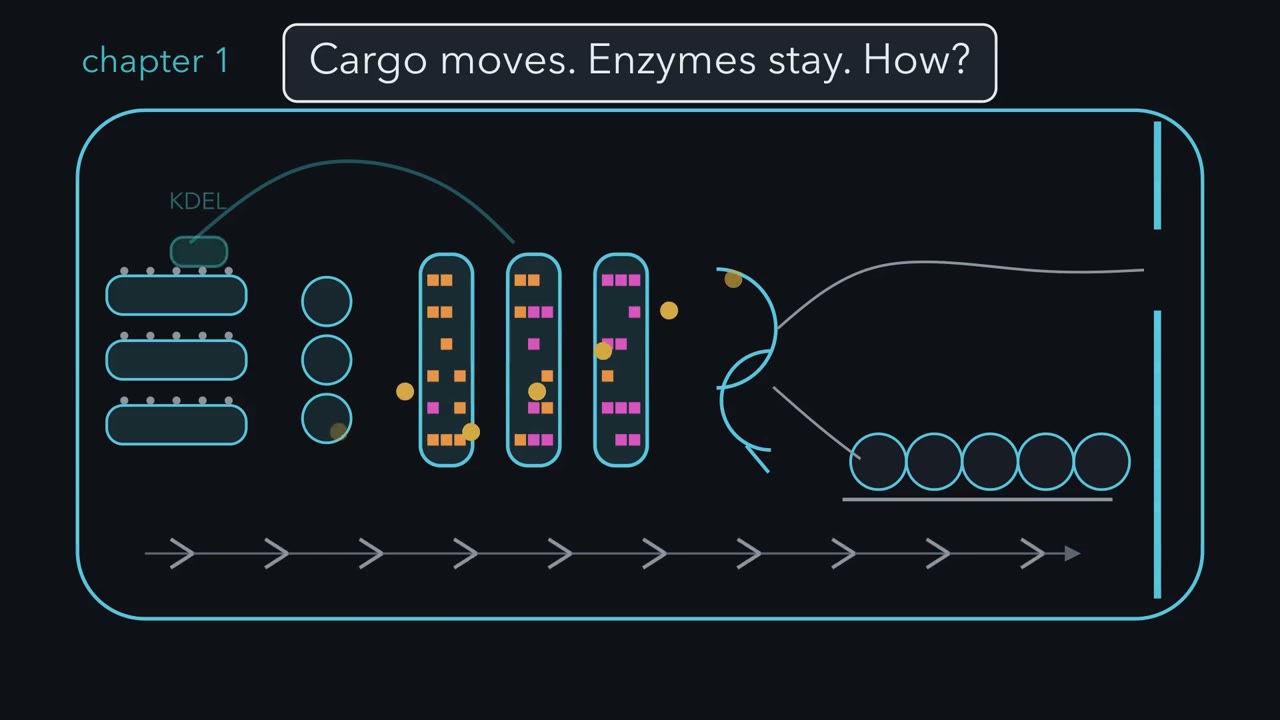
Silver grains in a photographic layer marked the label. At about 5 minutes they lay over the rough ER. At about 20, over the Golgi. At about an hour, over the storage granules. So the cohort's peak moves forward through a fixed order of stations, though it spreads out. The ER, a sorting dock, the Golgi stack, and the trans-Golgi network, where routes split. Now follow one protein. In the ER it gets a ready-made tree of 14 sugars, trimmed as it folds. In the Golgi, enzymes in successive sacs cut and rebuild it, roughly in order. One, mannosidase II, marks a red line. But these enzymes overlap from sac to sac, so the tree cannot say which sac the protein is in. It records the enzymes it has met: a rough odometer, not an address.
To read the record, sample at each chase time and treat each sample with an enzyme, Endo H. It cuts chains still mostly mannose, but not those rebuilt past mannosidase II. Cut protein loses sugar and runs faster on a gel. Over the chase, the cut band gives way to the uncut one. Some proteins should stay.
ER chaperones, which help others fold, leak forward too. Many end in a tag, KDEL. Past the ER, in slightly acidic compartments, a receptor grabs the tag. A coated vesicle carries both back, and in the near-neutral ER the receptor lets go. ER chaperones, which help others fold, A coded vesicle carries both back, and a coded vesicle carries both back, too. A coded vesicle carries both back, Now snip the tag off. Sean Munro and Hugh Pelham did this to the chaperone grp78, in cultured monkey cells. Where does it end up?
It is secreted with the cargo, because its KDEL tag is gone. For soluble cargo in animal cells, forward is the default unless a protein is held, fetched back, or sorted out. For soluble cargo, the trans-Golgi network can split the routes. Some carriers go straight to the surface: constitutive secretion, the default door. In this cell, digestive enzymes are sorted into granules instead: regulated secretion. They wait on a shelf until a stimulus releases them. Does that stimulus also speed up the line? So where are the labelled proteins an hour later? Mostly in storage granules. A glycoprotein among them can carry a sugar record of the enzymes it met.
For soluble cargo, going on is the default. Staying means being held or fetched back. Storing means being sorted, in ways still argued.
Label a pancreas cell's new proteins for a few minutes, then watch them move: what route do they take, and how do you know?
Continue in the lesson: The Secretory Pathway →
3:37 · Free, with captions and a transcript. The lesson has the full text, the questions and the sources.
More films from this lesson
How this film was made. Narration: written from this lesson's text and read by an AI narrator voice (Kokoro, af_heart). Animation: AI-generated in code (Manim) by Claude, a schematic with no drawn molecular structures. Captions come from the narration script. See something wrong? Report it.