Genetics and Molecular Biology · Skim version
Extending Mendel: Dominance, Multiple Alleles and Gene Interaction
Read the full lesson → Skim the whole course →
The guiding idea
Mate two yellow mice as often as you like: you will never get a yellow mouse that breeds true. Why?
Inheritance deals the boxes, and the gene products write the labels.
From the film: Same Boxes, New Labels
- Meiosis sets which alleles enter each parent's gametes; with random fertilization, that decides which allele pairs a child can get and how often. That part never changes in this lesson.
- What each allele's product does decides the label: a snapdragon with one red and one white allele is pink, while a pea with one purple allele is fully purple.
- In mice, one yellow allele makes a yellow coat, but two kill the embryo early, so that genotype drops out of the count.
- Every live yellow mouse is therefore a heterozygote, which is why yellow mice never breed true.
From the film: Two Whites Make Purple
- Two white-flowered sweet-pea strains gave purple hybrids.
- In the simplest model, each strain is blocked at a different step of making pigment, and the hybrid gets a working copy of each step.
- Selfing the hybrids gave about nine coloured to seven white: the usual sixteen two-gene boxes, with every box missing a step labelled white.
- In a cross of two double heterozygotes with unlinked genes, the sixteen boxes stay the same; how the genes act decides which ones look alike.
-
What you measure decides the word
-
ABO: three alleles, two sugars and codominance
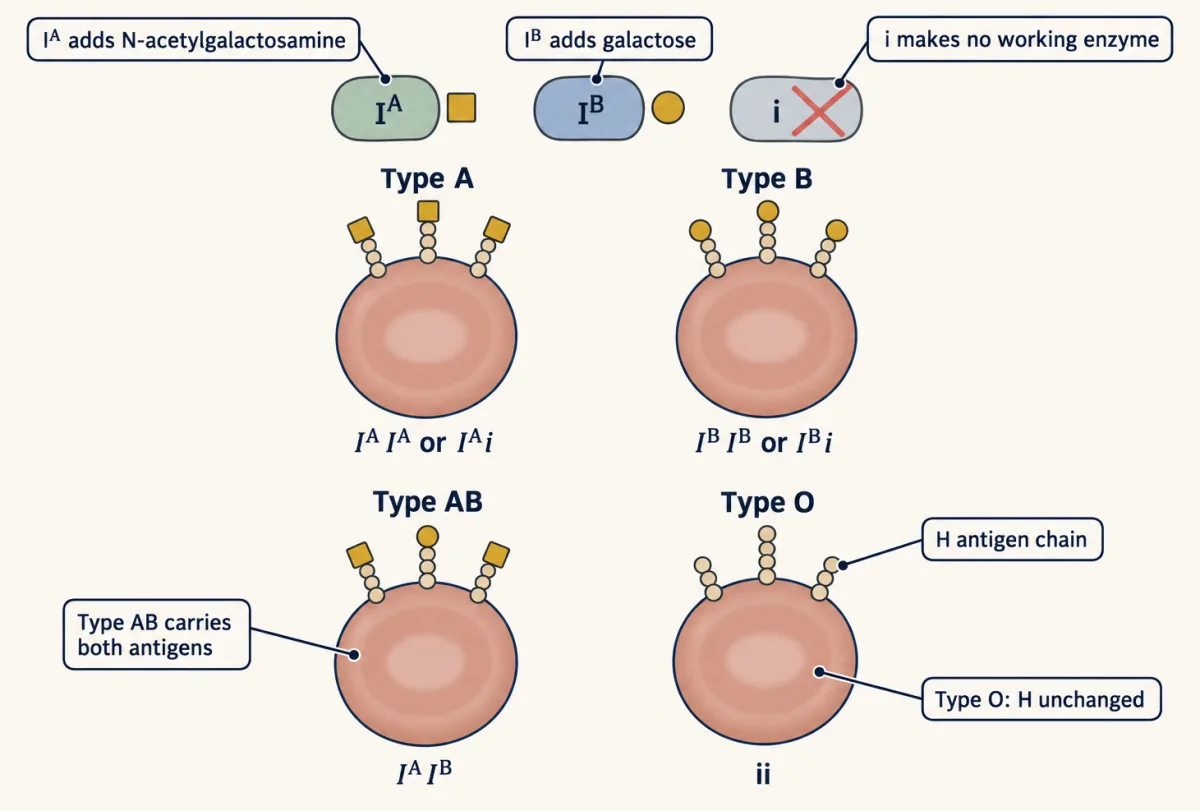
ABO type is set by which sugar tips the H antigen: I^A adds N-acetylgalactosamine to make A, I^B adds galactose to make B, an I^A I^B person carries both, and i makes no working enzyme, so H stays unchanged in type O. AI-generated illustration -
Why one copy is usually enough, and when it is not
-
Alleles that kill: the 2:1 ratio
-
Two genes, one trait: epistasis
-
Where the rule ends: penetrance and expressivity
-
Going deeper
Where this lesson fits
Before thisReview first
- Mendel's Peas: Segregation and Independent AssortmentThis course · Lesson 1
You need segregation and the 3:1 and 9:3:3:1 ratios from there, since this lesson only changes their labels.
- Chromosomes and Meiosis: The Physical Basis of Mendel's LawsThis course · Lesson 2
Meiosis deals the alleles into gametes, which sets the boxes that this lesson relabels.
- Probability, Crosses and the Chi-Square TestThis course · Lesson 3
You need to multiply probabilities per gene and count boxes to derive the ratios here.
After thisStudy next
- Reading Pedigrees: Human InheritanceThis course · Lesson 5
Reading carrier risk in families uses dominance, recessive lethality and incomplete penetrance from this lesson.
- Complementation and Gene Function: From Beadle and Tatum to BenzerThis course · Lesson 10
The 9:7 pairs of white mutants become a test for whether two mutations hit the same gene.
- Sex Linkage, Dosage Compensation and Non-Mendelian InheritanceThis course · Lesson 6
It moves on to inheritance patterns that change the boxes themselves, which this lesson set aside.
Elsewhere on the siteFilms, simulations and method films in other courses
- One Cross, Three PatternsFilm · Biology
Shows incomplete dominance and codominance patterns from one cross, such as snapdragons.
- Switch the inheritance patternSimulation · Biology
Lets you switch between dominance patterns and see how the same alleles show differently.
- Where the White Was HidingFilm · Biology
Reviews how Punnett squares organize the chances that this lesson regroups.
Suggested by an AI model from the lessons themselves, then checked. How we use AI