Ecology and Evolution · Skim version
Evolution of Development
Read the full lesson → Skim the whole course →
The guiding idea
Some lake sticklebacks have almost no pelvis, yet their Pitx1 protein is unchanged. If the protein did not break, what did?
A gene's protein and its pattern of use can evolve separately: in the best-studied case, freshwater threespine sticklebacks lost much of the pelvis when Pitx1 stopped being expressed there, linked to deletions in a pelvic enhancer, while the Pitx1 protein and its expression in the jaw stayed intact.
From the film: Same Protein, Different Switch
- In the pelvic-reduced Paxton Lake sticklebacks examined, the Pitx1 protein is unchanged.
- An enhancer is a stretch of noncoding DNA that switches a gene on in particular tissues, and one gene can have several.
- Paxton larvae still have Pitx1 RNA in the mouth and lower jaw, but none where the pelvis forms.
- Losing the protein outright would remove Pitx1 wherever it works; losing pelvic enhancer activity can shrink one body part and spare the gene's other jobs.
From the film: Putting the Switch on Trial
- In a reporter test, marine PelA drove expression in the developing pelvis, and the Paxton version with a deletion drove none in 8 fish.
- A reporter shows what a sequence can drive in a construct, not that the body depends on it.
- Marine PelA driving Pitx1, added to eggs from another pelvic-reduced lake, variably enhanced pelvic spines.
- Deletions with different endpoints remove PelA in many pelvic-reduced populations, so the same switch was lost more than once.
- Not every pelvic-reduced population carries a PelA deletion.
-
The puzzle: a lost pelvis with a working gene
-
Mapping: one major region, four minor
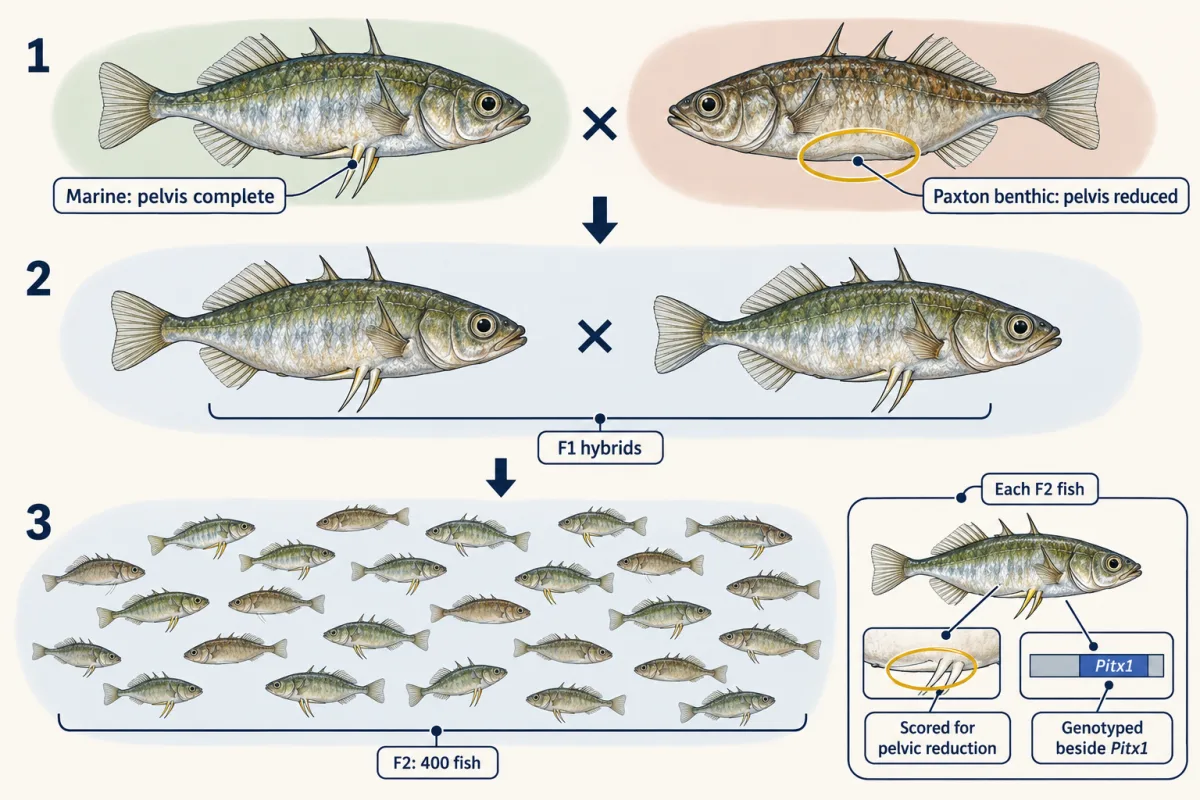
Crossing a marine fish with a Paxton benthic fish and breeding the F1 hybrids lets each F2 fish's genotype beside Pitx1 be compared with its pelvis. The fish and counts in the worked problem are invented. AI-generated illustration 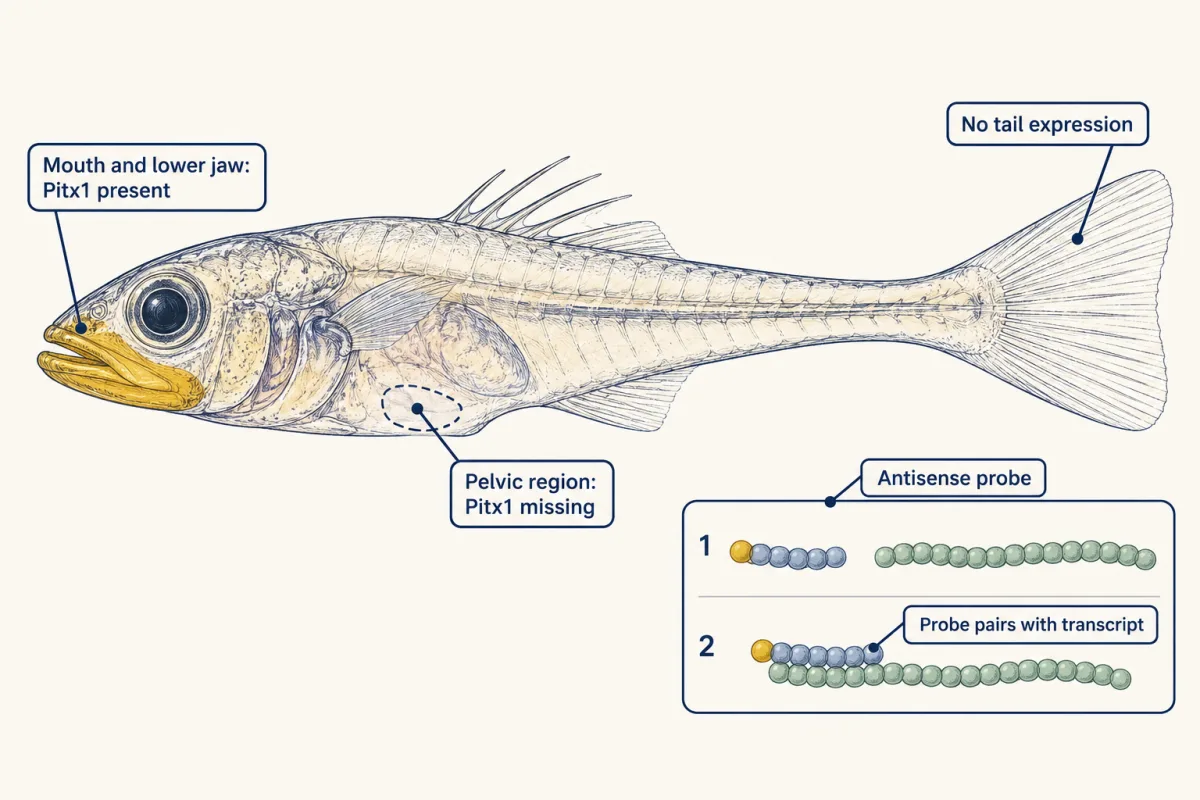
Paxton larvae still make Pitx1 transcript in the mouth and lower jaw but not where the pelvis forms, so the gene's pelvic use was lost while its jaw use stayed. Gold marks transcript detected with an antisense probe in the corrected 2006 figures; neither marine nor Paxton larvae showed any in the tail. AI-generated illustration -
Cis or trans: the F1 test
-
Enhancers on trial: a second switch, and why the first keeps breaking
-
What stays open
-
Going deeper
Where this lesson fits
Before thisReview first
- Reading Phylogenetic TreesThis course · Lesson 2
The lesson treats the pelvis as a homologous structure, and you need tree reading to follow that inherited-and-modified idea.
- Drift, Gene Flow and Competing ExplanationsThis course · Lesson 4
Judging whether repeated pelvic loss came from selection or chance needs the competing explanations for genetic change taught there.
- How to Test an Evolutionary ExplanationThis course · Lesson 1
Deciding what the mapping, F1 and reporter evidence does and does not show uses the evidence-testing habits taught there.
After thisStudy next
- Speciation: How Barriers to Gene Flow EvolveThis course · Lesson 7
It takes up how genetic differences like these between populations can build barriers to gene flow.
Elsewhere on the siteFilms, simulations and method films in other courses
- Gene targeting: knockout and knock-in miceMethod film
It shows how to delete a chosen DNA stretch in a mouse to test what it does, like the enhancer deletion tests.
- Enhancer logic board: combinations and open chromatinSimulation · Genetics and Molecular Biology
Its enhancer logic board shows how separate enhancers switch one gene on in different tissues.
- Access, Then AssemblyFilm · Genetics and Molecular Biology
It shows how deleting pieces of regulatory DNA reveals which enhancer controls a gene's pattern of use.
Suggested by an AI model from the lessons themselves, then checked. How we use AI