Films · Genetics and Molecular Biology
Access, Then Assembly
Read the transcript of “Access, Then Assembly”
Film transcript: Access, Then Assembly
Two cells carry the same genome. Why can they read different genes? Watch one gene in each nucleus. The DNA sequence matches. Yet one cell makes many messenger RNA molecules, while the other makes almost none. The puzzle is not missing genes. It is selective use.
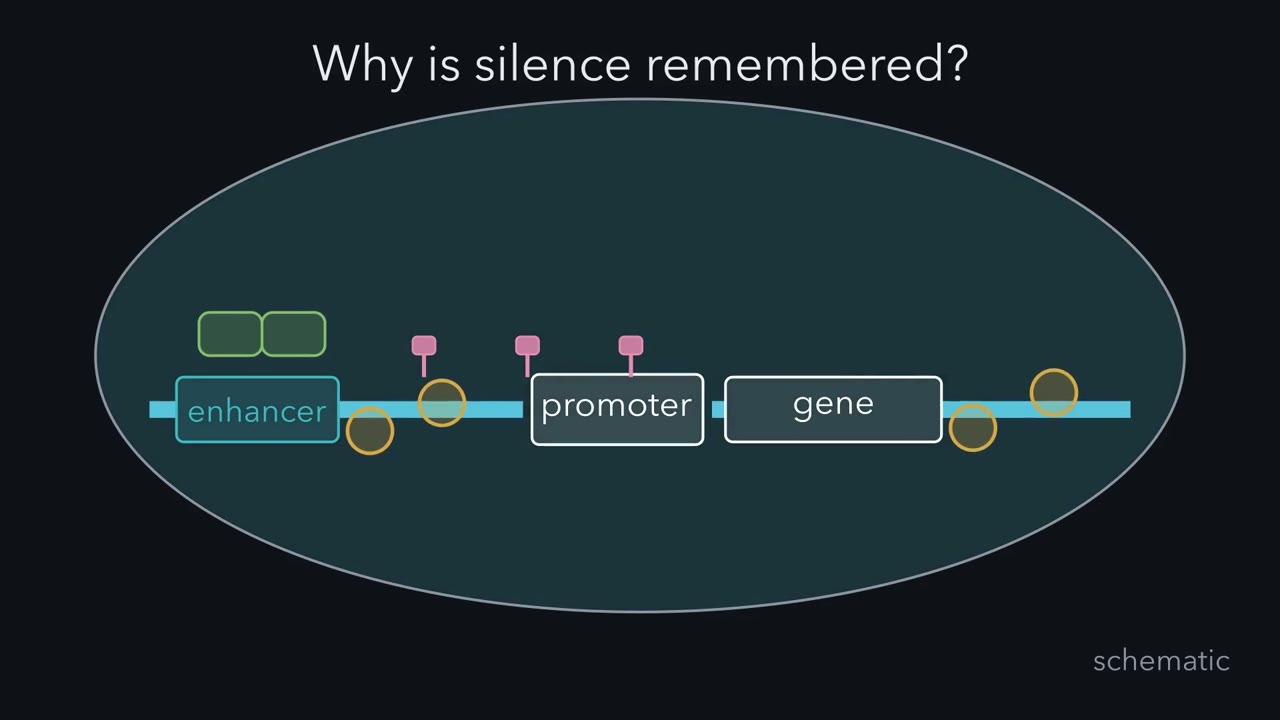
Eukaryotic DNA is packed into chromatin. Blue DNA wraps around gold nucleosomes. Packing does not make every gene permanently silent. It makes access conditional. Proteins must reach the promoter before transcription can begin. Packed DNA is harder, not impossible, to read. Remodelling complexes can move nucleosomes. As one gold block slides aside, the white promoter becomes reachable. Some pioneer factors can bind nucleosomal DNA, so access and regulator binding can influence each other. The promoter stays fixed while nucleosomes shift around it. Access is only one requirement. A teal enhancer can sit far from the promoter. Sequence-specific transcription factors bind the enhancer and recruit coactivators.
Mediator helps connect these regulators with RNA polymerase II at the promoter. The enhancer itself is DNA, not a diffusible protein. Now predict. Matching enhancer factors are present, but a nucleosome still covers the promoter. Is strong transcription guaranteed? Hold both requirements in view: regulatory assembly and access. Decide before the machinery moves.
No, not in this simplified case. The matching factors supply regulatory information, but the covered promoter remains hard to use. Bound factors can recruit a remodeller. Once it shifts the nucleosome, the assembled regulators can help raise transcription. Enhancers often act by combinations.
Picture a committee whose decision depends on which members arrive. One factor alone may do little. Two together may recruit machinery effectively. Different cells supply different combinations. Return to the two cells. Their DNA still matches. In the liver cell, the needed factors and accessible promoter coincide. In the kidney cell, a needed factor may be missing. A repressor could also explain low output. A reporter assay can test these pieces beside a promoter. Deleting a piece tests necessity, and testing it alone tests sufficiency. Combining pieces tests cooperation, and reversing one tests orientation. But the assay moves DNA from its native setting.
A genomic deletion is a stronger test there. The same genome can therefore support different outputs. Chromatin changes reachability. Enhancer-bound regulators change recruitment, including recruitment of enzymes that change reachability. Neither layer works as a universal switch. Together they make gene use conditional on cell state.
A liver cell and a kidney cell share one genome. How does each read a different part of it, and remember which part after it divides?
Continue in the lesson: Eukaryotic Gene Regulation and Epigenetics →
3:53 · Free, with captions and a transcript. The lesson has the full text, the questions and the sources.
More films from this lesson
How this film was made. Narration: written from this lesson's text and read by an AI narrator voice (Kokoro, af_heart). Animation: AI-generated in code (Manim) by Claude, a schematic with no drawn molecular structures. Captions come from the narration script. See something wrong? Report it.