Genetics and Molecular Biology · Skim version
DNA Repair and Recombination
Read the full lesson → Skim the whole course →
The guiding idea
If ultraviolet light joins two neighboring bases in your skin-cell DNA, how can the cell restore the original sequence?
Repair outcomes depend on what is damaged and what intact information remains.
From the film: How DNA Chooses a Repair Route
- Repair outcomes depend on what is damaged and what intact information remains.
- Direct reversal restores some damaged bases without cutting the DNA backbone.
- Base excision repair removes one damaged base; nucleotide excision repair removes a damaged stretch.
- Mismatch repair also needs a signal that identifies the newly made strand.
From the film: Two Ways to Mend a Broken Chromosome
- A broken chromosome can join its ends or copy a matching template.
- End joining needs no template and can work throughout the cell cycle.
- End joining can be exact when compatible ends need no processing.
- Homologous recombination usually copies the sister chromatid in S and G2.
-
Damage is constant: the lesions
-
Reversing and cutting out: direct reversal, BER and NER
-
Fixing the copier’s mistakes: mismatch repair
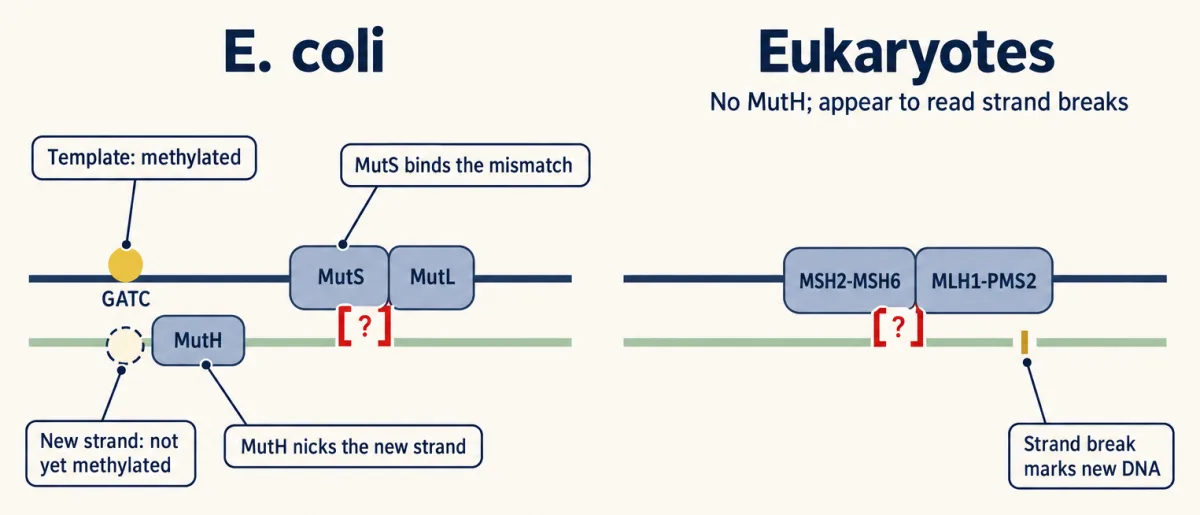
Mismatch repair needs more than a mispair: E. coli uses delayed GATC methylation, whereas eukaryotic systems appear to use breaks in newly made DNA to choose the strand to replace. AI-generated illustration -
Broken chromosomes: end joining and homologous recombination
-
When repair fails: three human conditions
-
Going deeper
Where this lesson fits
Before thisReview first
- DNA Replication: Semiconservative Copying and Its MachineryThis course · Lesson 13
You need semiconservative copying and proofreading from there to see where replication errors and the template strand come from.
- Mutation: Where Variation Comes FromThis course · Lesson 14
It separates a lesion from a heritable mutation and shows how errors and damage become new alleles.
- Complementation and Gene Function: From Beadle and Tatum to BenzerThis course · Lesson 10
The XP fusion design problem uses complementation groups to count genes, as taught there.
After thisStudy next
- Cancer as a Genetic DiseaseThis course · Lesson 21
It takes up Lynch syndrome and BRCA carriers and the loss of the second allele that lets repair-defective tumors arise.
- Forward and Reverse Genetics: Screens, RNAi and CRISPRThis course · Lesson 24
A Cas9 cut is a double-strand break, and its outcome depends on end joining versus homology-directed repair.
Elsewhere on the siteFilms, simulations and method films in other courses
- One Strand Is EnoughFilm · Biology
It shows how each strand serves as a template, the same intact information that excision repair copies.
- Mitosis stepper and phase counterSimulation · Biology
It shows S and G2 phases, when sister chromatids exist for homologous recombination to copy.
Suggested by an AI model from the lessons themselves, then checked. How we use AI