Cell Biology · Skim version
Cytokinesis and Organelle Inheritance
Read the full lesson → Skim the whole course →
The guiding idea
Push the spindle off-centre in a sea urchin embryo cell, and the signal for the furrow follows it before the furrow does.
Mitosis sorts the chromosomes; cytokinesis then has to cut the cell in the right place and hand each daughter a working set of organelles.
From the film: The Band Before the Furrow
- In the sea urchin and frog embryo cells studied, a band of active RhoA appears just under the membrane before the furrow.
- In sea urchin embryo cells the band still forms when actin cannot assemble, so the signal does not need the ring.
- When a needle pushes the spindle aside in these cells, active RhoA gathers over its new middle first and the furrow follows.
- Under the band, active RhoA turns on formins and promotes myosin II, which build and tighten the ring.
- In the embryo cells studied, the cut goes where the anaphase microtubules place a band of active RhoA.
From the film: Chance or Control
- In the simplest no-control model, each copy of an organelle goes to either daughter independently, like a coin toss.
- Under that model, the chance of an empty daughter is 2 × 0.5^n, so each added copy halves the risk.
- Chance is safe only for many independent units: with two copies, one daughter is empty half the time.
- A connected structure, such as the Golgi ribbon or a tubular mitochondrial network, counts as one unit and is broken up first or moved actively.
- In PtK1 cells the Golgi ribbon comes apart in mitosis and reforms after division; the spindle carries one centrosome to each pole.
-
From microtubules to the band
-
Making the cut
-
Plants build a wall from the inside out
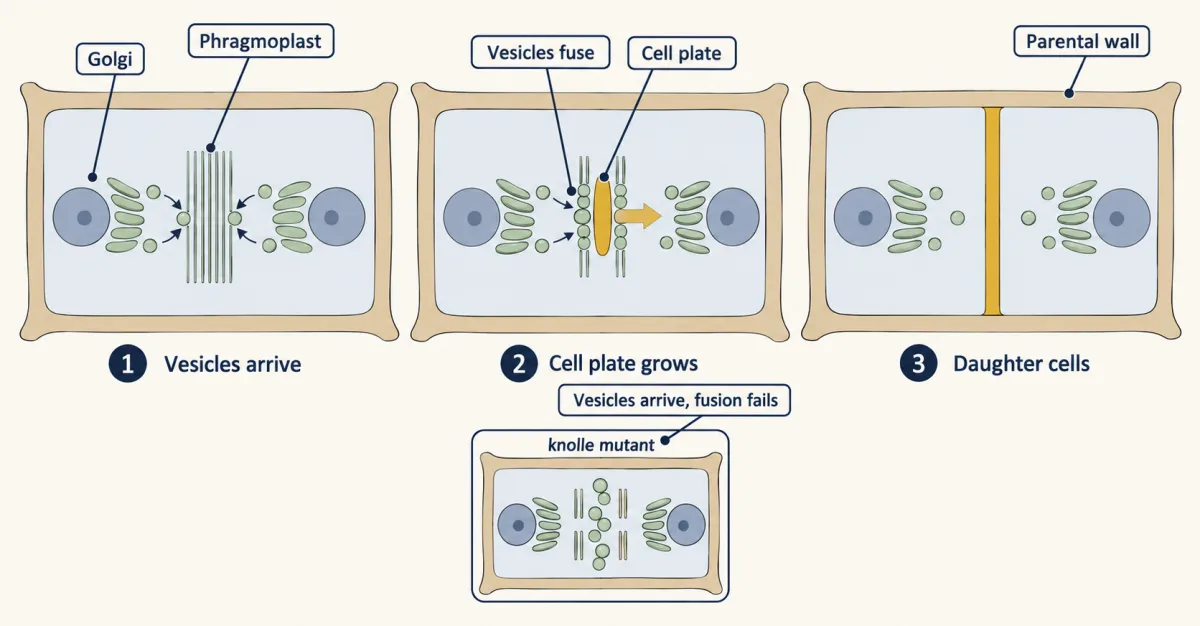
A plant cell cannot pinch, so the phragmoplast guides Golgi vesicles to the centre, where they fuse into a cell plate that grows outward until it joins the parental wall. In knolle mutant embryos the vesicles arrive but fusion appeared to fail. AI-generated illustration -
Sharing the contents: chance or control
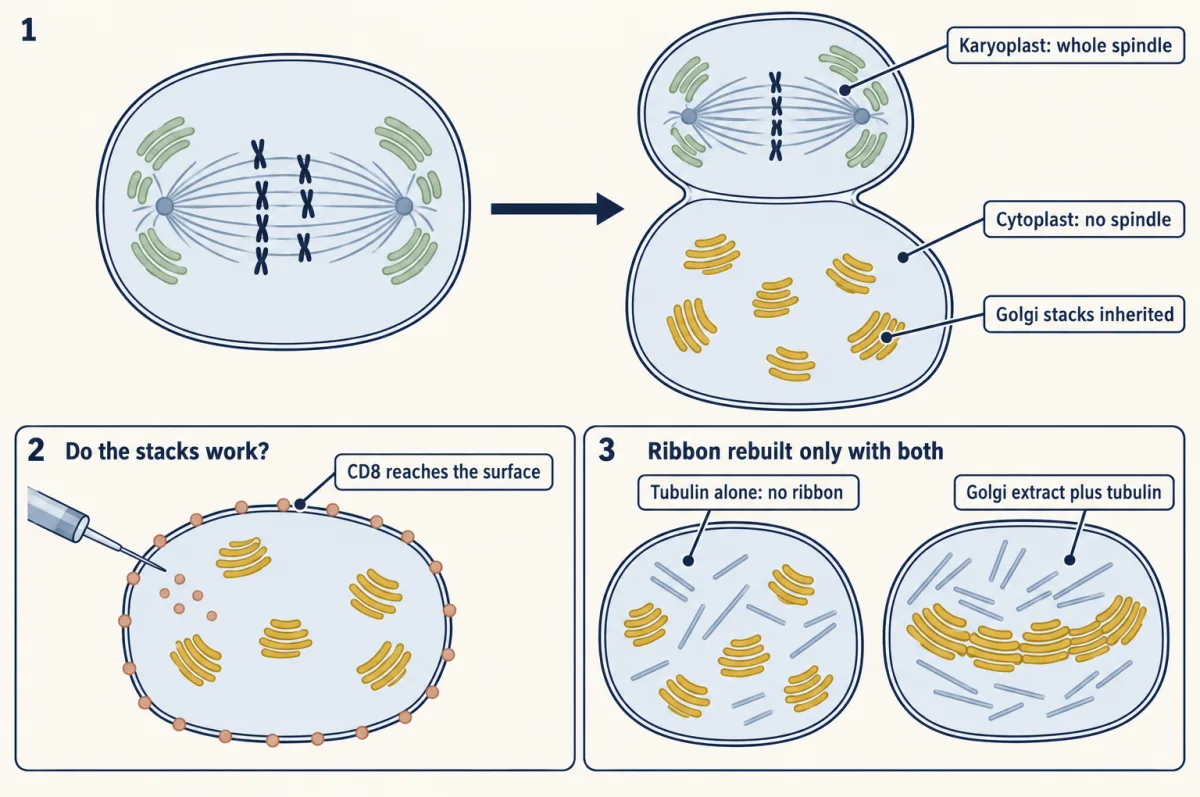
In an engineered division the cytoplast gets no spindle, yet it inherits working Golgi stacks and its CD8 reporter reaches the surface. Rebuilding the ribbon needed Golgi extract plus tubulin. This is one engineered division in one cell line. AI-generated illustration -
Going deeper
Where this lesson fits
Before thisReview first
- Mitosis and Chromosome SegregationThis course · Lesson 19
You need anaphase, the spindle midzone and chromosome separation from there, since cytokinesis cuts between the two sets.
- Cytoskeletal Polymers and DynamicsThis course · Lesson 14
The actin and microtubule behaviour you learn there is what builds the ring and the phragmoplast here.
- Vesicle Budding, Targeting and FusionThis course · Lesson 11
You need SNARE-driven vesicle fusion from there to understand how KNOLLE builds the cell plate.
After thisStudy next
- Cell Death and ClearanceThis course · Lesson 21
Cells that fail division or lose organelle shares can die, and this lesson shows how clearance follows.
- Stem Cells and Tissue RenewalThis course · Lesson 24
Stem cell renewal uses division where the cut position decides what each daughter receives.
Elsewhere on the siteFilms, simulations and method films in other courses
- How One Set Becomes TwoFilm · Biology
It shows how one cell's chromosomes are copied and separated, the step that cytokinesis follows.
- One Cell, One Shipping LineFilm · Biology
It shows how the Golgi and other organelles work as a system, which the cell must hand on to each daughter.
- A Water Balloon in a BoxFilm · Life Science
It shows the plant cell wall that the phragmoplast builds a new section of.
Suggested by an AI model from the lessons themselves, then checked. How we use AI