One Cell, One Shipping Line
Read the transcript of “One Cell, One Shipping Line”
Film transcript: One Cell, One Shipping Line
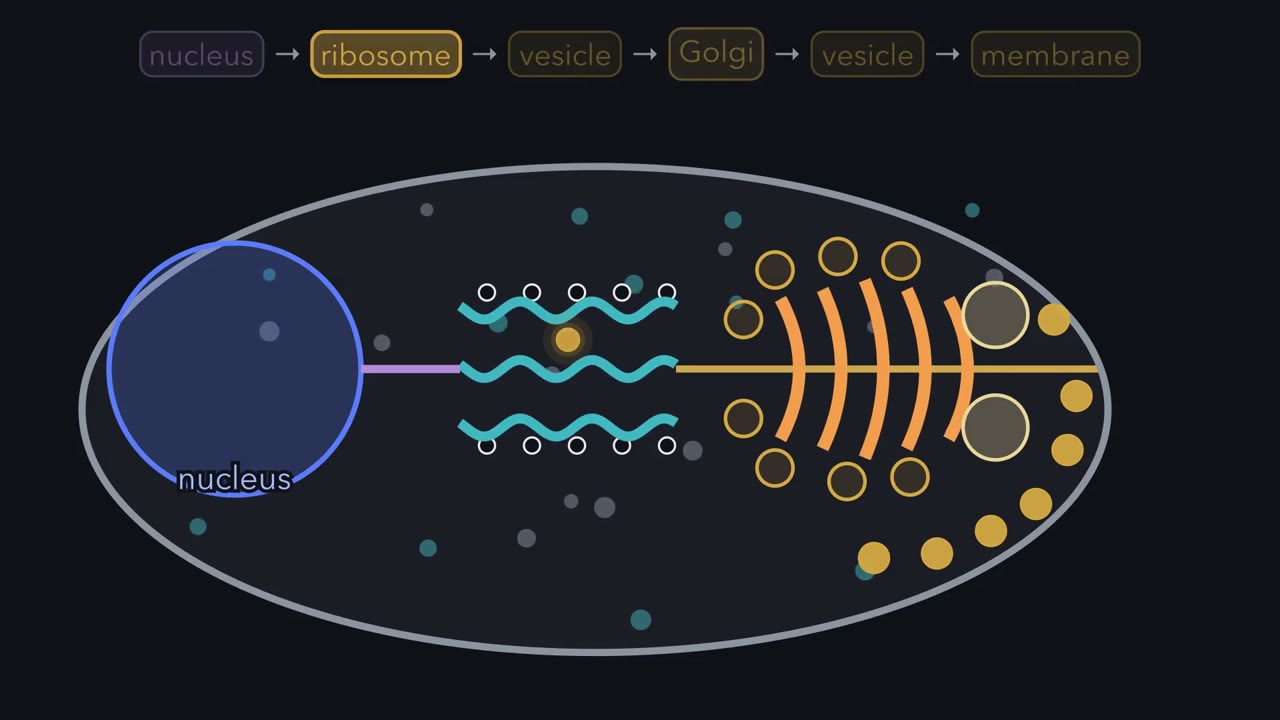
The insulin gene never leaves a beta cell's nucleus. So how does insulin end up outside the cell? After a meal, your blood sugar rises, and beta cells in your pancreas release this protein hormone. Here is the answer in one picture. First a copy of the instructions travels, then the protein itself. Each part can only work on what the part before it hands over. Start in the nucleus. It holds most of the cell's DNA, its instructions. The gene for insulin is one stretch of that DNA. But the gene itself stays put. Here is a puzzle for you. The gene stays locked in the nucleus. So what leaves the nucleus instead, carrying its instructions out?
A copy. The cell copies the gene into messenger RNA. That working copy leaves the nucleus and carries the instructions to the next stop. The next stop is a ribosome on the rough ER. The ER is a set of folded membranes. On the rough ER, ribosomes dot the surface. A ribosome reads the messenger RNA and links building blocks into a protein chain. The chain threads into the ER, where it folds.
Now the protein has to move. A vesicle, a small bubble of membrane, buds off the ER. It carries the protein across to the Golgi apparatus. The Golgi is a stack of flat sacs. It sorts the protein and packs it into new vesicles. There the protein waits until it is needed. At the last stop, a vesicle meets the cell membrane. The two membranes fuse. The vesicle opens to the outside, and insulin is released. None of this is free. Building a protein chain and moving vesicles both use energy. Much of that energy comes as ATP, a small molecule cell parts can use. Mitochondria release energy from sugar and store it in ATP. Now look at the whole route.
The nucleus sends out a copy. Then the protein moves: rough ER, vesicle, Golgi, vesicle, cell membrane. Notice what a route like this means. Each part can only work on what the part before it hands over. So every step depends on the one before it. So how does insulin get out of the cell? No single part does it. A copy of the gene leaves the nucleus, and the protein is handed from part to part.
Mitochondria supply much of the ATP.
The insulin gene never leaves a beta cell's nucleus, yet insulin leaves the cell after a meal. What carries it out, and in what order?
Continue in the lesson: Organelles as a System →
3:12 · Free, with captions and a transcript. The lesson has the full text, the questions and the sources.
More films from this lesson
How this film was made. Narration: written from this lesson's text and read by an AI narrator voice (Kokoro, af_heart). Animation: AI-generated in code (Manim) by Claude, a schematic with no drawn molecular structures. Captions come from the narration script. See something wrong? Report it.