Developmental Neuroscience · Unit 6: Axons find their way
Crossing the Midline Once: Slit, Robo and Comm
Rewritten on : new text, figures, flashcards and film. Your notes and highlights stay, but the text around them may have moved.
Under review Parts of this lesson are still being checked.
- How fly Commissureless keeps Robo off precrossing axons is debated: endosomal sorting, a still unknown second Comm activity and Nedd4-driven ubiquitination of Robo1 are all proposed. The debate now sits under Going deeper (How Comm holds Robo back) and is awaiting a final read.
The text stays up while the check is done. If you spot a problem, report it. All lessons under review.
An axon is pulled toward the midline, crosses it, and then treats it as forbidden ground. What changed?
Pause when the reading reaches a film, and offer to play it. Saved on this device.
Watch the film now, or keep listening
Builds on:Netrin and DCC: One Cue, Two AnswersPioneers, Guideposts and the Logic of Guidance CuesThe Growth Cone: The Tip That Steers the AxonWhy these?
 ▶ Watch One Crossing, and Only One · 2:41
Read the transcript of “One Crossing, and Only One”
Film transcript: One Crossing, and Only One
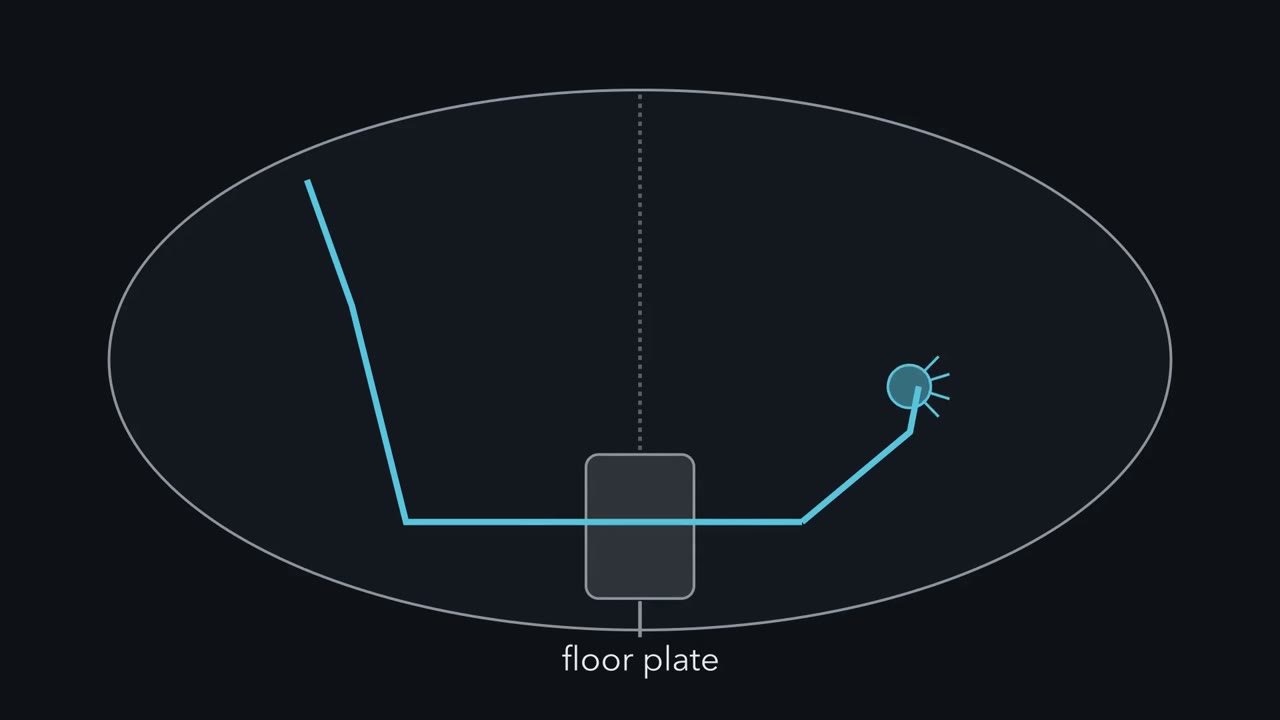
An axon grows toward the midline of the nervous system. It crosses. Then it treats that same midline as forbidden ground. What changed? Your left and right sides have to talk. Much touch and pain information from one side ends up in the opposite half of the brain. The two halves of the spinal cord also coordinate walking. Both jobs need commissural axons, axons that cross the midline. Their neighbours, ipsilateral axons, stay on the side where they started. They must never cross. A commissural axon has three jobs. Grow toward the midline. Enter it and leave it. And never come back. Each job fails in a different way. If the pull still beats the push after crossing, the axon stalls there.
Get repelled too early, and it never crosses at all. Lose the repulsion after crossing, and it might wander back. Now look at the midline itself. In the fly it is a row of glial cells. In the spinal cord it is the floor plate. The same cells present the same molecules before, during and after an axon passes. The midline did not change. So the change has to be in the axon. That leaves three puzzles. Why does an axon drawn to the midline leave it? Why does it never come back? And why do its ipsilateral neighbours never cross at all? Here is the one idea to carry through. While an axon crosses, the midline stays the same. The axon changes what it can hear.
The midline makes a repellent called Slit. The growth cone carries Robo receptors that hear it. In a simple toy model, the axon's push is Slit times the repelling Robo activity on its growth cone. The axon is turned away only when that push passes a threshold. Ipsilateral axons keep the push high from the start. Commissural axons hold it low until they have crossed. Then they let it rise. Flies do this with a protein called Comm. Mammals do it with a relative of Robo, called Robo3. So a Slit and Robo mutant can be read with three questions. Is Slit there? Can the axon hear it? When does it start hearing it? The takeaway: the midline stays the same, and the axon changes what it can hear, and when. That is the repulsion side of the story.
From the film
- The midline stays the same while an axon crosses; the axon changes what it can hear.
- The midline makes the repellent Slit, and the growth cone carries Robo receptors that hear it.
- Commissural axons hold the push low until they have crossed, and then let it rise.
A commissural axon is drawn toward the midline of the nervous system, crosses it, and then treats that same midline as forbidden ground from then on.
In the fly the midline is a row of glial cells; in the vertebrate spinal cord it is the floor plate, a strip of cells along the ventral midline. The same cells present the same molecules before, during and after any one axon passes. So the change has to be in the axon. The question is: what does the growth cone change about itself at the midline, and how does the change stick?
The problem: one crossing, and only one
Your left and right sides have to talk. Much sensory information from one side of the body, such as touch and pain, ends up in the opposite half of the brain, and the two halves of the spinal cord coordinate walking. Both need commissural axons, axons that cross the midline to the other side. Their neighbours, ipsilateral axons, stay on the side where they started and must never cross.
A commissural axon has three jobs. It must grow toward the midline, which in vertebrates it does partly by following netrin made by the floor plate and by neural progenitors (the mechanism is in that lesson). It must enter the midline and leave it. And it must never come back. Each job fails in a different way. If its pull toward the midline still outweighed any push after crossing, it would stall there. If it were repelled too early, it would never cross at all. If it lost its repulsion after crossing, it might wander back.
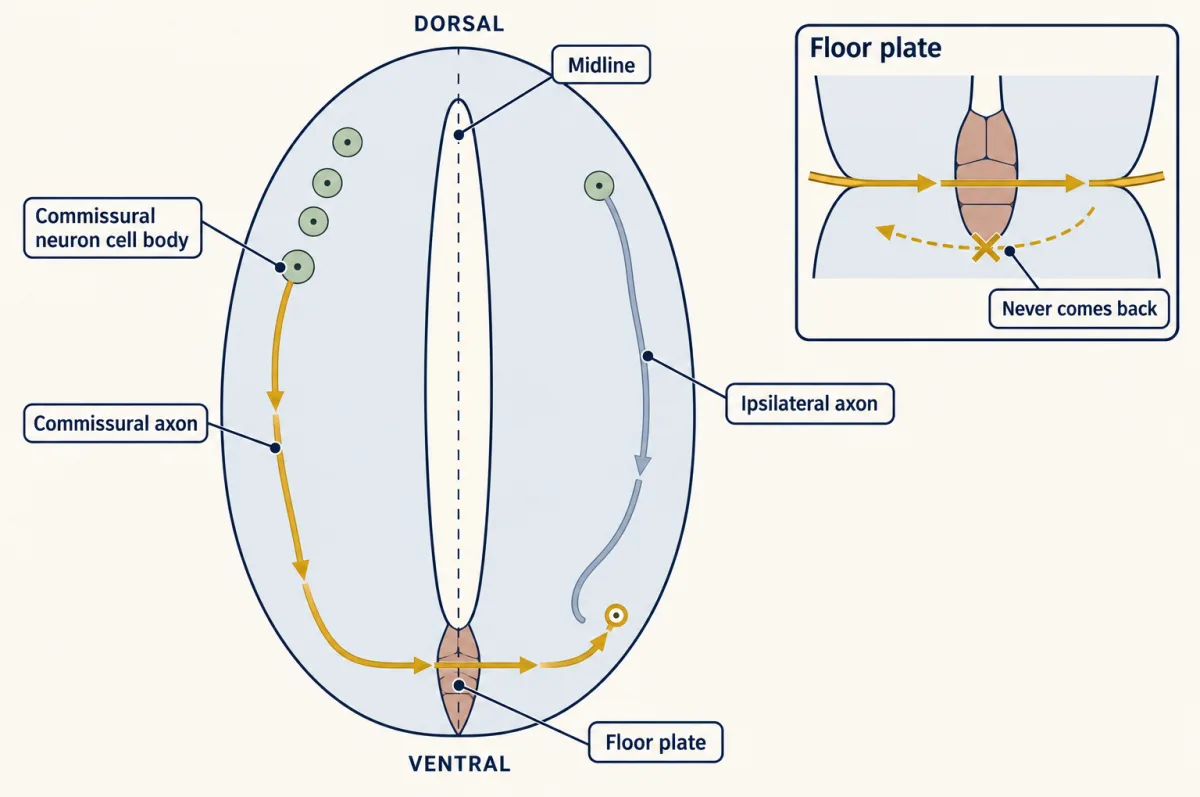
That leaves three puzzles.
- Why does an axon that is drawn to the midline leave it?
- Why does it never come back?
- Why do its ipsilateral neighbours never cross at all?
The one idea to carry through this lesson. While an axon crosses, the midline stays the same; the axon changes what it can hear. In a simple toy model of one axon, push ≈ Slit at the midline × repelling Robo activity on the growth cone. The axon is turned away only when that push passes a threshold. Ipsilateral axons keep the push high from the start. Commissural axons hold it low until they have crossed (with Comm in flies, Robo3 in mammals), then let it rise. So a Slit–Robo mutant can be read with three questions: Is Slit there? Can the axon hear it? When does it start hearing it? The model covers repulsion only; its limits are listed after the mutant table.
Reading the fly ladder
Read the transcript of “Reading the Ladder”
Film transcript: Reading the Ladder
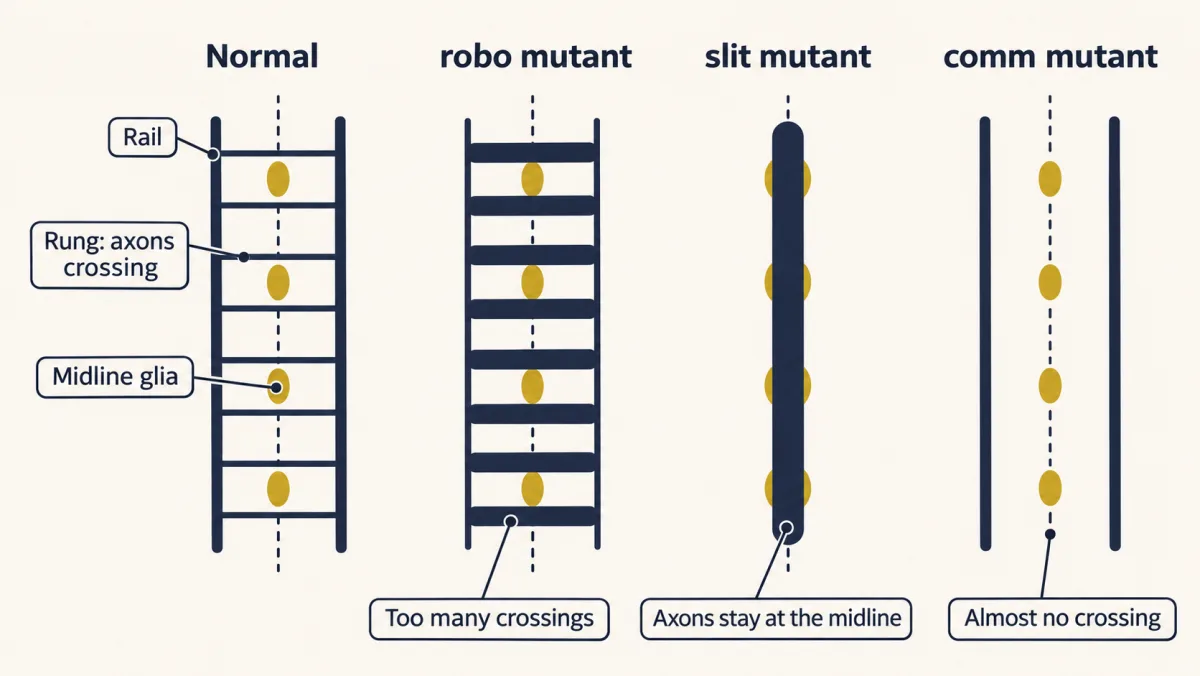
How do you find the genes that let an axon cross only once? Look at the nerve cord of a fly embryo. Stained for its axons, the nerve cord looks like a ladder. Two long rails run the length of the body. In each segment, two rungs cross between them. These rungs are the commissures. Most commissural axons cross once, turn, and run in a rail on the far side. In 1993, Corey Goodman's laboratory reported a screen for mutations that disturb this ladder. The screen recovered loss-of-function mutants, in which a gene's activity is reduced or lost. These were strong losses. Before looking, set up the logic. The midline makes a repellent. Axons carry a receptor for it.
Something in the axon sets when the receptor works. First case. Axons lose their main receptor for the repellent. What does the ladder look like? Little holds axons off the midline. Ipsilateral axons cross. Commissural axons cross and then cross back. The rungs thicken. This is the mutant called roundabout, or robo. Its axons circle back across. Second case. The midline makes no repellent. Predict the ladder.
The repellent's push is gone, so axons that reach the midline are not pushed out. They enter and do not leave. Over time the two rails collapse into a single bundle down the middle. This is the slit mutant. Third case. Commissural axons have a working receptor before they cross. What now?
They are pushed away before they can cross. Almost no axon crosses, and the rungs nearly vanish. This is commissureless, or comm. The name says it: the rungs are nearly gone. In 1998, Thomas Kidd, Tear, Goodman and colleagues cloned robo. It encodes a receptor that spans the membrane once. Its timing was the telling part. Axons that never cross carry Robo on their growth cones from the start. Axons that do cross carry high levels of Robo only after they have crossed. Picture the ladder stained for Robo protein. The rails are bright. They hold ipsilateral axons and axons already across. The rungs, where axons are crossing, are much dimmer. The same axon carries little Robo while it crosses, and a lot once it is across.
That is what deaf until crossed means. Deaf here means a much weaker response, not none.
From the film
- In the fly nerve cord, robo mutants have too many crossings, slit mutants collapse into a single central bundle, and comm mutants have almost no rungs.
- The same axon carries little Robo while it crosses and a lot once it is across.
- Deaf until crossed means a much weaker response to Slit, not none.
The answer was found in the fly embryo. Stained with an antibody that marks its axons, the fly’s central nerve cord looks like a ladder: two long rails run the length of the body, and in each segment two rungs, the commissures, cross between them. Most commissural axons cross once, turn, and run in a rail on the far side.
In 1993 Mark Seeger, Guy Tear, Dolors Ferres-Marco and Corey Goodman reported a screen for mutations that disturb this ladder. The screen recovered loss-of-function mutants, in which a gene’s activity is reduced or abolished; a null mutant has none left. The mutants below are strong losses of function. Before looking at the ladders, apply the rule.
Predict. What should the ladder look like in each case? (a) Axons lose their main receptor for the repellent. (b) The midline makes no repellent. (c) Commissural axons have a working receptor before they cross.
Check your prediction
(a) Main receptor lost. Little holds axons off the midline. This is roundabout (robo): too many crossings. Ipsilateral axons cross, and commissural axons cross and then cross back, so the rungs thicken.
(b) No repellent. The repellent’s push is gone, so axons that reach the midline are not pushed out. This is the slit mutant: axons enter the midline and do not leave. Over time the two rails collapse into a single bundle running down the middle.
(c) Receptor working too early. Commissural axons are pushed away before they can cross. This is commissureless (comm): almost no axon crosses, and the rungs nearly vanish.
Roundabout and commissureless were named for these ladders. Why (a) and (b) differ, when Slit turns out to be Robo’s ligand, comes below.
The signature evidence: when Robo is on the axon
In 1998 Thomas Kidd, Tear, Goodman and colleagues cloned robo. It encodes a receptor of the immunoglobulin superfamily that spans the membrane once, and vertebrates have relatives of it. Its timing was the telling part. Axons that never cross carry Robo on their growth cones from the start. Axons that do cross carry high levels of Robo only after they have crossed.
Picture the ladder stained for Robo protein. The rails are bright: they hold ipsilateral axons and axons that have already crossed. The rungs, where axons are crossing, are much dimmer. The same axon carries little Robo while it crosses and a lot once it is across. That picture is what “deaf until crossed” means. Here and below, “deaf” is shorthand for a much weaker response, not none.
Slit is the ligand
Read the transcript of “A Quarter of the Push, Many Times the Errors”
Film transcript: A Quarter of the Push, Many Times the Errors
Robo is a receptor that keeps axons off the midline. So where is the repellent it receives? In 1999, a run of papers in one issue of the journal Cell named it. It is Slit, a large protein secreted by the midline glia. A companion paper showed that Slit proteins bind Robo receptors. Recombinant Slit2 repels embryonic spinal motor axons in culture. The fly genetics tested the link with flies missing one copy of each gene. Flies missing one copy are called heterozygotes. Here are made-up numbers in the spirit of that experiment. Score 50 segments per genotype for wrong crossings. Missing one copy of slit, 2 percent of segments go wrong. Missing one copy of robo, 4 Now remove one copy of each gene.
Under a simple independent-error model, you would expect about 6 What would a much bigger number mean? The made-up result is 32 That is far more than the singles together. Use a toy version of the rule. Count only Robo1, and let each factor scale with gene dose. Then one missing copy leaves half the push. One missing copy of each leaves a quarter. Suppose errors simply tracked the push that was lost. Then the double would barely differ from the singles. Now add a threshold. Segments vary, so the push varies a little from one segment to the next. With half the push, almost every segment still sits above the threshold. Few fail. With a quarter, the average push sits near the threshold.
Many segments drop below it. A jump this large points to a genetic interaction. A shared pathway with a threshold explains it simply. These numbers alone cannot prove that model. The binding data and the null mutants say that the process is a ligand acting on a receptor. One puzzle remains. If Slit is Robo's ligand, why do the null mutants look different?
Flies have three Robo receptors. Losing Robo1 removes much of the repulsion, so axons cross freely. Robo2 remains and still hears Slit. So axons are pushed out of the midline, though not kept from crossing back. Remove Robo1 and Robo2 together, and the ladder looks much like slit. Losing Slit removes the push through every Robo. Axons at the midline are not pushed out.
The takeaway: the ligand is shared, and the receptors share the work. Near threshold, small losses can make large effects.
From the film
- Slit is a protein secreted by midline glia that binds Robo receptors and repels axons.
- In the toy model, losing one copy of each gene leaves a quarter of the push, and a threshold can turn that into many more errors.
- Flies have three Robo receptors, so the ligand is shared and the receptors share the work.
A receptor that keeps axons off the midline should have a repellent at the midline. In 1999 a run of papers in one issue of Cell named it. Kidd, Kimberly Bland and Goodman showed by genetics that Slit, a large protein secreted by the midline glia, acts with Robo: flies missing one copy of each gene had crossing errors that flies missing one copy of either gene rarely showed. Katja Brose, Bland and colleagues from Goodman’s laboratory and Marc Tessier-Lavigne’s showed that Slit proteins bind Robo receptors and that recombinant Slit2 repels embryonic spinal motor axons in culture. Slit is the midline’s repellent. On the growth cone, Robo turns that signal into retreat partly through regulators of Rho-family GTPases, the cytoskeleton regulators you met in that lesson.
Worked problem: a quarter of the push, many times the errors
The dosage result deserves numbers. These are made up, in the spirit of that experiment; the MCAT question below uses the same ones. Score 50 segments per genotype for longitudinal axons (which should stay in the rails) that wrongly cross. Flies missing one copy of slit, called heterozygotes and written slit/+, show the error in 1 segment of 50 (2%). Flies missing one copy of robo show it in 2 of 50 (4%).
Predict. Flies missing one copy of each gene. If the two genes acted independently, about how many errors would you expect? What would a much larger number tell you?
Check your prediction
Take a simple null: the two segment errors occur independently, either one counts, and baseline errors are negligible. Then 1 − (0.98 × 0.96) ≈ 5.9%, about 3 segments of 50. The made-up result is 16 of 50, or 32%. (Genes in separate pathways need not give additive frequencies; this null is only a yardstick.)
Step 1: the push. Keep the toy as simple as possible. Count only Robo1, the main receptor, and let Slit and Robo1 each scale with gene dose, so the push is Slit × Robo1 and wild type is 1. One missing copy of either gene leaves half the push. Missing one copy of each leaves a quarter. These are toy assumptions, not measured signal levels.
Step 2: no threshold. Suppose errors simply tracked the push that was lost. A single heterozygote loses half; the double loses three quarters, only 1.5 times as much. Errors would rise from about 3% (the average of the two singles) to about 4.5%, nowhere near 32%.
Step 3: a threshold. Segments vary, so the push varies a little from one segment to the next. With half the push, almost every segment still sits above the threshold, and few fail. With a quarter, the average push sits close to the threshold, and many segments drop below it. A small further loss gives a large jump in errors.
A jump this large points to a genetic interaction: the two genes probably work together. A threshold in one shared pathway is the simplest explanation, but the dosage data alone do not prove a threshold or a single pathway, and they do not uniquely select a quantitative model (Going deeper fits two). Binding and functional evidence show that Slit acts through Robo.
Why slit and robo mutants look different
If Slit is Robo’s ligand, why do the null mutants differ? Flies have three Robo receptors: Robo (often called Robo1), Robo2 and Robo3. Despite the shared name, fly Robo3 is not the fly version of the mouse Robo3 (Rig-1) you meet later. Losing Robo1 removes much of the repulsion, so axons cross freely. Robo2 remains and still hears Slit, so axons are pushed out of the midline, though not kept from crossing back. Flies lacking both Robo1 and Robo2 look much like slit mutants. Fly Robo3 also binds Slit but works mainly on positioning axons within the rails. Losing Slit removes the push through every Robo, and axons that reach the midline are not pushed out. The ligand is shared; the receptors share the work.
Commissureless: the gate is in the axon
Read the transcript of “Comm: The Gate Is in the Axon”
Film transcript: Comm: The Gate Is in the Axon
In comm mutants, Slit is still at the midline, and Robo is still made. Yet almost no axon crosses. Why? The rule offers one answer. The axon hears Slit too early. If so, Comm's job is to keep Robo down before crossing. How would you test that with genetics alone? In 1998, Tear, Goodman and colleagues did two experiments. First, make a fly lacking both robo and comm. Will it look like comm, like robo, or something new?
It looks like robo. Follow it step by step. In a comm mutant, Robo is too high before crossing. Axons are repelled early and do not cross. In the double mutant there is no Robo1 at all. So there is no Robo1 to be too high. With Robo1 gone, losing Comm changes nothing. The embryo shows only the robo phenotype. This reasoning is called epistasis. When one gene only turns another down, the double looks like the gene turned down. That is the downstream gene.
Second experiment, the reverse. Make Comm in every neuron, at a modest level. What happens to the ladder? Robo protein falls, and the ladder looks like robo. Ipsilateral axons cross, and commissural axons recross. Extra Comm everywhere turns Slit hearing down everywhere. Much stronger Comm can give a more severe, slit-like collapse. So Comm is not a second cue. It sets how much Robo the axon has, and when.
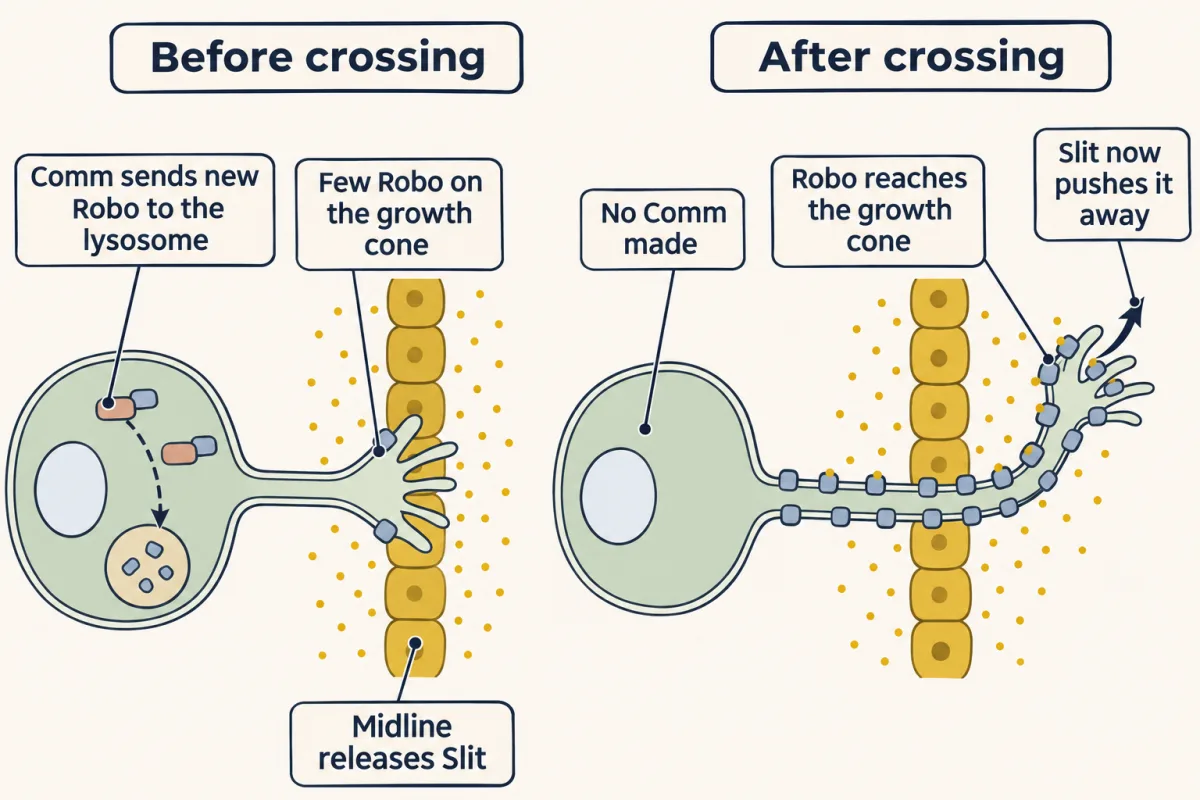
How does it do that? In 2002, Keleman, Dickson and colleagues proposed a sorting model. Comm is made in commissural neurons for a short time, before and during crossing. Inside the neuron, it meets newly made Robo. It diverts it away from the surface, into late endosomes and lysosomes. There, Robo is destroyed. The growth cone crosses carrying little Robo.
Once the axon has crossed, the neuron stops making Comm. Robo reaches the growth cone. Now the Slit it just crossed repels it. Sorting is real. In living embryos, Comm stops a tagged Robo from reaching the axon tip. But it is not the whole story. Flies whose Robo cannot be sorted develop normally. Yet they still need Comm to cross. So Comm has at least one more way to hold Robo back. What that is remains debated. For prediction, you need only the result. While Comm is present, Robo1 stays low, and the axon hears Slit only weakly.
From the film
- In comm mutants Slit and Robo are present, so axons must hear Slit too early.
- Comm sets how much Robo the axon has, and when, rather than acting as a second cue.
- Sorting Robo to lysosomes is real but not the whole story, and how Comm holds Robo back is still debated.
comm mutants are the puzzle. Slit is still at the midline, and Robo is still made, yet almost no axon crosses. The rule offers one explanation: in comm mutants the axon hears Slit too early. If that is right, Comm’s job is to keep Robo down before crossing.
How would you test that with genetics alone? Kidd, Claire Russell, Goodman and Tear (1998) did two experiments.
Predict. Make a fly lacking both robo and comm. If Comm works only by lowering Robo, what should the ladder look like: like comm (almost no rungs), like robo (extra crossings), or something new?
Check your prediction
Like robo, and that is what they saw. Follow it step by step.
- In a comm mutant, Robo is too high before crossing, so axons are repelled early and do not cross.
- In the double mutant there is no Robo1 at all, so there is no Robo1 to be too high.
- With Robo1 gone, losing Comm changes nothing. The embryo shows only the robo phenotype.
This reasoning is called epistasis. When one gene acts only by turning a second gene down, the double mutant looks like the mutant of the gene that is turned down. That gene, here robo, is the downstream one.
They also did the reverse: they made Comm in every neuron during embryonic development, at a modest level. Robo protein fell, and the ladder looked like robo. Ipsilateral axons crossed and commissural axons recrossed. Extra Comm everywhere turns Slit hearing down everywhere. Stronger pan-neural Comm has been reported to give a slit-like collapse instead (Kidd and colleagues, 1998; Rajagopalan and colleagues, 2000), perhaps by suppressing Robo2 as well as Robo1, since losing both receptors looks like losing the ligand; the phenotype alone does not show which receptors fell.
So Comm is not a second cue. It sets how much Robo the axon has, and when.
How Comm does it: the sorting model
Krystyna Keleman, Barry Dickson and colleagues (2002) proposed the influential sorting model.
- Comm is made in commissural neurons, for a short time before and during crossing.
- Inside the neuron it meets newly made Robo and diverts it from the route to the surface into late endosomes and lysosomes, where Robo is destroyed. A short sequence in Comm, LPSY, was needed for this sorting in their assays.
- The growth cone crosses carrying little Robo.
- Once the axon has crossed, the neuron stops making Comm. Robo reaches the growth cone, and Slit at the midline it just crossed now repels it.
Sorting receptors toward lysosomes is covered in that lesson and receptor trafficking in that lesson.
Sorting is real but not the whole story: Comm still matters when Robo cannot be sorted, so it has at least one more way to hold Robo back, which is debated (Going deeper). For predicting phenotypes, remember the result: while Comm is present, Robo1 is kept low and the axon hears Slit only weakly.
Mammals mute Robo, and also clear it
Read the transcript of “Mammals Mute Robo, and Also Clear It”
Film transcript: Mammals Mute Robo, and Also Clear It
Comm has been found only in some insects. So how does a mammalian axon stay deaf until it crosses? The fly has one slit gene. Mice have three, and two conventional Robo receptors, Robo1 and Robo2. Earlier work found that mice lacking Slit1 and Slit2 had no defect in commissural axon guidance. In 2004, researchers removed all three. Use the three questions. What should the axons do?
With no Slit, there is no Slit push, though other cues remain. The axons still reach the midline, drawn by netrin. Many stalled in the floor plate. Others crossed and then turned back. Next, a culture experiment. Zou and colleagues grew pieces of embryonic rat spinal cord, called explants, in a gel. Dorsal explants gave axons that had not yet crossed. Explants that kept the floor plate gave axons that had crossed. Each kind sat beside cells releasing Slit2. Which axons should Slit affect?
Slit2 held back the growth of axons that had crossed. Axons that had not crossed were not held back. These were different axons, not one axon before and after. Still, crossing goes with a change in the response to Slit. So what keeps a mammalian axon deaf before it crosses? An unusual member of the Robo family, called Robo3. In 2004, it was found on commissural axons before they cross. Remove Robo3 from a mouse. Slit is present. Robo1 and Robo2 are still made. Predict.
Almost no commissural axons cross. They approach the floor plate and turn away. They hear Slit too early. That resembles the fly comm mutant. But Robo3 does not clear Robo1 and Robo2 from the surface. It blunts their response while they stay in the membrane. Comm lowers Robo1 by sorting, and in at least one other way. Robo3 mutes it. Mammals also clear some Robo1. Proteins called Ndfip1 and Ndfip2 send it to be degraded before crossing. Two splice forms of Robo3 matter here. In mouse, the form present before crossing disappears afterwards. A second form appears on crossed axons and helps keep them from recrossing. Mammalian Robo3 has a second job too.
It works with the netrin receptor DCC and strengthens netrin attraction. The same gene matters in people. Mutations in human Robo3 cause horizontal gaze palsy with progressive scoliosis. In patients, motor and sensory pathways that normally cross in the brainstem appear uncrossed. The takeaway: mammals both mute their Robo receptors and clear some of them, until the axon has crossed.
From the film
- Mice lacking all three Slit genes show stalled and recrossing commissural axons.
- Robo3 blunts the response of Robo1 and Robo2 to Slit before crossing, while they stay in the membrane.
- Mammals both mute Robo and clear some Robo1, until the axon has crossed.
Three Slits
The fly has one slit gene. Mice have three, and two conventional Robo receptors, Robo1 and Robo2. Earlier work on mice lacking Slit1 and Slit2 had found no defect in commissural axon guidance. In 2004 Hua Long, Tessier-Lavigne and colleagues removed all three Slit genes.
Predict. In a mouse lacking Slit1, Slit2 and Slit3, what should spinal commissural axons do at the floor plate?
Check your prediction
Slit is gone, so there is no Slit push, though other guidance signals remain. The axons still reach the midline, attracted by netrin. Spinal commissural axons showed the fly phenotype: many stalled in the floor plate, and others crossed and then turned back. The stalling echoes the fly slit mutant, the recrossing the fly robo mutant. Redundancy of this kind makes a once-only decision hard to break by one mutation.
The axon learns to hear
The fly ladder shows that Robo rises after crossing. A vertebrate culture experiment shows the response itself differing before and after crossing. Zou and colleagues (2000) grew pieces of embryonic rat spinal cord, called explants, in a collagen gel. Some explants were cut from the dorsal cord, so their commissural axons had not yet reached the floor plate; netrin-1 was added to make those axons grow out. Other explants kept the floor plate, so the axons growing out of them had crossed it. Each kind was set beside cells releasing Slit2, or beside control cells.
Predict. Which axons should Slit2 affect, and why?
Check your prediction
Slit2 inhibited the growth of axons that had crossed the floor plate, but not of axons that had not. These are different axons in different explants, not one axon before and after, so the experiment does not show the switch happening. It does fit the fly picture: crossing the midline goes with a change in how commissural axons respond to Slit.
Robo3: a family member that mutes the others
Vertebrates still need an axon that ignores Slit before crossing. The same year as the Slit triple mutant, Christelle Sabatier, Tessier-Lavigne and colleagues found the vertebrate solution in an unusual member of the Robo family, Robo3, also called Rig-1. Robo3 is made on commissural axons before they cross.
Predict. Remove Robo3 from a mouse. Slit is present, and Robo1 and Robo2 are still made. What happens at the floor plate?
Check your prediction
Almost no commissural axons cross. They approach the floor plate and turn away. The axons hear Slit too early, and the result resembles the fly comm mutant.
Robo3 does not clear Robo1 and Robo2 from the surface. It blunts their response to Slit while they stay in the membrane, by a molecular action still unresolved. Comm, by contrast, lowers Robo1 delivery through sorting and also inhibits it in another way. Mammals use both strategies, though: Ndfip1 and Ndfip2, proteins unrelated to Comm, send Robo1 to be degraded before crossing. So mammals both mute Robo and lower it; how much each contributes is not settled.
Two splice forms of Robo3 matter here. In mouse, the form present before crossing, Robo3.1, disappears afterwards, and a second form, Robo3.2, appears on crossed axons and helps keep them from recrossing. Mammalian Robo3 also has a second job: it works with the netrin receptor deleted in colorectal cancer (DCC) and strengthens netrin attraction. So an axon without it is both repelled too early and pulled less strongly toward the floor plate.
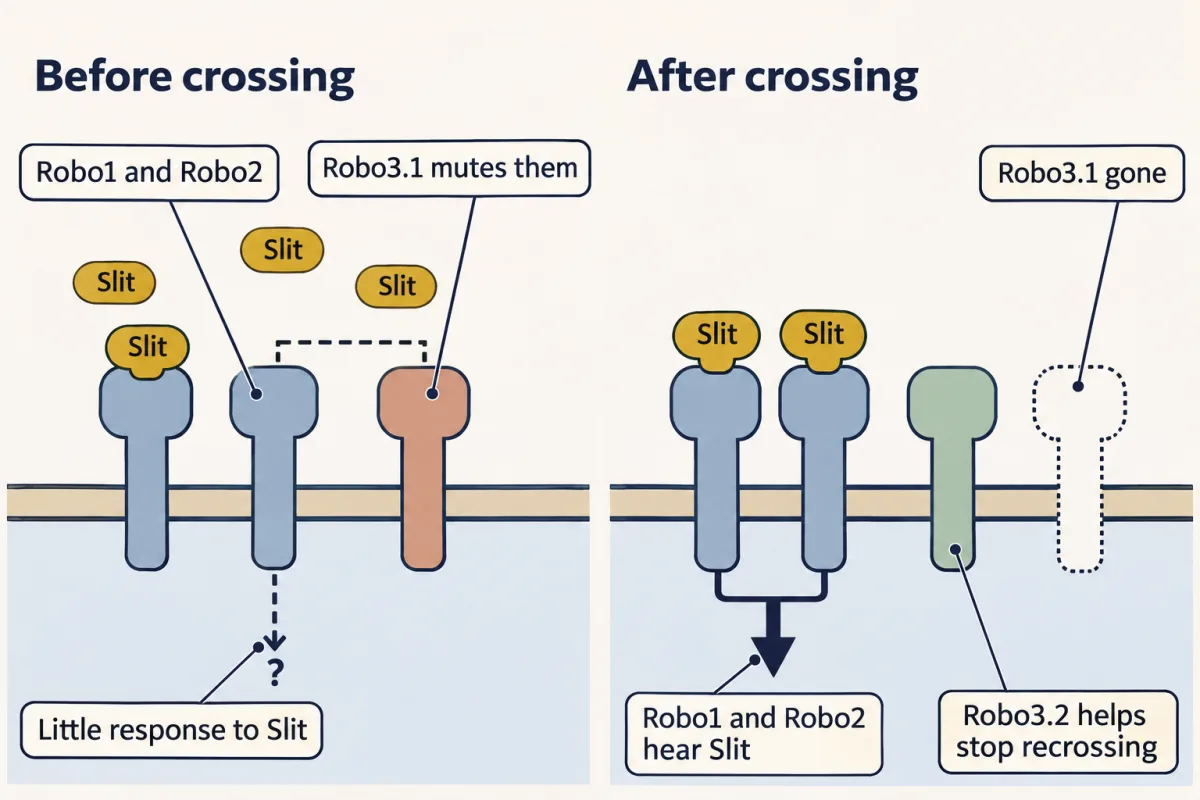
The same gene matters in people. Mutations in human ROBO3 cause horizontal gaze palsy with progressive scoliosis, and in patients the motor and sensory pathways that normally cross in the brainstem appear uncrossed.
A decision stays made
What makes the crossing final is physical. The neuron changes the amount or activity of a receptor on its own growth cone, and keeps the change, while Robo1 and the midline stay the same. In flies the neuron stops making Comm. In mouse Robo3.1 disappears, freeing Robo1 and Robo2 to respond, and Robo3.2 joins them in keeping the axon away.
Attraction has to be dealt with too: the balance of pull and push has to tip toward leaving. How the changes in attraction and repulsion are coupled is still being worked out (Going deeper).
Predicting midline mutants
Read the transcript of “Predicting Midline Mutants”
Film transcript: Predicting Midline Mutants
Can three questions predict a Slit and Robo mutant? Is Slit there? Can the axon hear it? When does it start hearing it? Here is a ledger. Each row is a genotype. Read across before looking at the last column. Wild type first. A commissural axon barely hears Slit before crossing, and hears it well after. It crosses once. An ipsilateral axon hears Slit from the start. It never crosses. Try a row. A fly mutant for comm. Slit is there. When does the axon hear it?
Too early. It is repelled before crossing, and almost no rungs form. Next row. A fly lacking both robo and comm. Predict. Like robo. Robo2 is still there, so axons are pushed out, and some come back. Now a fly making Comm in every neuron, at a modest level. Can the axon hear Slit after crossing?
Only weakly. Robo is kept low, so axons cross and may come back. The ladder looks like robo. The mouse rows read the same way. With no Slits, there is no Slit push, so axons stall or recross. With no Robo3, axons hear too early, and almost none cross. The last row is where the rule fails. Remove Robo1, Robo2 and Robo3 together. The rule predicts that some crossing returns, because the receptors acting too early are gone. In the spinal cord, crossing partly returns. In hindbrain precerebellar axons, it does not. So there, Robo3 must do more than mute. It also strengthens netrin attraction, which removing Robo1 and Robo2 cannot replace. That points to the rule's main limit: it covers repulsion only.
After crossing, pull and push must tip toward leaving. How that happens is still being worked out. So what makes the crossing final? The neuron changes a receptor on its own growth cone, and keeps the change. In flies, the neuron stops making Comm. In mice, the form of Robo3 that muted the others disappears. The takeaway: an axon pushed too hard too early never crosses. One pushed too weakly after crossing may stall, or cross again.
From the film
- Three questions predict a Slit or Robo mutant: is Slit there, can the axon hear it, and when does it start hearing it.
- An axon pushed too hard too early never crosses; one pushed too weakly after crossing may stall or cross again.
- The rule covers repulsion only, and the change that makes crossing final is a receptor change the neuron keeps.
Each row asks the three questions. Read it across before looking at the last column.
| Genotype | Slit at the midline? | Hears Slit before crossing? | Hears Slit after crossing? | What the rule predicts | What is seen |
|---|---|---|---|---|---|
| Wild type, commissural axon | yes | weakly (below the threshold) | strongly | crosses once | crosses once |
| Wild type, ipsilateral axon | yes | yes | yes | never crosses | never crosses |
| Fly robo | yes | weakly (Robo2) | weakly (Robo2) | crosses, pushed out, may come back | ipsilateral axons cross; commissural axons recross |
| Fly comm | yes | yes, too early | yes | repelled before crossing | almost no rungs |
| Fly slit | no | nothing to hear | nothing to hear | enters and is not pushed out | axons stay; rails collapse to the middle |
| Fly robo;comm | yes | weakly | weakly | like robo | like robo |
| Fly, modest Comm in every neuron | yes | weakly | weakly (Robo kept low) | crosses and may come back | robo-like ladder |
| Mouse, no Slit1, Slit2, Slit3 | no | nothing to hear | nothing to hear | may stall or recross | many stall; some recross |
| Mouse, no Robo3 | yes | yes, too early | yes | repelled before crossing | almost none cross |
| Mouse, no Robo1, Robo2, Robo3 | yes | no Robo1 or Robo2 to hear with | no Robo1 or Robo2 to hear with | some crossing returns; axons may then stall or recross | spinal cord: crossing partly returns; hindbrain precerebellar axons: no |
The last row is where the rule fails. In the spinal cord, removing Robo1 and Robo2 as well as Robo3 lets some crossing return, because the receptors that were acting too early are gone. In hindbrain precerebellar axons it does not (see the limits below).
Compare two rows that look like opposites, the Slit triple mutant and the Robo3 null: they remove opposite sides of a gate. Without Slit the gate cannot close behind the axon. Without Robo3 it cannot open for it.
What the rule covers, and where it stops. It covers Slit–Robo repulsion, in the fly and in the vertebrate spinal cord. Four limits matter.
- More than one Robo contributes. Robo1 and Robo2 share the midline job in flies and in mice. The push is not a simple count of receptors: fly Robo2 can also hold back Robo1 (Going deeper), and the toy ignores saturation.
- It says nothing about attraction, which also has to tip toward leaving (Going deeper).
- Robo3 does more than mute Robo1 and Robo2. In pontine neurons it also strengthens netrin–deleted in colorectal cancer (DCC) attraction. The failed hindbrain rescue shows that removing Robo1 and Robo2 is not enough there; it does not show which extra activity matters most.
- Robo is not the only midline force. Other repellents, such as semaphorins, act on crossed axons through other receptors, and a Slit fragment has been reported to act through PlexinA1 rather than a Robo.
A related logic, with different cues and with each retinal neuron’s type setting which receptors it makes, decides which retinal axons cross at the optic chiasm, a case taken up in that lesson.
Design problem
In mouse, commissural axons switch from Robo3.1 before crossing to Robo3.2 after. Suppose you could make them keep Robo3.1 after they cross, and never make Robo3.2. What does the rule predict? Design the experiments to test the prediction.
Saved in this browser only.
One way to do it
Predict with the three questions. Slit is there. Before crossing, the axon is muted as normal, so it should reach and cross the floor plate. After crossing, Robo3.1 is still there to mute Robo1 and Robo2, so their push stays low. The rule predicts more axons that stall in the floor plate or cross back. It does not predict a complete loss of Slit response, because other repellents, and a Slit fragment acting through PlexinA1, still act. Robo3’s boost to netrin attraction, if the persisting form carries it, would add to any stalling.
Build the animals. Removing Robo3.2 does not by itself keep Robo3.1 on the axon, because the neuron also controls when and where Robo3.1 protein appears. So engineer the persistence of Robo3.1 separately, and compare four groups with matched timing and expression levels: controls; persisting Robo3.1 with Robo3.2 intact; Robo3.2 lost alone; and both changes together. The Robo3.2-only group shows how much recrossing comes from losing Robo3.2 alone.
Check that the manipulation did what you meant. Stain for Robo3.1 on axon segments past the floor plate; it should be there in the mutant and absent in controls. Measure Robo1 and Robo2 at the surface, by labelling an outside part of the receptor without opening the cells, alongside total protein. Unchanged surface levels with a weaker Slit response point to muting rather than loss of the receptor.
Score the phenotype. Label commissural axons at matched ages, for example with dye applied to the dorsal spinal cord or by tracing single axons. Out of all labelled axons, count four outcomes: never reaching or entering the floor plate, stalling in it, leaving on the far side without recrossing, and recrossing. The first category checks that the approach was normal.
Test the mechanism in culture. Take explants whose axons have crossed the floor plate and set them beside Slit-releasing cells, as in the explant experiment. Slit should inhibit the growth of control crossed axons. If persisting Robo3.1 keeps Robo1 and Robo2 muted, the mutant’s should be inhibited less.
Going deeper
How Comm holds Robo back: the open question
The model has been revised more than once. The early model had Comm made in midline cells and transferred into the axons crossing them. In 2002 Marios Georgiou and Tear reported that comm is needed in the commissural neurons as well as in midline cells, and Keleman and colleagues then proposed sorting. Keleman, Carlos Ribeiro and Dickson’s 2005 work in living embryos found that Comm stops Robo-GFP from reaching the axon tip. In 2008 Giorgio Gilestro replaced fly Robo with a form that Comm cannot sort. Those flies were normal, yet removing Comm from them still blocked crossing. So sorting is real but redundant: Comm has a second, still unknown way to hold Robo back.
Whether ubiquitin is involved has gone back and forth. Myat, Tear and colleagues (2002) proposed that Comm recruits the ubiquitin ligase Nedd4, and Keleman and colleagues (2005) found that Comm worked without being ubiquitinated itself. In 2025 Sullivan and Bashaw reported that Comm instead brings Nedd4 to ubiquitinate Robo1. Their evidence in embryos comes from sensitised genetic backgrounds and has not yet been tested by other laboratories.
Other brakes on Robo before crossing
Other brakes act alongside Comm. Robo2 on neighbouring cells can inhibit Robo1 in trans (Evans and colleagues, 2015), and Frazzled, the fly relative of deleted in colorectal cancer (DCC), switches on comm transcription (Yang and colleagues, 2009). Comm has been found only in some insects. In vertebrates, PRRG4 shares Comm’s sorting motif and lowers Robo1 in cultured cells (Justice and colleagues, 2017), but its role in commissural axons has not been tested. The vertebrate pathway with evidence in living animals is Ndfip1/2 with Nedd4 (Gorla and colleagues, 2019 and 2022).
The dosage result, fitted
A toy fit makes the threshold argument concrete. Let each segment have a net guidance margin: an average set by the toy Slit × Robo1 calculation, plus the same normally distributed scatter in every genotype. Score an error when the margin falls below a threshold. This margin is not literal Slit-dependent push, which would be exactly zero in a slit null. Fit the made-up numbers: single heterozygotes with an average of 0.5 and 3% errors (the average of 2% and 4%), the double heterozygote with 0.25 and 32%. The fit gives scatter of about 0.177 and a threshold of about 0.167. Extrapolated, it predicts about 0.0001% errors in wild type (average 1) and about 83% at an average of 0 (slit null). These are not measured mutant penetrances; treat the fit as an illustration.
A sum of the two doses, each counting equally, (S + R)/2, with a threshold also fits the two heterozygote points. Under it a slit null and the double heterozygote both average 0.5 and both give about 32% errors, which is hard to reconcile with the much more severe slit null collapse. But that collapse is described, not scored on the same assay, so this is not a quantitative test. The invented counts do not pick one model.
Robo3’s other jobs
Mammalian Robo3 binds Slit little if at all, but it binds a different ligand, NELL2. How Robo3 dampens Robo1 and Robo2 at the molecular level is still an open question.
Switching off attraction
The rule covers repulsion. A crossed axon also has to leave despite the midline’s pull. Floor-plate exposure reduces commissural axons’ response to netrin in hindbrain explants (Shirasaki and colleagues, 1998), yet some hindbrain axons keep netrin–DCC attraction after crossing (Shoja-Taheri and colleagues, 2015), so attraction need not vanish altogether. A widely cited 2001 report that Robo binds DCC and silences netrin attraction (Stein and Tessier-Lavigne) was retracted in 2023, so that coupling should not be treated as established.
How Robo moves the growth cone
Robo signals through srGAPs, Abl and Ena, among other effectors, to reshape actin locally. Which Rho-family GTPases it changes depends on the context. In vertebrate cell-migration assays, srGAP1 links Slit–Robo signalling to switching off Cdc42; in fly midline guidance, Robo recruits Sos to switch on Rac. So Robo turns some GTPases off and others on.
Your notes
Select any text in the lesson to highlight it or add a note to it. Your highlights and notes are saved in this browser and collected in your notebook.
This browser is not letting the site save anything (a private window or strict privacy settings), so highlights and notes will be lost when you leave the page.
How we measure it
Antibody staining of the fly nerve cord
Fly embryos are fixed and stained with an antibody that marks all central axons, or with one that marks only a few longitudinal bundles. The ladder of rails and rungs then shows at a glance whether too many axons cross, too few cross, or axons pile up at the midline.
Double mutants and dosage tests
Two mutations are combined in one animal, or one copy of each gene is removed. When gene A acts only by turning gene B down, the double mutant lacking both looks like the B single mutant, and B is the downstream gene. If losing one copy of each gene gives a defect that neither single loss gives, the two genes probably work together in one process; binding or other tests are needed to show they are one pathway.
Collagen-gel explant co-culture
A piece of embryonic spinal cord is set in a three-dimensional gel beside a clump of cells engineered to release a candidate cue, with mock-transfected cells (put through the same procedure without the cue's gene) as a control. Axons that grow more on the far side than the near side are probably being repelled, once effects on growth rate and survival are ruled out.
Knockout mice
A conventional knockout mouse carries a gene inactivated in every cell. Crossing knockouts of related genes, such as Slit1, Slit2 and Slit3, reveals functions that one gene alone hides because its relatives can cover for it.
Practice questions on this lesson (3) → MCAT-style, original, each with an explanation
Where this lesson fits
Before thisReview first
- Netrin and DCC: One Cue, Two AnswersThis course · Lesson 23
It teaches the netrin pull toward the midline that commissural axons must be drawn by before they cross and leave.
- Pioneers, Guideposts and the Logic of Guidance CuesThis course · Lesson 22
It sets out the logic of attractive and repulsive cues that this lesson applies to the midline.
- The Growth Cone: The Tip That Steers the AxonThis course · Lesson 3
You need to know how the growth cone turns a cue into steering through actin to follow Robo signalling.
After thisStudy next
- Semaphorins and RepulsionThis course · Lesson 25
It covers another repellent that acts on crossed axons through different receptors, the other midline force mentioned here.
- Topographic Maps: Sperry's Eye and Eph GradientsThis course · Lesson 26
It takes receptor-level changes in how axons respond to cues further, as seen at the optic chiasm and in maps.
Elsewhere on the siteFilms, simulations and method films in other courses
- Complementation (cis-trans) testMethod film
The lesson reads the robo;comm double mutant and mutant combinations to decide how the genes act together.
Suggested by an AI model from the lessons themselves, then checked. How we use AI
Finish line
Test yourself
8 questions
Practice and MCAT-style, with explained answers.
Next · Lesson 25
Semaphorins and Repulsion
Pain fibres and muscle afferents enter the spinal cord side by side. One kind stops in the dorsal horn; the other runs on to the motor neurons. What sorts them?
Continue →