Developmental Neuroscience · Skim version
Crossing the Midline Once: Slit, Robo and Comm
Read the full lesson → Skim the whole course →
The guiding idea
An axon is pulled toward the midline, crosses it, and then treats it as forbidden ground. What changed?
While a commissural axon crosses, the midline stays the same and the axon changes what it can hear: it keeps its response to the repellent Slit low until it has crossed.
From the film: One Crossing, and Only One
- The midline stays the same while an axon crosses; the axon changes what it can hear.
- The midline makes the repellent Slit, and the growth cone carries Robo receptors that hear it.
- Commissural axons hold the push low until they have crossed, and then let it rise.
From the film: Reading the Ladder
- In the fly nerve cord, robo mutants have too many crossings, slit mutants collapse into a single central bundle, and comm mutants have almost no rungs.
- The same axon carries little Robo while it crosses and a lot once it is across.
- Deaf until crossed means a much weaker response to Slit, not none.
From the film: A Quarter of the Push, Many Times the Errors
- Slit is a protein secreted by midline glia that binds Robo receptors and repels axons.
- In the toy model, losing one copy of each gene leaves a quarter of the push, and a threshold can turn that into many more errors.
- Flies have three Robo receptors, so the ligand is shared and the receptors share the work.
From the film: Comm: The Gate Is in the Axon
- In comm mutants Slit and Robo are present, so axons must hear Slit too early.
- Comm sets how much Robo the axon has, and when, rather than acting as a second cue.
- Sorting Robo to lysosomes is real but not the whole story, and how Comm holds Robo back is still debated.
From the film: Mammals Mute Robo, and Also Clear It
- Mice lacking all three Slit genes show stalled and recrossing commissural axons.
- Robo3 blunts the response of Robo1 and Robo2 to Slit before crossing, while they stay in the membrane.
- Mammals both mute Robo and clear some Robo1, until the axon has crossed.
From the film: Predicting Midline Mutants
- Three questions predict a Slit or Robo mutant: is Slit there, can the axon hear it, and when does it start hearing it.
- An axon pushed too hard too early never crosses; one pushed too weakly after crossing may stall or cross again.
- The rule covers repulsion only, and the change that makes crossing final is a receptor change the neuron keeps.
-
The problem: one crossing, and only one
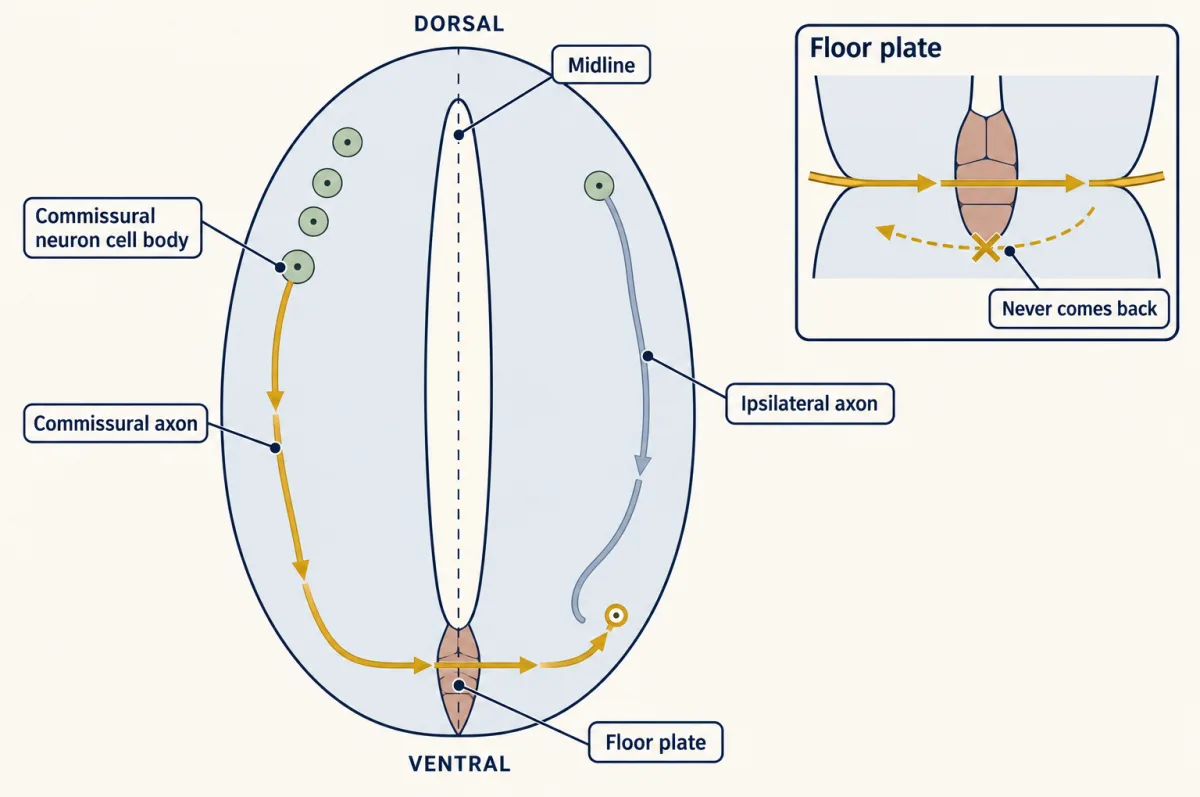
A commissural axon grows toward the ventral floor plate, crosses the midline and leaves it, and does not recross in normal pathfinding. Its ipsilateral neighbour stays on its own side. This is a schematic cross section; the real post-crossing turn runs along the length of the cord, out of this plane. AI-generated illustration -
Reading the fly ladder
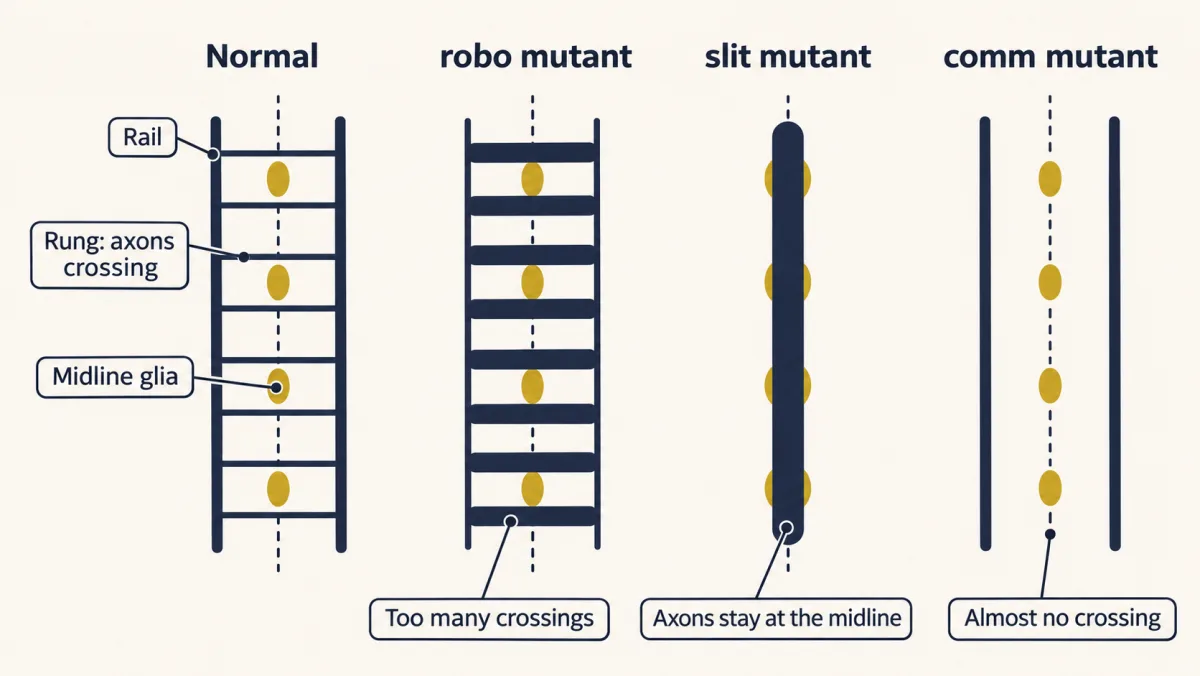
The fly nerve cord is a ladder of two rails and crossing rungs. Without the receptor Robo, too many axons cross; without the midline repellent Slit, axons that reach the midline stay there and the rails collapse; without Comm, almost no axon crosses. AI-generated illustration -
Slit is the ligand
-
Commissureless: the gate is in the axon
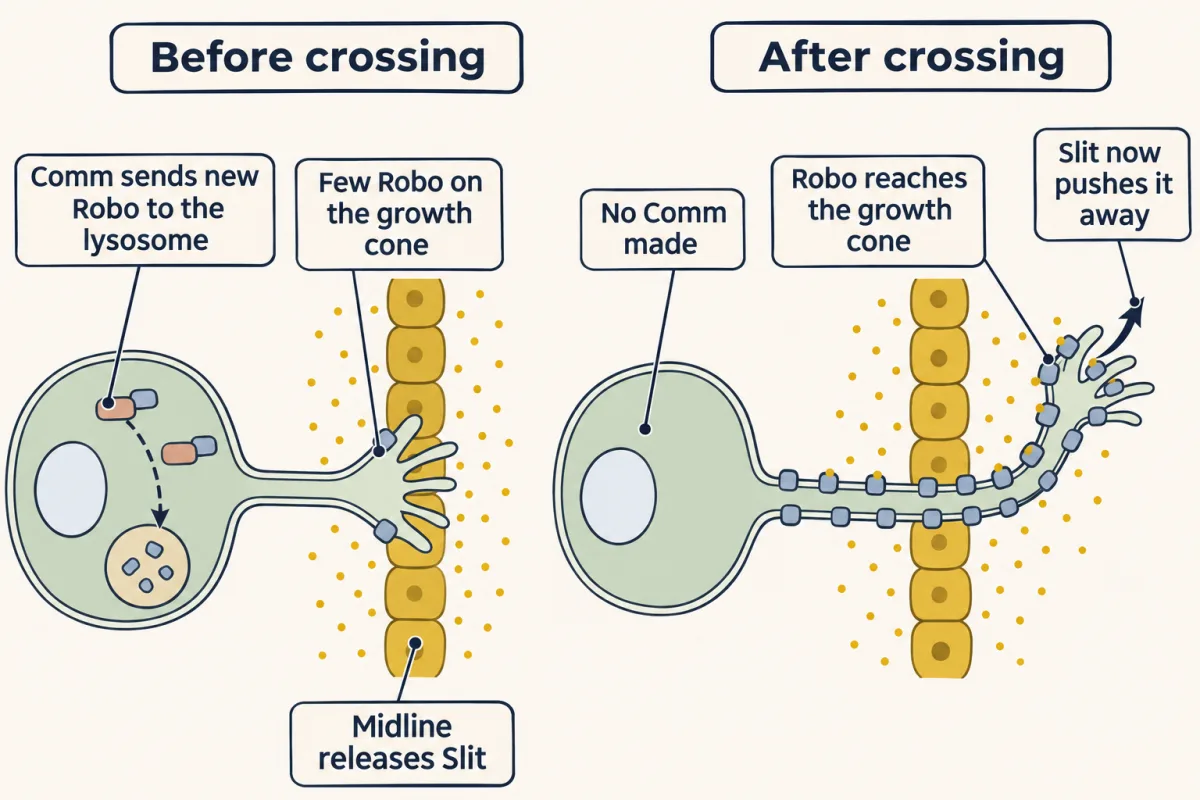
In the sorting model, Comm diverts newly made Robo to lysosomes while the axon crosses, so the growth cone hears Slit only weakly. Once across, the neuron stops making Comm, Robo reaches the growth cone, and Slit at the midline now repels it. Sorting is not the whole story: Comm has at least one other way to hold Robo back. AI-generated illustration -
Mammals mute Robo, and also clear it
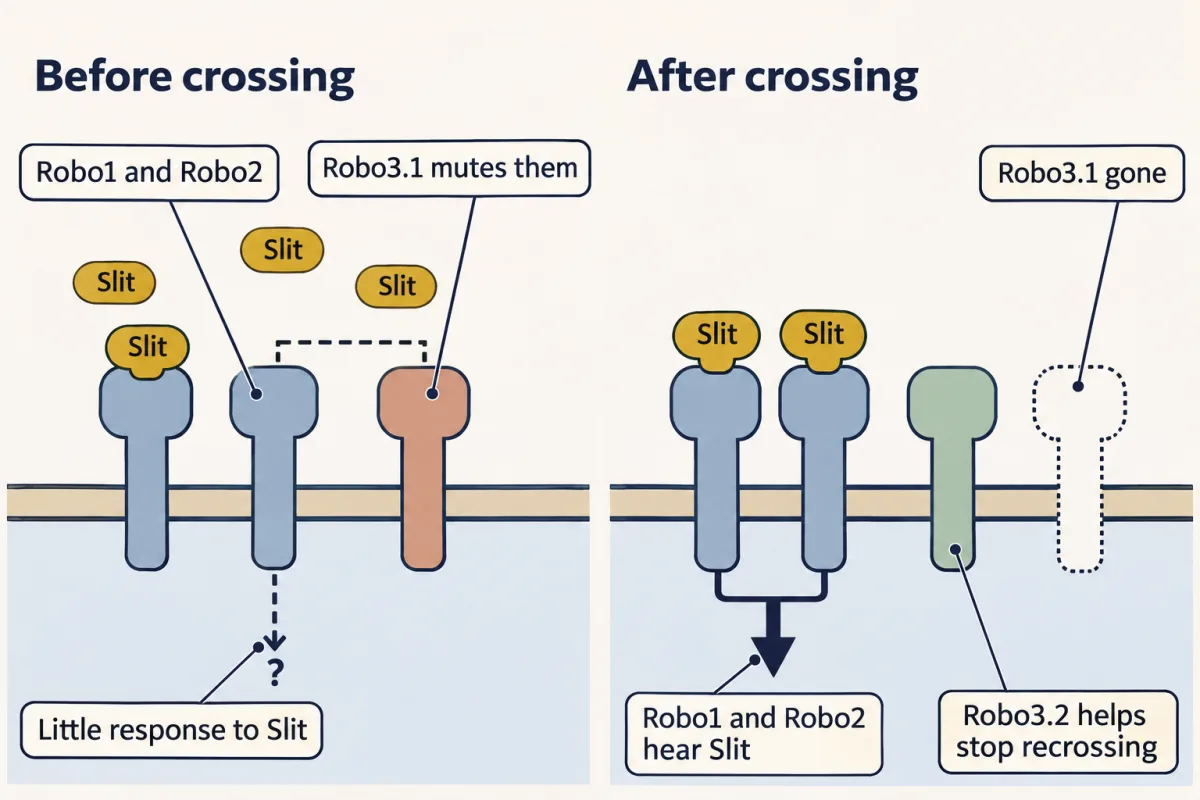
Before crossing, Robo3.1 blunts the response of Robo1 and Robo2 to Slit while they stay in the membrane, by a mechanism still unresolved. After crossing, Robo3.1 disappears, Robo1 and Robo2 respond to Slit, and Robo3.2 helps keep the axon from recrossing. Mammals also send some Robo1 for degradation before crossing. AI-generated illustration -
A decision stays made
-
Predicting midline mutants
-
Going deeper
Where this lesson fits
Before thisReview first
- Netrin and DCC: One Cue, Two AnswersThis course · Lesson 23
It teaches the netrin pull toward the midline that commissural axons must be drawn by before they cross and leave.
- Pioneers, Guideposts and the Logic of Guidance CuesThis course · Lesson 22
It sets out the logic of attractive and repulsive cues that this lesson applies to the midline.
- The Growth Cone: The Tip That Steers the AxonThis course · Lesson 3
You need to know how the growth cone turns a cue into steering through actin to follow Robo signalling.
After thisStudy next
- Semaphorins and RepulsionThis course · Lesson 25
It covers another repellent that acts on crossed axons through different receptors, the other midline force mentioned here.
- Topographic Maps: Sperry's Eye and Eph GradientsThis course · Lesson 26
It takes receptor-level changes in how axons respond to cues further, as seen at the optic chiasm and in maps.
Elsewhere on the siteFilms, simulations and method films in other courses
- Complementation (cis-trans) testMethod film
The lesson reads the robo;comm double mutant and mutant combinations to decide how the genes act together.
Suggested by an AI model from the lessons themselves, then checked. How we use AI