Genetics and Molecular Biology · Skim version
Chromosomes and Meiosis: The Physical Basis of Mendel's Laws
Read the full lesson → Skim the whole course →
The guiding idea
A fruit fly cell has eight chromosomes and its sperm have four. Which four does a sperm get, and what decides it?
Mendel's two laws happen in meiosis: segregation is the separation of homologous chromosomes at anaphase I (or at anaphase II, when one crossover falls between the locus and its centromere), and independent assortment is the random orientation of different chromosome pairs at metaphase I.
From the film: One of Each Pair, by Coin Toss
- Homologs are the two members of a chromosome pair, one from each parent; sister chromatids are the two copies made in S phase.
- Count centromeres to count chromosomes: a copied chromosome is still one chromosome.
- Meiosis I deals one homolog of each pair to each cell and meiosis II splits sisters, so each gamete gets one allele of each gene: the law of segregation.
- Each pair faces the spindle by its own coin toss, so genes on different chromosomes assort independently.
- Independent assortment is a count over many meioses; ignoring crossovers, one meiosis gives only two kinds of gamete.
From the film: What Holds the Pair, and What Lets Go
- Cohesin rings hold sister chromatids together from S phase until they are cut.
- Crossing over exchanges segments between non-sister chromatids in prophase I; a chiasma marks where it happened.
- In most organisms studied, a crossover plus the cohesin on the arms beyond it ties two homologs together until anaphase I.
- In yeast and mammals as studied, arm cohesin is cut at anaphase I, while shugoshin protects cohesin at the centromeres until anaphase II.
- When these links fail, gametes can end up with too many or too few chromosomes.
-
Count before you divide: homologs, sisters and ploidy
-
Meiosis I separates homologs; meiosis II separates sisters
-
Where Mendel’s laws live in the cell
-
Four sperm, one egg
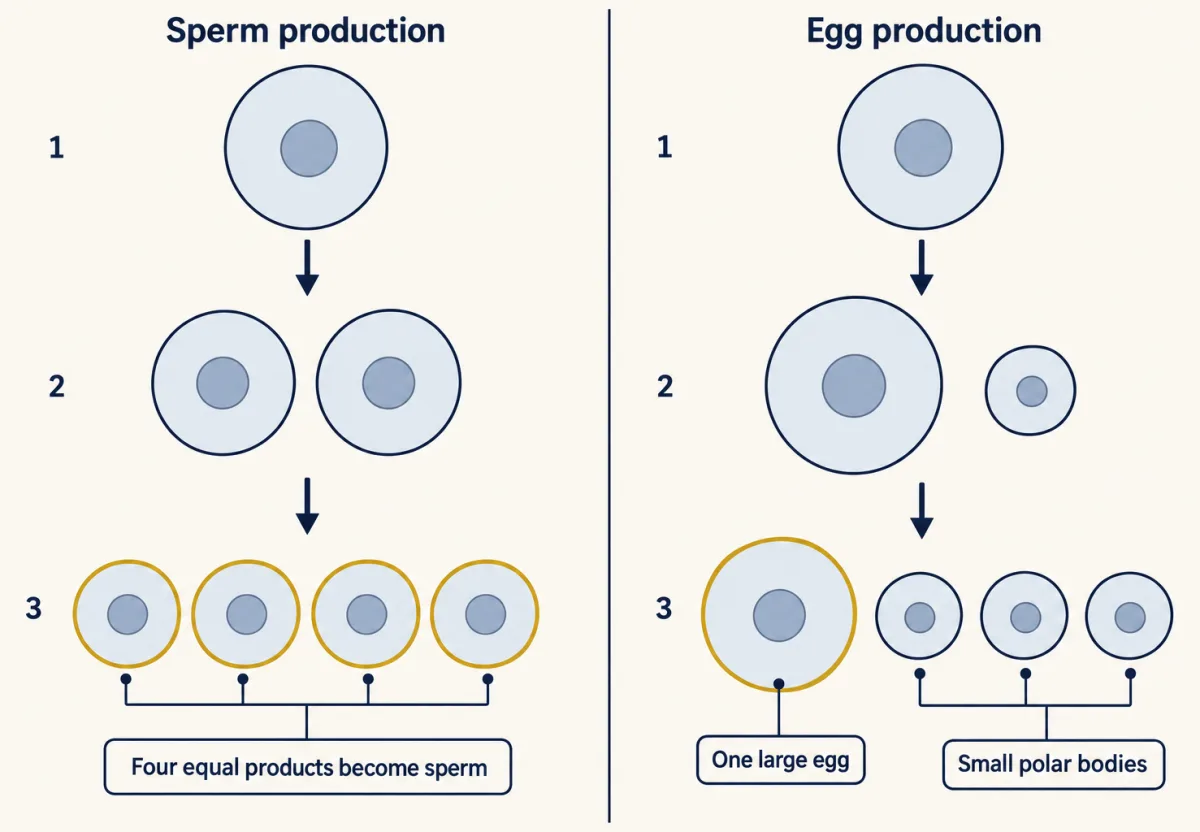
One meiosis makes four sperm but only one egg: the egg keeps nearly all the cytoplasm, and the polar bodies carry off the spare chromosome sets. AI-generated illustration -
Crossing over: what holds the pair, and what it does to alleles
-
Sutton, Boveri and the proof
-
Going deeper
Where this lesson fits
Before thisReview first
- Mendel's Peas: Segregation and Independent AssortmentThis course · Lesson 1
You need Mendel's two laws from there, because this lesson shows the chromosome movements that carry them out.
After thisStudy next
- Linkage and Recombination MappingThis course · Lesson 8
It takes the case of genes on one chromosome, where independent assortment fails and crossing over sets the ratios.
- Sex Linkage, Dosage Compensation and Non-Mendelian InheritanceThis course · Lesson 6
It follows the X and Y through meiosis to explain why reciprocal crosses differ.
- Chromosome Number and Structure: Aneuploidy and RearrangementsThis course · Lesson 7
It shows how failed homolog or sister separation leaves gametes with too many or too few chromosomes.
Elsewhere on the siteFilms, simulations and method films in other courses
- Meiosis shufflerSimulation · Biology
It shuffles homologs through meiosis, showing how random orientation makes different gamete combinations.
- How One Set Becomes TwoFilm · Biology
It shows copying chromosomes then separating the sisters, the contrast against meiosis I.
Suggested by an AI model from the lessons themselves, then checked. How we use AI