Life Science · Skim version
The Carbon and Water Cycles
Read the full lesson → Skim the whole course →
The guiding idea
Why does the air over a Hawaiian volcano lose carbon dioxide every summer and win it back every fall and winter?
The carbon dioxide in the air goes up only when more flows in than flows out, and down only when more flows out than flows in: plants take out more than is put back every northern summer, and burning adds a little more each year.
From the film: The Air Is a Tub
- Picture the air as a tub of carbon: its carbon dioxide goes up only when more flows in than flows out, and down only when more flows out than flows in.
- Photosynthesis takes carbon dioxide out of the air. Respiration, decomposition and burning put it back, and the ocean takes some in and gives some back.
- In the northern summer, plants take out more than is put back, so the level at Mauna Loa falls; from fall through spring it rises.
- In 2025 the biggest monthly drop was July to August, but the lowest month was September. A tub keeps draining as long as out beats in.
- Burning fossil fuels adds a little more than is taken out, so the whole record climbs. Compare the same month across years to see the climb.
From the film: One Door for Two Cycles
- Water moves by evaporation, condensation, precipitation, infiltration and runoff, and plants send it back to the air by transpiration.
- One study estimated that nearly two thirds of the water moving from land into the air goes through plants. The estimate has a wide range.
- Carbon dioxide comes into a leaf through the same tiny openings that water vapor goes out of.
- In dry weather plants close those openings to save water, so they take in less carbon dioxide. One study estimated about 30 percent less across Europe in the hot, dry summer of 2003. So a change in one cycle can change the other.
- Carbon and water are used again and again; energy comes in as sunlight and leaves as heat.
-
Explain: the flows in and out of the tub
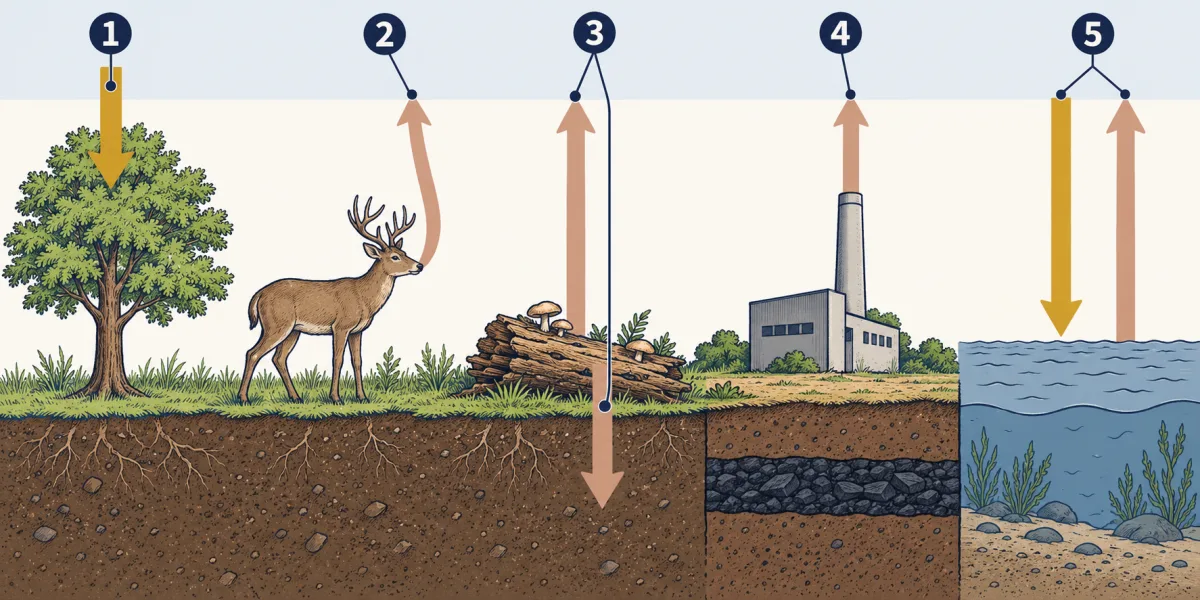
- photosynthesis
- respiration
- decomposition
- combustion
- ocean
-
Explore: run the tub
-
Explain: why Hawaii’s air follows the northern seasons
-
Explain: water moves, and plants help move it
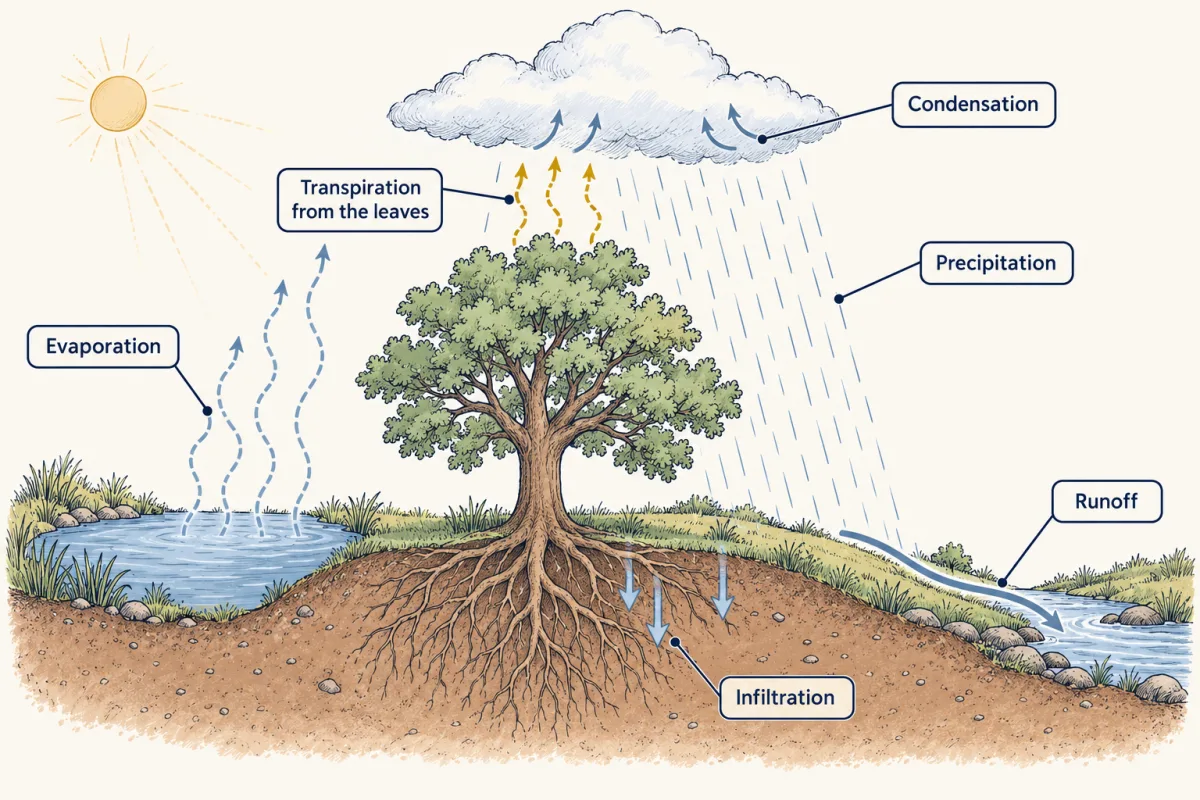
Water cycles around a Virginia oak: it evaporates from the pond and leaves the oak’s leaves as vapor, condenses into cloud, falls as rain, and soaks in or runs off to the stream. AI-generated illustration -
Explain: how the cycles connect
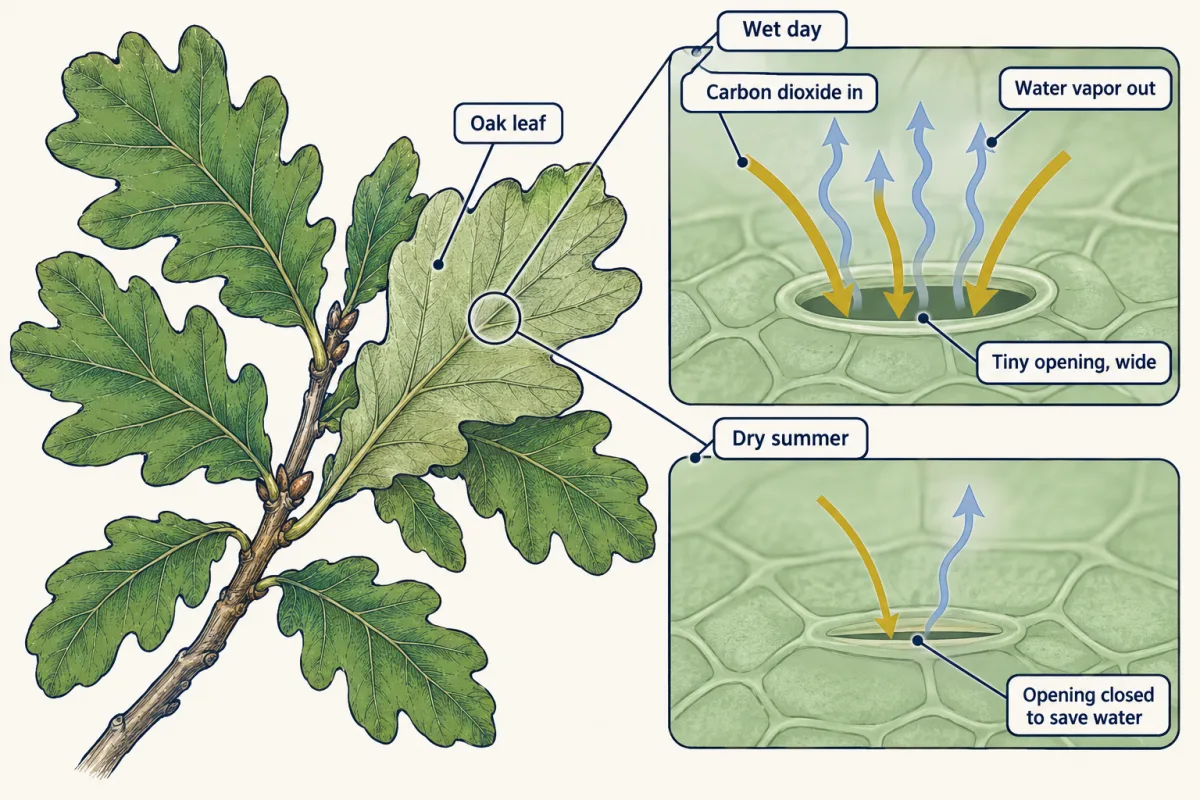
Carbon dioxide comes in through the same tiny openings that water vapor goes out of, so in dry weather, when a plant closes them to save water, less carbon dioxide gets in. AI-generated illustration -
Elaborate: a year of air at Mauna Loa
-
Evaluate: check your thinking
-
Going deeper
Where this lesson fits
Before thisReview first
- Partners in EnergyThis course · Lesson 11
You use both processes here as the flows that take carbon out of the air and put it back.
- Producers, Consumers and DecomposersThis course · Lesson 13
Decomposers returning carbon to the air and soil is one of the four flows in this lesson.
- Photosynthesis Feeds the WorldThis course · Lesson 9
Plants building sugar from carbon dioxide and water is the flow that drains the air tub.
After thisStudy next
- Big Changes: Dead Zones, Storms and ClimateThis course · Lesson 24
Extra carbon in the air and runoff carrying nutrients into water are used to explain big ecosystem changes.
- People Change HabitatsThis course · Lesson 25
People change the cycles you studied here, for example by burning fuel and changing land.
Elsewhere on the siteFilms, simulations and method films in other courses
- Follow an atomSimulation · Biology
It lets you follow a carbon atom through air, living things, soil and ocean, as the box model here does.
- Set Up: Thirsty CeleryFilm · Biology Together
It shows water travelling up a plant, the path water takes before leaving leaves as transpiration.
- We All Live DownstreamFilm · Biology Together
It shows rain running downhill, which is the runoff part of the water cycle.
Suggested by an AI model from the lessons themselves, then checked. How we use AI