Genetics and Molecular Biology · Skim version
Cancer as a Genetic Disease
Read the full lesson → Skim the whole course →
The guiding idea
If cancer is a genetic disease, why are most of the DNA changes in a tumor not inherited?
Cell lineages expand when their DNA changes improve growth or survival.
From the film: One Cell, Two Routes
- Cell lineages expand when their DNA changes improve growth or survival. Every change a lineage carries, driver or passenger, spreads with it.
- Most cancer-associated changes arise in body cells during life, not through inheritance.
- Oncogenes usually gain function, while tumor suppressors usually lose function.
- An inherited RB1 change raises risk, but a retinal cell still needs a second hit.
From the film: Reading a Tumor Family Tree
- Variant fractions trace DNA changes through expanding tumor cell lineages.
- A matched normal helps separate variants that are usually germline from somatic variants.
- A clonal variant is in every tumor cell; a subclonal variant is in only one branch.
- Purity and copy number shape the variant fraction measured in a tumor sample.
-
Two kinds of cancer gene: accelerators and brakes
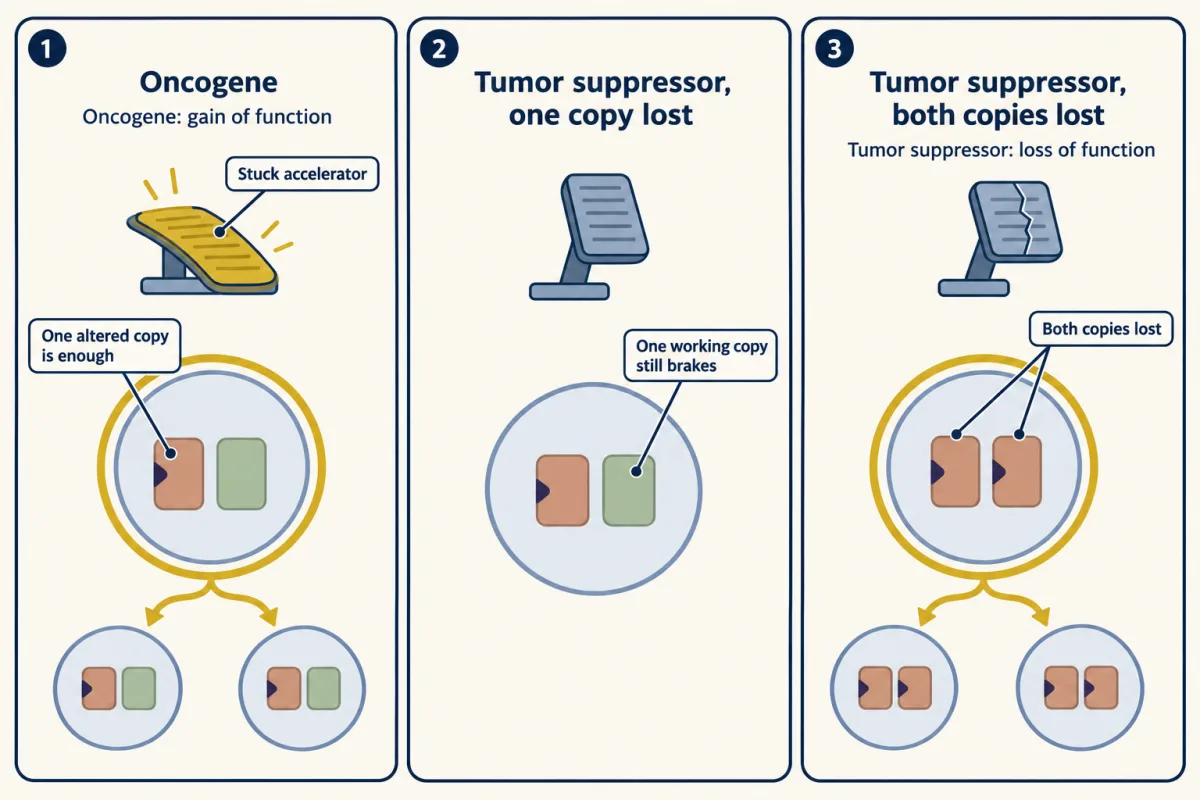
An oncogene is an accelerator stuck on, so one altered copy is usually enough. A tumor suppressor is a brake, and one working copy usually still holds, so a cell must normally lose both copies before it divides unchecked. AI-generated illustration -
Retinoblastoma and the two-hit arithmetic
-
How the second hit happens: loss of heterozygosity
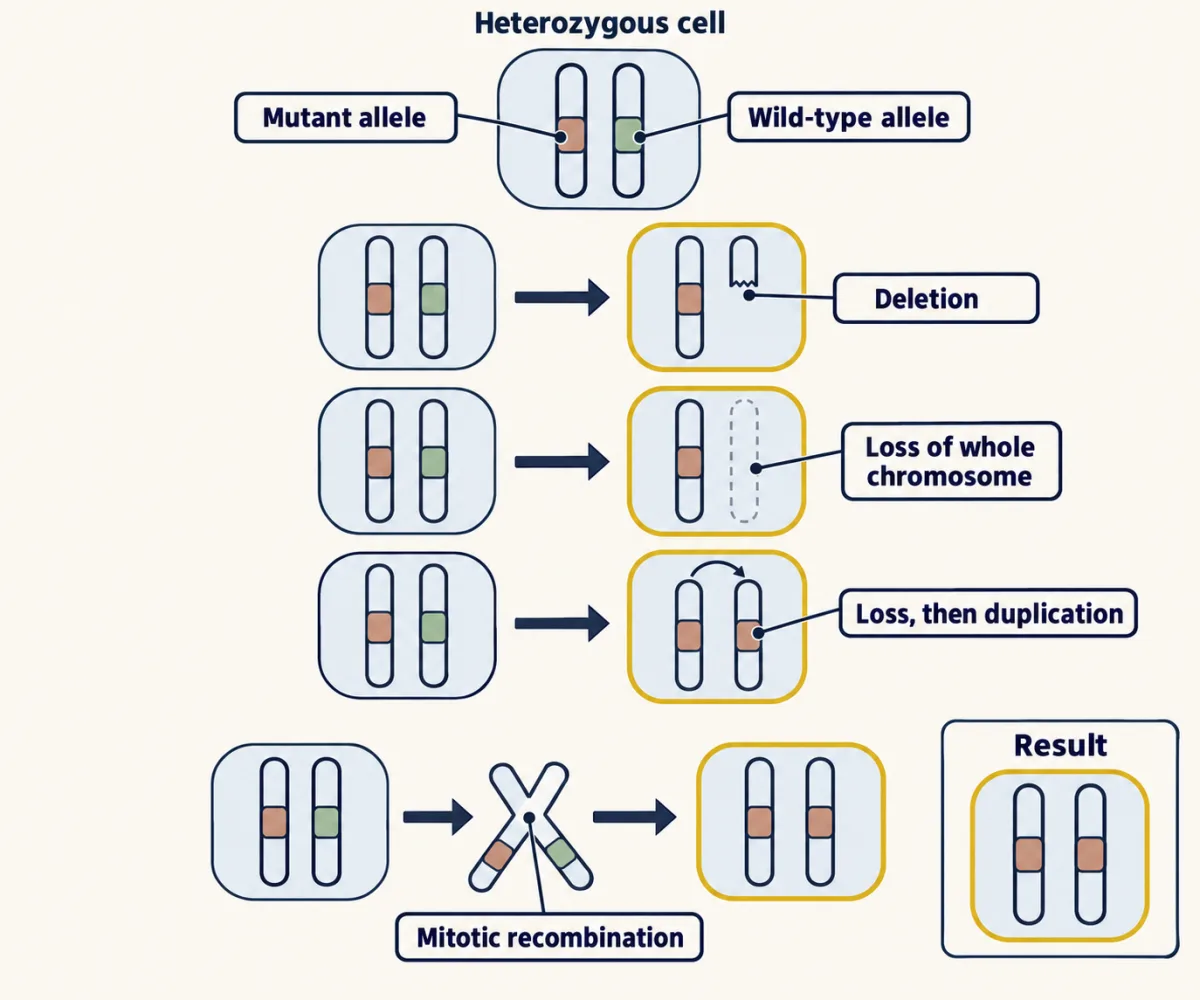
A cell with one mutant and one working RB1 allele can lose the working one by deletion, by losing the whole chromosome, by losing it and duplicating the remaining one, or by mitotic recombination. Each route removes the two-different-alleles state. AI-generated illustration -
Instability and clonal evolution
-
Reading a tumor genome
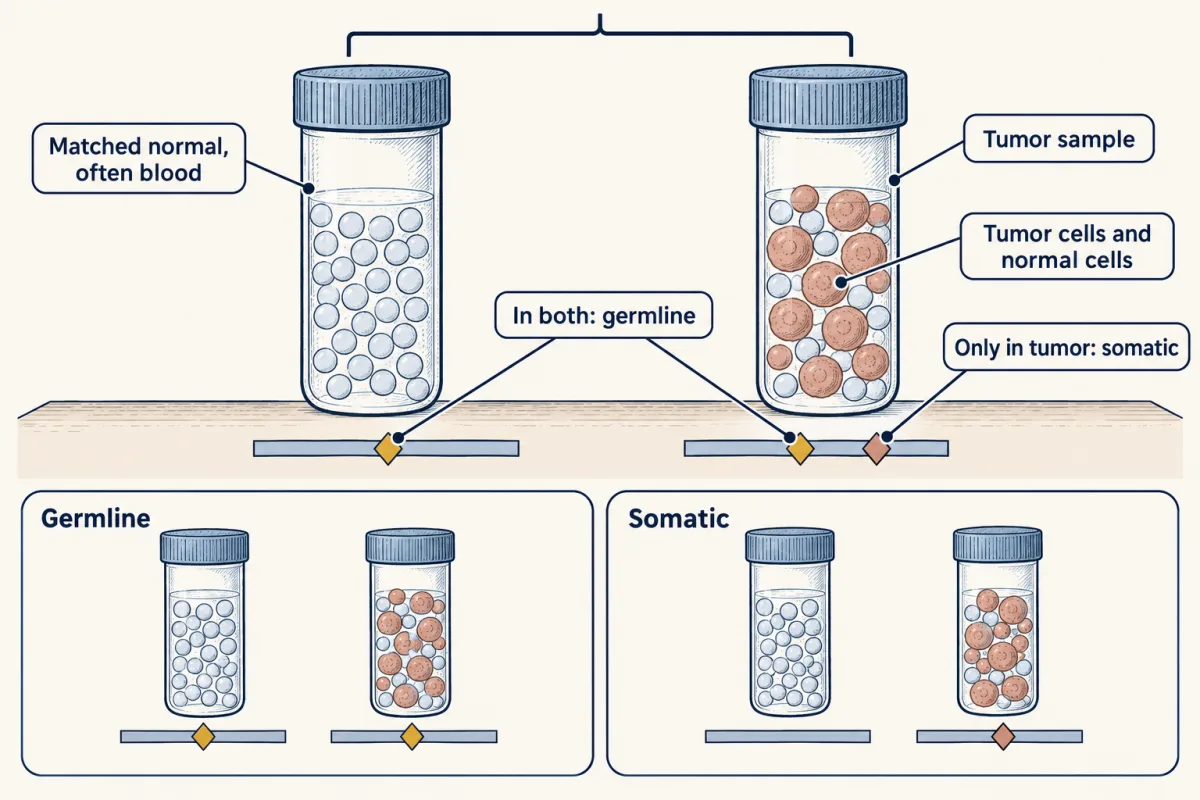
Tumor and matched-normal sequencing separates variants seen in both samples, which are usually germline, from variants seen only in the tumor, which are usually somatic; purity and copy number then shape the measured VAF. AI-generated illustration -
Going deeper
Where this lesson fits
Before thisReview first
- Reading Pedigrees: Human InheritanceThis course · Lesson 5
You need to read dominant inheritance and penetrance in a pedigree to see why an RB1 allele is dominant in a family.
- DNA Repair and RecombinationThis course · Lesson 15
Mismatch repair, BRCA and double-strand break repair explain how genome instability raises the supply of mutations here.
- Mutation: Where Variation Comes FromThis course · Lesson 14
Mutation supplying variants that selection then sorts is the logic behind tumor lineages expanding.
After thisStudy next
- Recombinant DNA, Cloning and PCRThis course · Lesson 22
PCR and cloning are tools used to detect and confirm cancer-gene variants like those found in tumors.
- Sequencing and GenomesThis course · Lesson 23
Reading variant fractions in tumor and matched-normal data uses the sequencing methods taught there.
- Population Genetics: Hardy-Weinberg and Evolutionary ForcesThis course · Lesson 25
Selection acting on variants within lineages here is taken further as allele frequency change in populations.
Elsewhere on the siteFilms, simulations and method films in other courses
- Sealed or TornFilm · Cell Biology
It shows how apoptosis, the process p53 can trigger, takes a damaged cell apart.
Suggested by an AI model from the lessons themselves, then checked. How we use AI