Biochemistry · Skim version
The Calvin Cycle: Fixing Carbon from Thin Air
Read the full lesson → Skim the whole course →
The guiding idea
Most of the carbon in the sugars, proteins, and DNA of living things was first fixed from CO2 by this loop.
The Calvin cycle is the chemistry that builds you.
From the film
- Rubisco joins one CO₂ to five-carbon RuBP, yielding two 3-PGA.
- Over three steady-state turns, five of six G3P rebuild RuBP; one is net.
- At steady state, the ordinary C3 cycle costs 3 ATP and 2 NADPH per CO₂.
- Rebuilding RuBP explains why ATP demand exceeds NADPH demand.
-
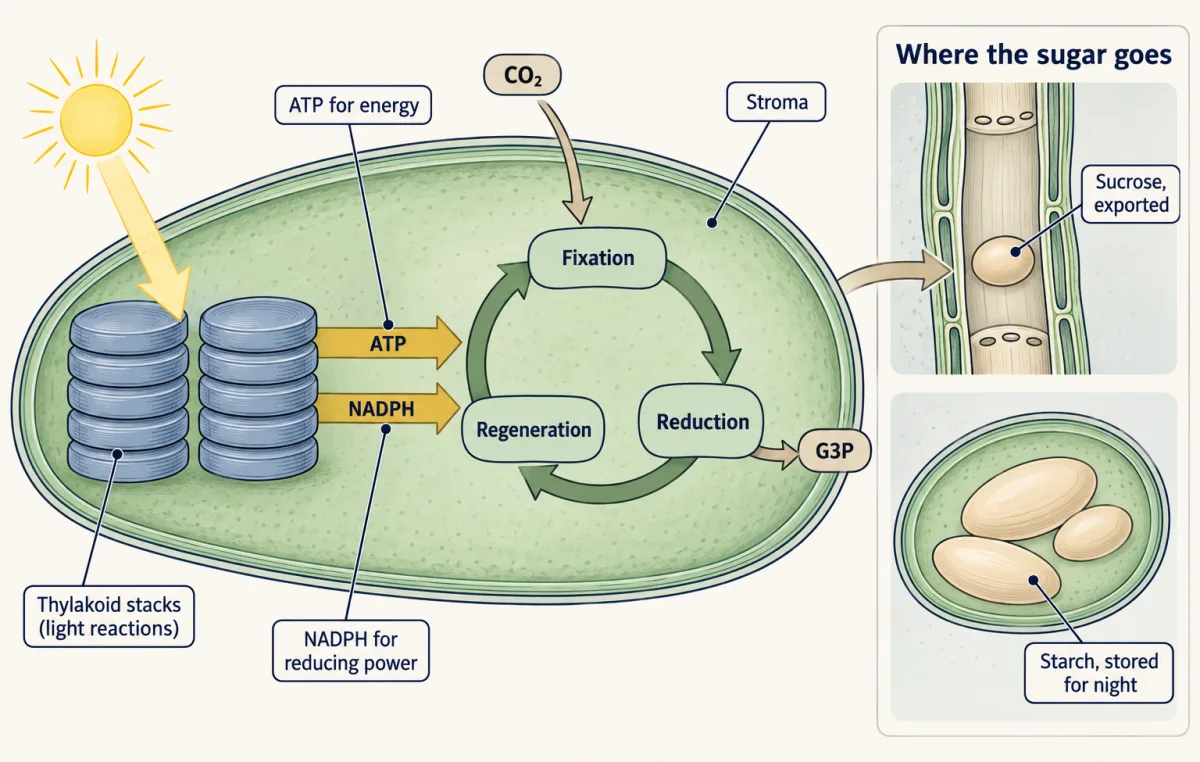
The Calvin cycle runs in the chloroplast stroma, using ATP for energy and NADPH for reducing power from the light reactions. Its triose-phosphate product can supply starch synthesis inside the chloroplast or cross the envelope for sucrose synthesis in the cytosol; sucrose is then transported through the phloem. AI-generated illustration -
Act 1, the first clue: a three-carbon acid
-
Count the carbons, and the bill follows
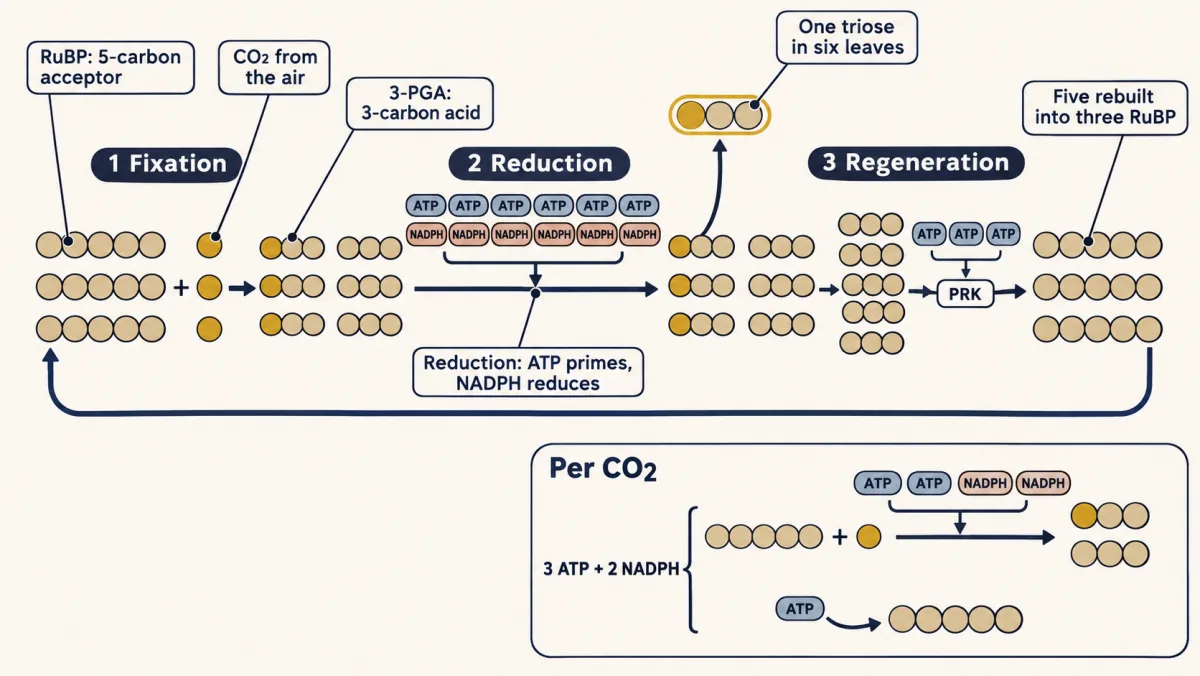
Count the carbons and the bill follows. Three turns take in 3 carbons from the air and make six trioses (18 carbons). Five trioses (15 carbons) must be rebuilt into the three RuBP acceptors, so only one leaves as profit. Per CO2, two 3-PGA each need 1 ATP and 1 NADPH, and one RuBP needs 1 ATP to rebuild: 3 ATP + 2 NADPH. AI-generated illustration -
Switch off the light, or the CO₂
-
Act 2: the control panel runs on light
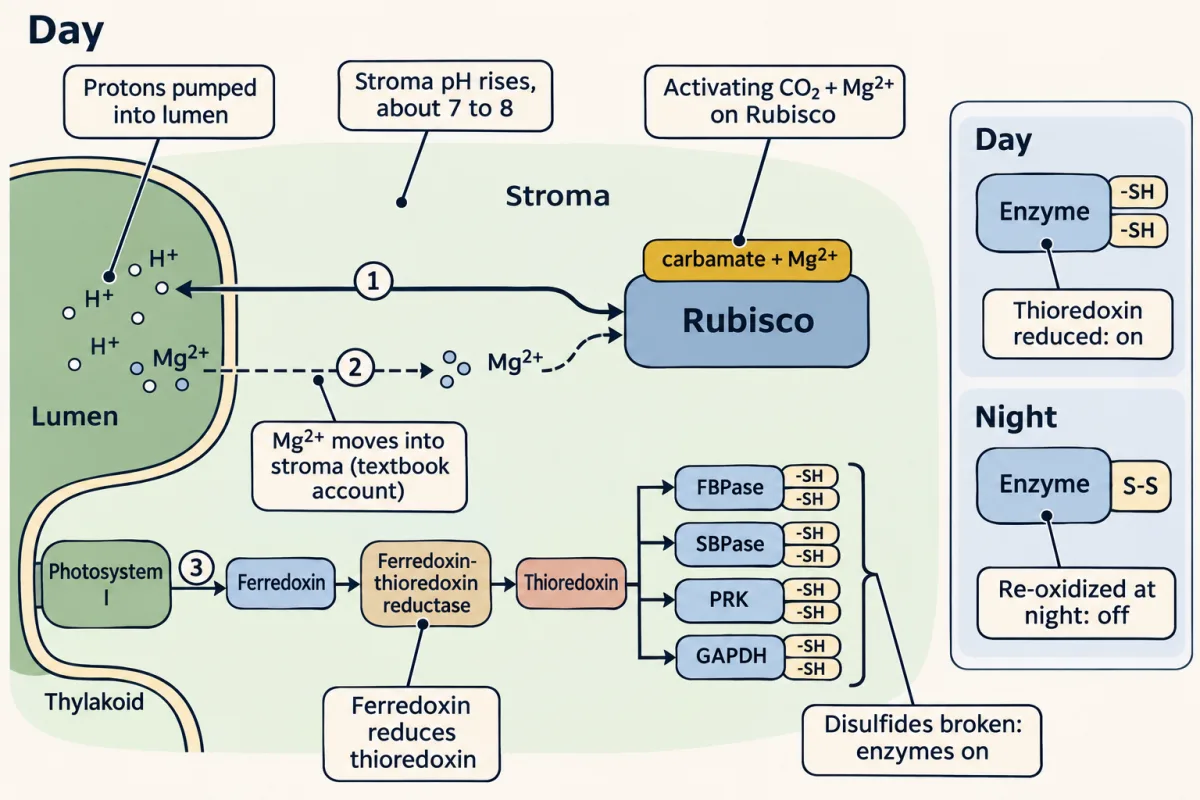
Light flips three switches in the stroma. Proton pumping raises stromal pH, and in the textbook account Mg2+ moves into the stroma; both help a separate, activating CO2 and Mg2+ build Rubisco's working site. Reduced thioredoxin breaks regulatory disulfides on four Calvin enzymes. At night thioredoxin is re-oxidized, the disulfides reform, and the cycle stalls. AI-generated illustration -
Photorespiration: the ledger broken
-
C4 and CAM: paying for a CO₂ pump
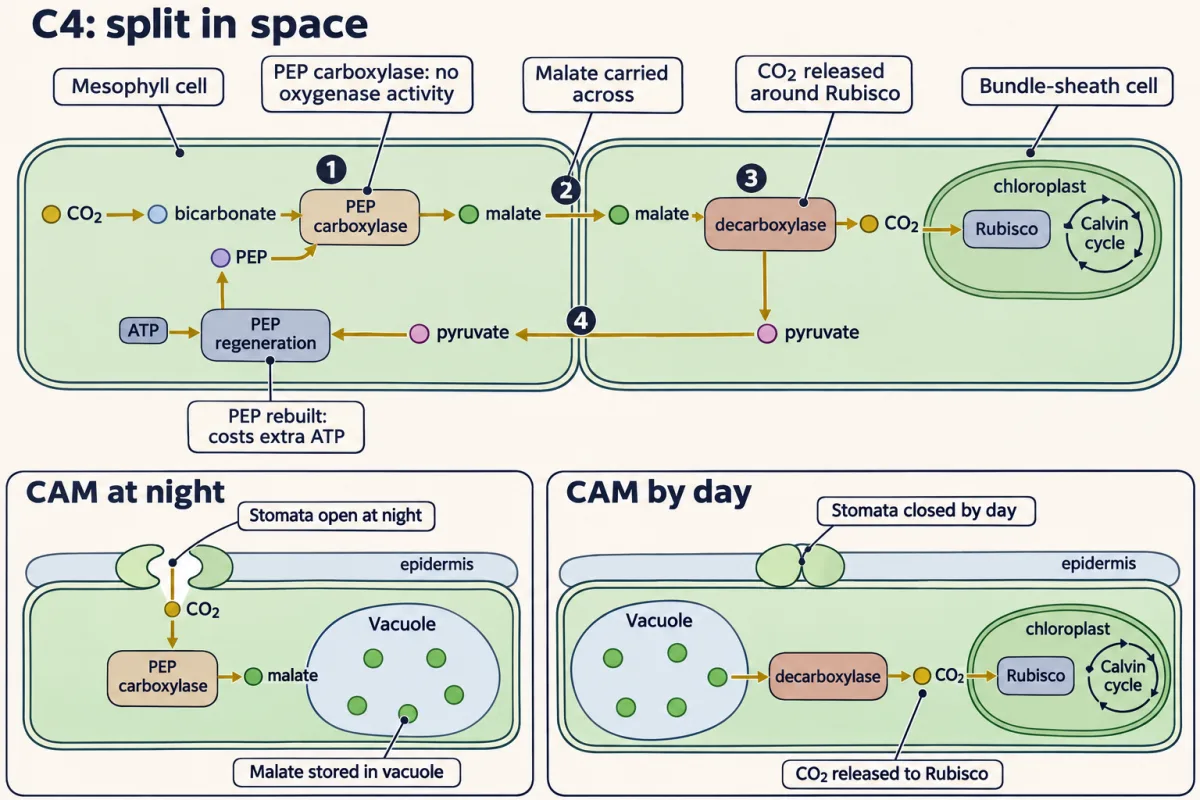
Two ways around Rubisco's flaw. C4 plants split the work in space: PEP carboxylase captures CO2 in mesophyll cells, malate carries it to bundle-sheath cells, where it is released around Rubisco, and pyruvate returns to rebuild PEP at an extra ATP cost. CAM plants split it in time, fixing CO2 into malate at night and releasing it to Rubisco by day behind closed stomata. AI-generated illustration -
Going deeper
Where this lesson fits
Before thisReview first
- Photosynthesis: The Light ReactionsThis course · Lesson 22
This lesson spends the ATP and NADPH that the light reactions make, and uses their ferredoxin-thioredoxin signal.
- Basic Concepts of Enzyme ActionThis course · Lesson 7
You need to know how enzymes speed a reaction, to follow how Rubisco makes its cut without spending ATP.
- Glycolysis: The Investment-and-Payoff PathwayThis course · Lesson 16
The reduction stage runs two glycolysis steps backward, so you need those steps and the triose sugars from there.
After thisStudy next
- The Pentose Phosphate Pathway: NADPH and Five-Carbon SugarsThis course · Lesson 24
It runs the same transketolase carbon shuffles in reverse to make NADPH and ribose-5-phosphate.
- Integration of Metabolism: How the Body Switches FuelsThis course · Lesson 30
It shows how light-driven carbon fixation and the sugar it makes fit into the whole body's fuel switching.
Elsewhere on the siteFilms, simulations and method films in other courses
- A Tree Made of AirFilm · Biology
It shows how carbon from air becomes glucose and why atoms are conserved, the carbon count used here.
- What Becomes a Tree?Film · Life Science
It shows light powering sugar-building from carbon dioxide and water, the job this cycle does.
- Pulled From the TopFilm · Organismal Biology
It shows why leaf pores that take in carbon dioxide also lose water, which is why C4 and CAM matter.
Suggested by an AI model from the lessons themselves, then checked. How we use AI