Physiology · Skim version
Regulating Arterial Pressure
Read the full lesson → Skim the whole course →
The guiding idea
A reflex pushes back on every change in arterial pressure within seconds. Cut its nerves in a dog, and what happens to the daily average?
Resting arterial pressure in an adult human sits in a narrow band, yet the reflex that pushes back on a fall acts in seconds and the kidney that sets the level takes days.
-
The fast buffer: the baroreflex
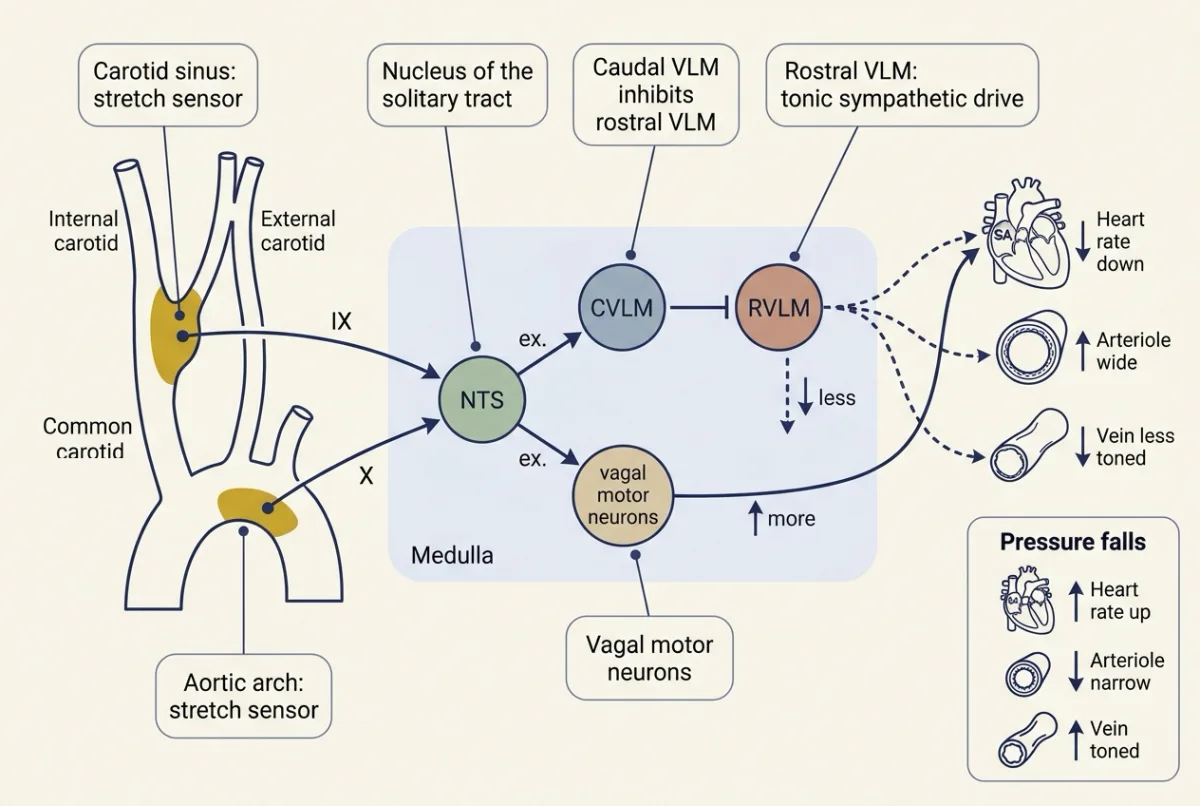
When pressure rises, the solitary nucleus turns sympathetic drive down and vagal drive up, so heart rate, resistance and venous tone all fall; a fall in pressure reverses every arrow, within seconds. AI-generated illustration -
The slow setter: the kidney balances salt
-
How the curve gets moved
-
One reflex, three tests
-
Does the reflex also set the level?
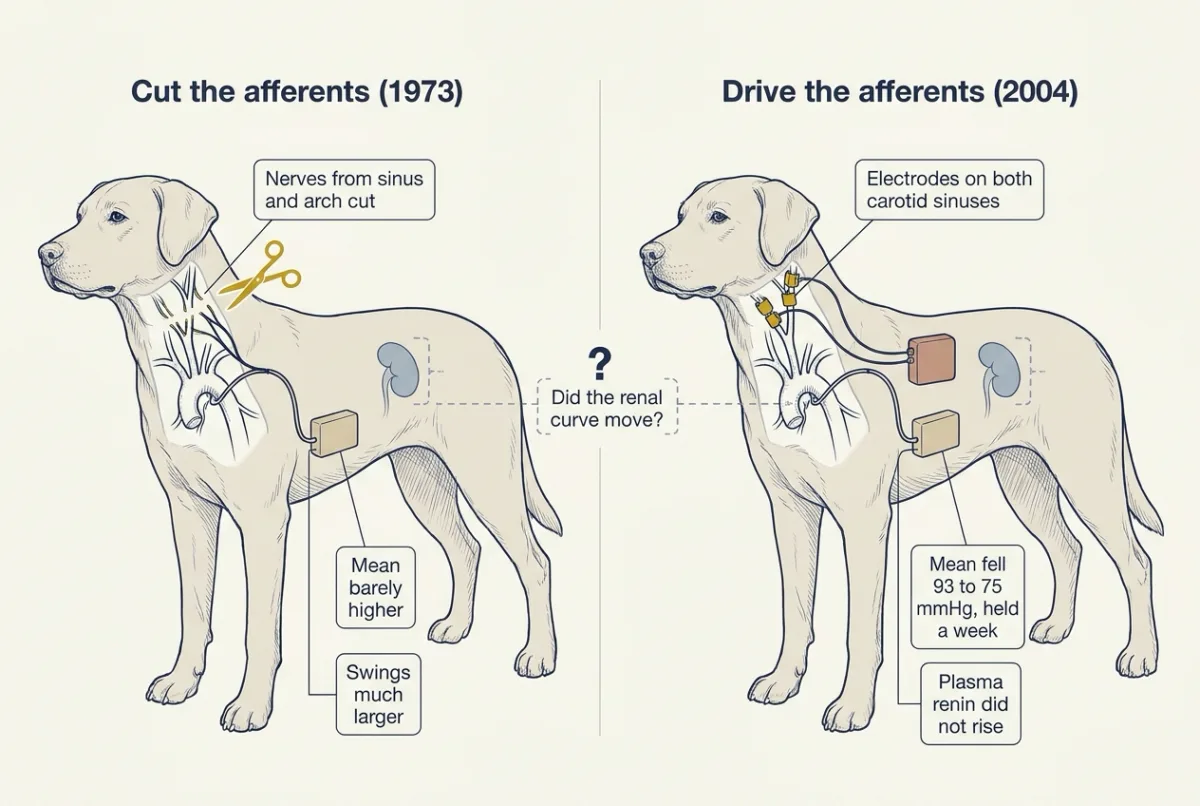
Cutting the reflex's afferents mainly enlarged the swings, while driving them held pressure lower for a week, so afferent input can lower pressure, but whether the intact reflex sets the long-term level is still open. AI-generated illustration -
Why some pressures stay high
-
Going deeper
Where this lesson fits
Before thisReview first
- Cardiac Output and Venous ReturnThis course · Lesson 7
This lesson uses how falling volume lowers venous return and cardiac output, and how that changes arterial pressure.
- Resistance, Compliance and Local Blood FlowThis course · Lesson 8
Mean arterial pressure as cardiac output times peripheral resistance, and how vessels set resistance, is used throughout.
- Body Water and Its CompartmentsThis course · Lesson 1
Salt and water retention changing extracellular volume is the slow setter of pressure here.
After thisStudy next
- Exercise: The Whole Body at WorkThis course · Lesson 30
Exercise tests the baroreflex and cardiovascular control, with resetting and sympathetic drive, in the whole body.
- Water, Sodium and Potassium BalanceThis course · Lesson 17
It takes the renal handling of sodium and water, which sets the pressure level here, further.
- Pregnancy, Birth and LactationThis course · Lesson 29
Pregnancy shows pressure and volume control shifting, with the renal setting moved, in a real physiological state.
Elsewhere on the siteFilms, simulations and method films in other courses
- Every Response Has a Running TimeFilm · Organismal Biology
It traces a reflex route from receptor through integrating centre to effector, the same path layout the baroreflex follows.
- Leak and Push-BackFilm · Organismal Biology
It shows a push-back response holding a variable steady, which is the idea of negative feedback gain used here.
Suggested by an AI model from the lessons themselves, then checked. How we use AI