Leak and Push-Back
Read the transcript of “Leak and Push-Back”
Film transcript: Leak and Push-Back
In a room hot enough to cook an egg, why didn't the man cook? In 1775, Charles Blagden sat in a room heated close to the boiling point of water. On another visit, eggs in that room roasted hard. Start with the egg. Hot air pours heat into it. Nothing pushes back. So the egg keeps warming toward the air's temperature. It cooks along the way. Now the man. The same air pours heat into him. Call that flow the leak. Yet the thermometer under his tongue barely moved. It stayed about one degree above his usual. Something in his body pulled the other way. Call it push-back. Leak drags the inside toward the outside. Push-back drags it toward a fixed value.
Push-back comes from a loop with five parts. First, the regulated variable, the quantity being held. Here it is core body temperature. Second, the set point, the reference value it is held around. Third, the sensor, which measures the variable.
Temperature-sensitive nerve cells in the skin and brain do this. Fourth, the integrator, a region of the brain called the hypothalamus. It compares the sensed value with the set point and sends out a command. Fifth, the effectors, which change the variable. As he warms, skin blood vessels widen and carry heat to the surface.
Sweat glands release sweat, which removes heat as it evaporates. Cool him instead, and other effectors take over. Skin vessels narrow to keep heat in, and muscles shiver. Either way, the push points back toward the set point. That is negative feedback. So how far does the inside follow the outside? That depends on how strong push-back is compared with leak.
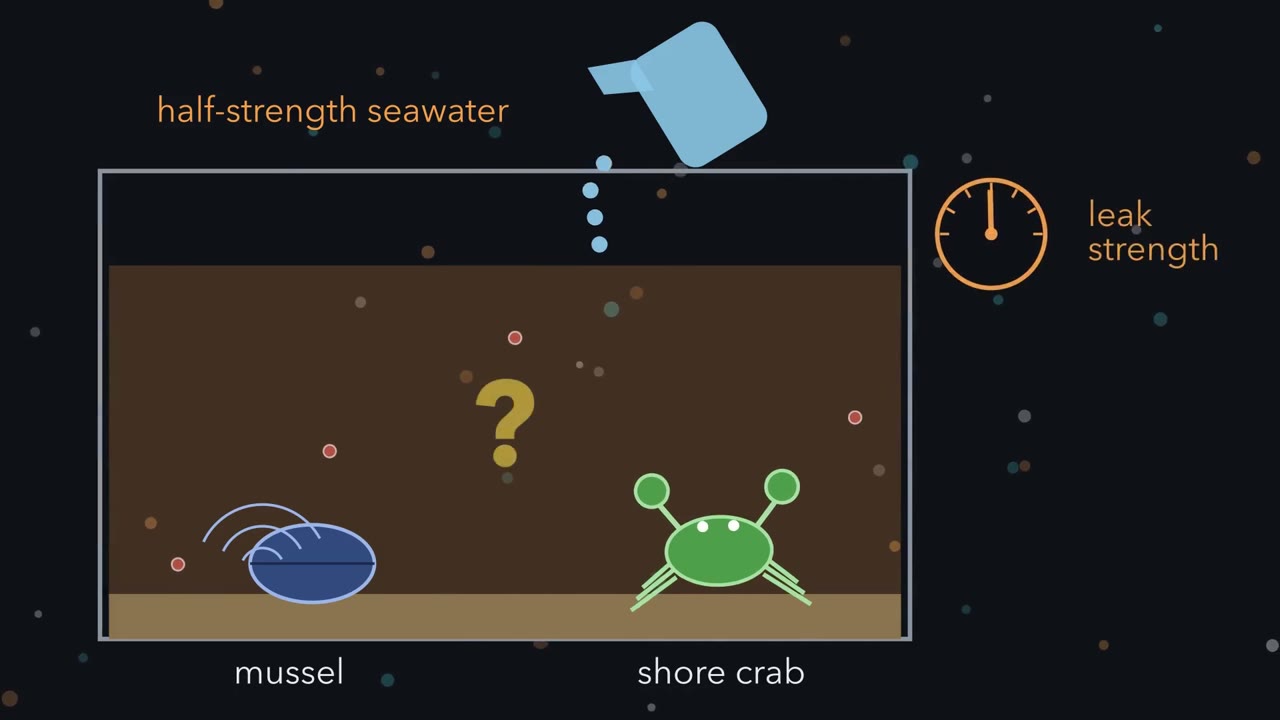
Strength means the pull for each degree of gap. Set the two dials equal, so push-back is exactly as strong as leak. Then raise the outside by ten degrees. Does the inside follow all of it, half, or none? Half. In this simple model, the two pulls always balance once the inside settles. With equal strengths, they balance when the two gaps are equal, halfway. Turn push-back strength down to zero, and the inside follows the outside completely, like the egg. That end of the dial is a conformer. Turn push-back strength far above leak strength, and the inside barely moves. That end is a regulator. Back to the hot room. Blagden's body pushed back, so his temperature barely moved.
The trials lasted minutes, so they show push-back, not its strength. The egg had no push-back at all.
In a room heated to about 93 degrees C, close to the boiling point of water, the thermometer under a man’s tongue barely moved. What was holding it there?
Continue in the lesson: Tissues, Organs and Homeostasis →
3:23 · Free, with captions and a transcript. The lesson has the full text, the questions and the sources.
More films from this lesson
How this film was made. Narration: written from this lesson's text and read by an AI narrator voice (Kokoro, af_heart). Animation: AI-generated in code (Manim) by Claude, a schematic with no drawn molecular structures. Captions come from the narration script. See something wrong? Report it.