Genetics and Molecular Biology · Skim version
Bacterial and Phage Genetics: Conjugation, Transduction and Transformation
Read the full lesson → Skim the whole course →
The guiding idea
Two E. coli strains that each cannot make several nutrients are mixed. A few cells can now make them all. Where did the genes come from?
How donor DNA travels determines the map: ordered arrival maps gene order and time gaps map distance (for Hfr transfer at a roughly steady rate); shared carriage maps proximity because closer genes travel together more often (for generalized transduction).
From the film: From DNA Route to Gene Order
- For Hfr transfer, ordered arrival maps gene order; if transfer is roughly steady, time gaps map distance.
- Transformation uses free DNA, conjugation needs contact, and transduction uses a phage.
- A filter tests for cell contact; DNase tests for exposed DNA.
- A recovered recombinant reports entry, integration and expression.
From the film: When Genes Share a Phage
- Shared carriage maps proximity; closer genes travel together more often.
- Generalized transduction can carry any short region of the host chromosome.
- Specialized transduction carries genes beside a phage's attachment site.
- Frequencies against one selected marker rank proximity but cannot place genes left or right; three-factor classes settle the order.
-
Three routes, two tests
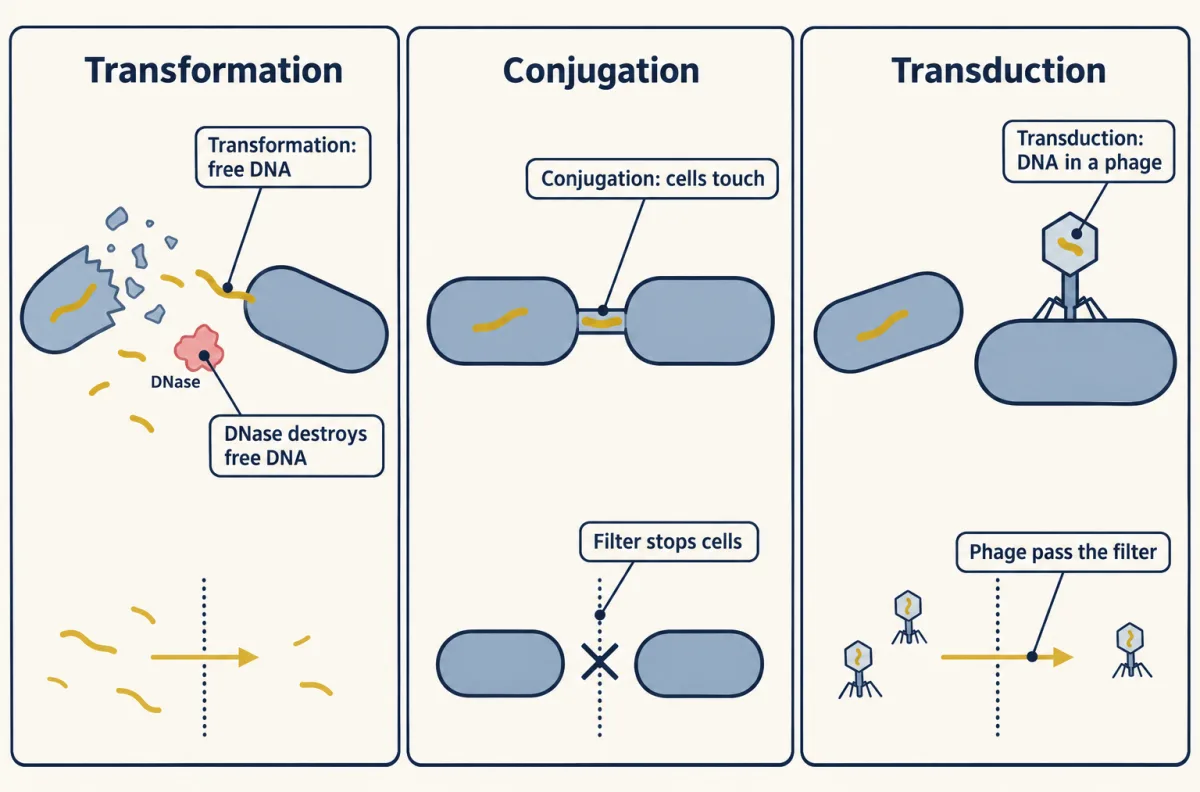
A filter tests for cell contact; DNase tests for exposed DNA. A phage coat protects transduced DNA from DNase. AI-generated illustration -
Conjugation: a chromosome enters in order
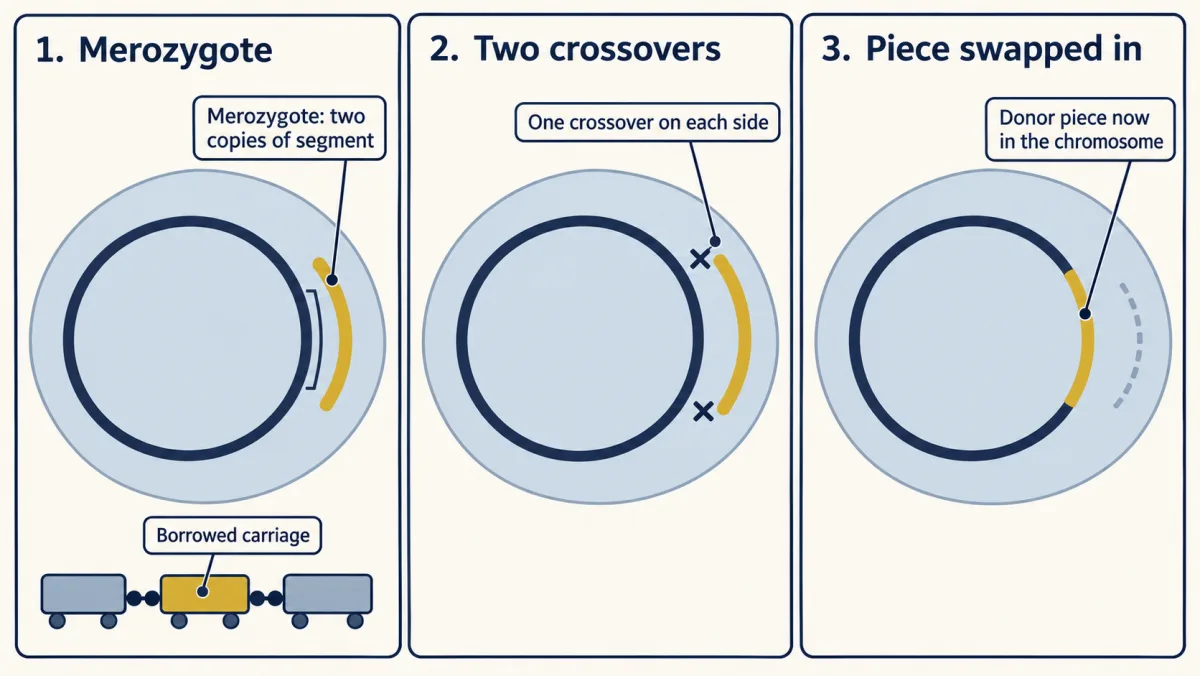
For a matching linear chromosome fragment, recombination on both sides replaces one recipient segment while preserving a circular chromosome, like a borrowed carriage that stays only when coupled on both sides. AI-generated illustration -
Transduction: host DNA inside a phage
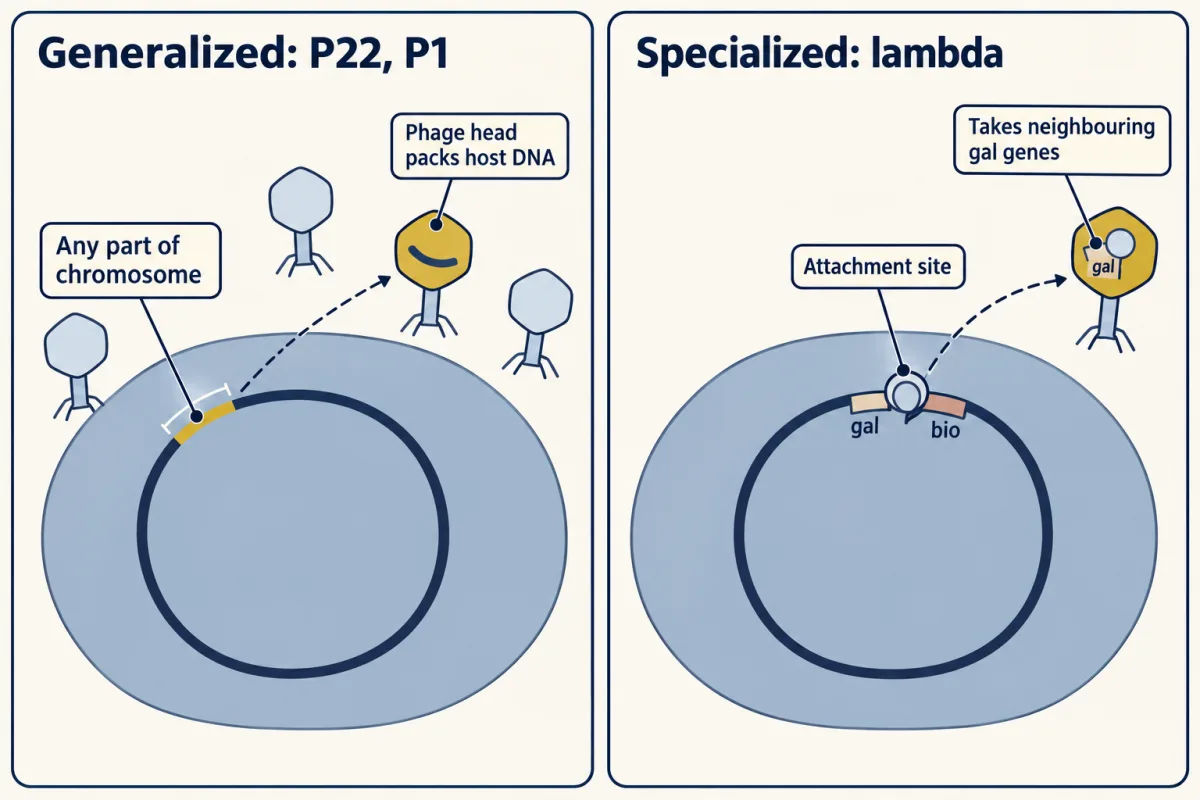
Generalized transduction can carry any short region of the host chromosome, whereas specialized transduction carries genes beside a phage's attachment site. AI-generated illustration -
Why bacteria and phage made genetics fast
-
Going deeper
Where this lesson fits
Before thisReview first
- Linkage and Recombination MappingThis course · Lesson 8
You need to know how recombination frequency turns into map distance before reading distances from entry times.
- Chromosomes and Meiosis: The Physical Basis of Mendel's LawsThis course · Lesson 2
You need the idea of crossing over between homologous DNA to see how an incoming piece gets integrated.
After thisStudy next
- DNA Is the Genetic MaterialThis course · Lesson 12
Griffith's transformation, only mentioned here, is worked through as evidence that DNA carries the heredity.
- DNA Repair and RecombinationThis course · Lesson 15
The recombination machinery that integrates incoming DNA, such as the recB-dependent steps, is explained there.
- Recombinant DNA, Cloning and PCRThis course · Lesson 22
Plasmids and selectable resistance markers from bacterial genetics become the tools for cloning DNA.
Suggested by an AI model from the lessons themselves, then checked. How we use AI