Press play to start at .
A Voltage With Passengers
From the film
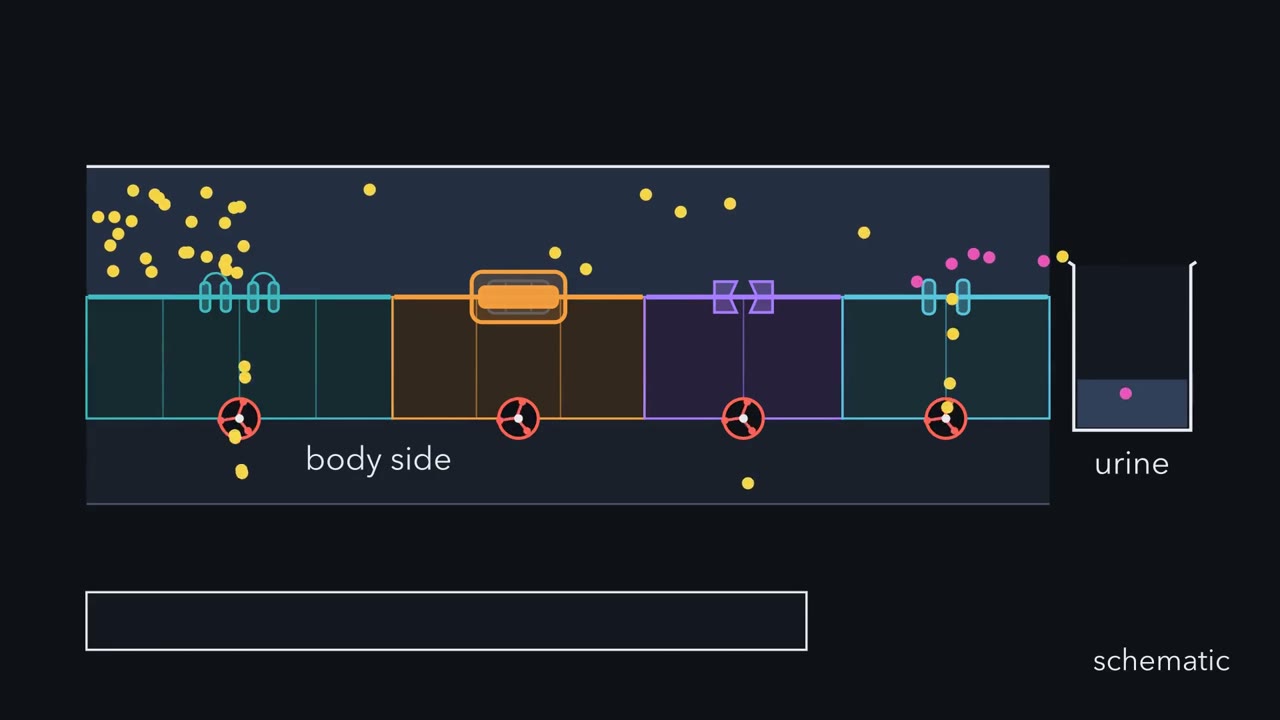
- In isolated rabbit thick limbs, salt left the fluid, water stayed, and the lumen sat about 7 millivolts positive.
- NKCC2 moves no net charge; chloride leaving to the blood and potassium recycling to the lumen through ROMK make the voltage.
- The positive lumen pushes cations between the cells, and pushes two-charge calcium and magnesium twice as hard.
- Textbook estimates credit the thick limb with about 60 to 70 percent of filtered magnesium and 20 to 25 percent of filtered calcium.
- Block a door whose segment builds a voltage, and the ions that voltage moved move much less.
Read the transcript of “A Voltage With Passengers”
Film transcript: A Voltage With Passengers
Tap a sentence to play from there.
- 0:00 Sodium that a blocked door missed flowed on, and cost potassium downstream.
- 0:06 But furosemide also raises urinary calcium, and its door carries no calcium.
- 0:12 So how?
- 0:16 In 1973, Rocha and Kokko held single rabbit thick limbs on glass pipettes.
- 0:24 Salt left the fluid, but water stayed.
- 0:27 And the lumen sat positive, about 7 mV.
- 0:31 Its door, NKCC2, carries one sodium, one potassium and two chlorides together.
- 0:38 That is no net charge.
- 0:40 So where does the voltage come from?
- 0:43 Follow each ion out.
- 0:46 Sodium leaves toward the blood through the pump.
- 0:49 Chloride leaves toward the blood through chloride channels.
- 0:53 Negative charge has crossed to the blood side.
- 0:56 Now potassium. Tubular fluid holds little of it, compared with sodium and chloride.
- 1:04 So how does this door keep getting the potassium it needs?
- 1:13 It recycles. Most of the potassium goes back into the lumen, through the potassium channel ROMK. Positive charge returns to the lumen side.
- 1:25 Negative charge goes to the blood, and positive charge goes back to the lumen.
- 1:31 So the lumen ends up a few millivolts positive.
- 1:35 The circuit around the door makes the voltage.
- 1:38 The junctions between these cells let cations through.
- 1:43 The positive lumen pushes them out between the cells, toward the blood.
- 1:48 Calcium and magnesium carry two charges each, so they are pushed twice as hard.
- 1:53 At +7 mV, voltage alone could hold a one-charge ion in the lumen near 77% percent of its blood level. A two-charge ion, about 59%.
- 2:05 percent. That is a limit, not a measurement.
- 2:09 That is why this segment matters for magnesium most of all.
- 2:14 Textbook estimates credit it with about 60–70% of filtered magnesium.
- 2:21 For calcium, the estimate is about 20–25%.
- 2:25 Here is the one idea.
- 2:28 A door can move ions it never carries, if its segment builds a voltage.
- 2:34 Block that door, and the voltage's passengers move much less.
- 2:38 That is how furosemide, blocking a sodium door, ends up raising urinary calcium.
- 2:45 The proximal tubule also takes back calcium between its cells, more than the thick limb does. This rule leaves that out.
- 2:54 So look past what a door carries.
- 2:57 Ask what voltage its segment was building, and which ions that voltage moved.
The kidney: the same idea, other levels
A level is a place to start, not a rank. If this loses you, the rung below teaches the same idea, told more simply.
College, upper level · the level you chose
Glomerular Filtration and Renal Blood Flow
Two arterioles set filtration: GFR about 125 mL per min, filtration fraction 0.2.
Physiology · about 30 min · film 3:18 · 8 practice questions
Tubular Transport, Segment by Segment · this lesson
NKCC2, NCC and ENaC doors: block one and calcium and potassium shift.
Physiology · about 33 min · film 3:04 · 6 practice questions
College, a first course · the level you chose
Filter 180 litres of plasma, take back about 99%: the nephron's ledger.
Organismal Biology · about 20 min · film 3:26 · 6 practice questions
Play the ladder · 4 films, about 13 min, from a first college course to upper-level college. Each film waits for you to press play.
Next door
- Water and salt balance: Two Loops, One Ratio · 3:22 The kidney is the organ that fixes how much water and salt leaves the body, so fluids stay steady.
- Acid-base balance: Acid-Base Balance The kidney removes acid and rebuilds bicarbonate, which keeps blood pH near 7.4.
- Red blood cells: Blood Cells, Hematocrit and Clotting The kidney senses oxygen in the blood and tells the bone marrow how many red cells to make.
More films from this lesson
Continue in the lesson: Tubular Transport, Segment by Segment →
Free, with captions and a transcript. The lesson has the full text, the questions and the sources.
How this film was made. Narration: an AI narrator voice (Kokoro, af_heart) reading narration written from this lesson's text. Animation: AI-generated in code (Manim) by Claude, a schematic with no drawn molecular structures. Captions come from the narration script. See something wrong? Report it.