Neuroscience · Skim version
Visual Cortex
Read the full lesson → Skim the whole course →
The guiding idea
Cut one optic nerve and one eye goes blind. Cut one optic tract and both eyes lose the same half of the world. Why the difference?
Approximately, many early visual neurons add up the light in their own patch of the world, counting ON regions as plus and OFF regions as minus, then turn the sum into firing through a threshold.
From the film: Adding Up the Light
- Add up the light in a cell's patch of the world, counting ON regions as plus and OFF regions as minus.
- A bigger sum means stronger drive, a sum near zero leaves the spontaneous rate, and a negative sum lowers firing.
- This is a good first approximation for many cells in the retina and thalamus and for simple cells in cortex.
From the film: Why a Bar Beats a Spot
- A bar along a simple cell's ON strip collects plus all along it, so it beats a small spot.
- Orientation selectivity comes, to a first approximation, from the shape of the receptive field, and a threshold sharpens it further.
- Hubel and Wiesel suggested that geniculate cells with ON centres in a row feed one cortical cell, though how the flanks are built is less settled.
From the film: Anywhere in the Field, and Columns
- A complex cell keeps its preferred angle but tolerates changes in position, which one sum cannot explain.
- Hubel and Wiesel proposed that complex cells pool simple cells of one angle at slightly different places, though this step is still debated.
- In cat and monkey, cells down a vertical track tend to share an angle, but in rat cortex sharply tuned cells sit among neighbours with unrelated preferences, so tuning does not need a map.
-
Two puzzles and one rule
-
Where: every fibre reports one patch of the world
-
What: adding up the light
-
Why a bar beats a spot
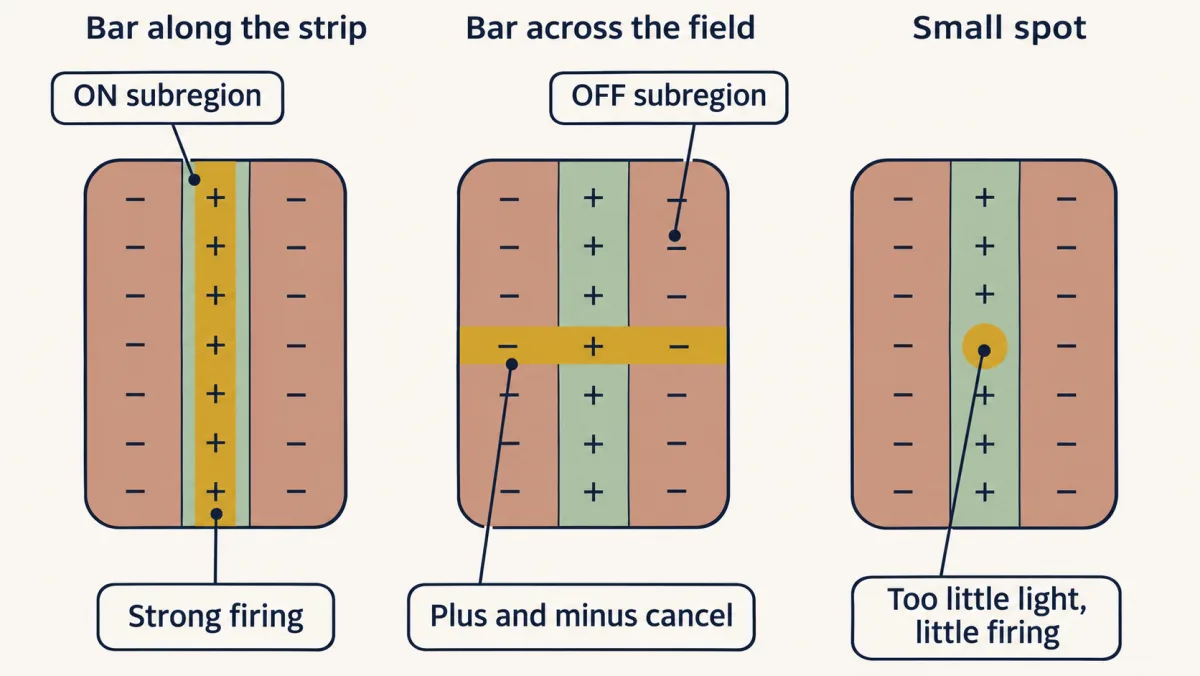
For a simple cell, a bar along the ON strip drives it hard, while a bar across the field, where plus and minus cancel, or a small spot does little. AI-generated illustration 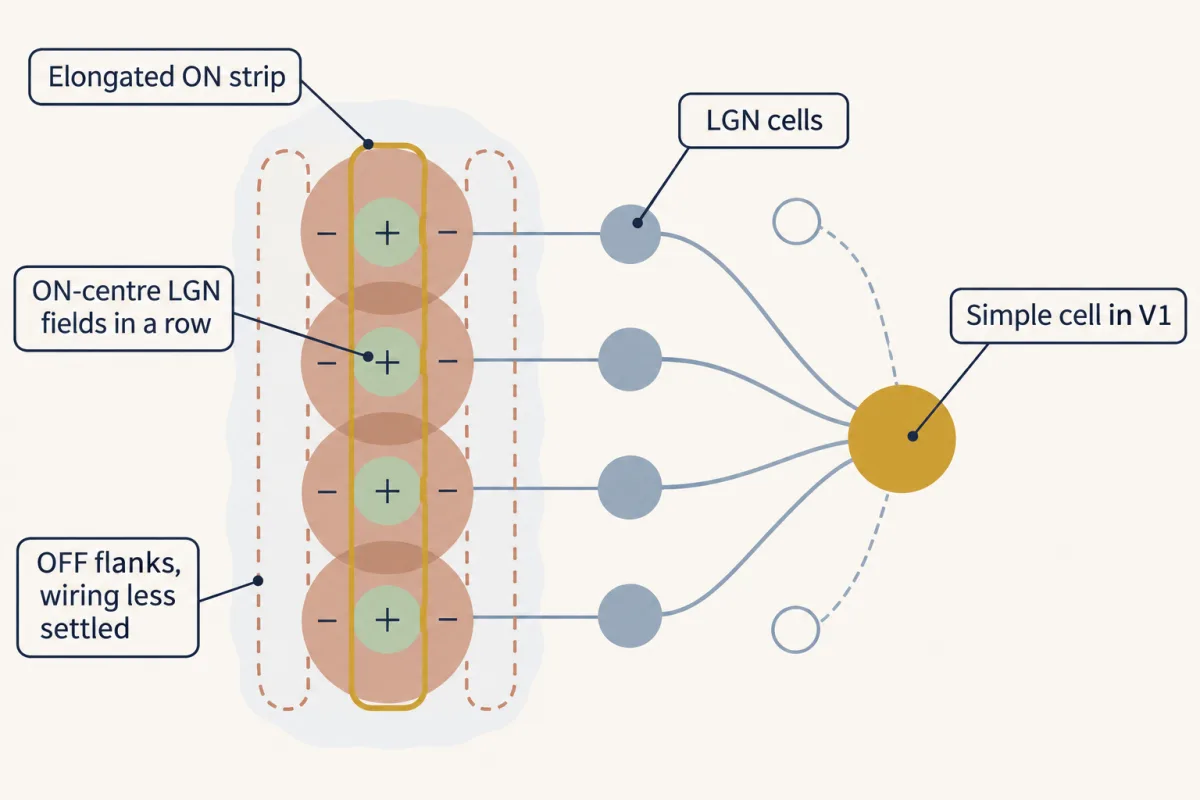
In Hubel and Wiesel's proposal, LGN cells with ON centres in a row converge on one simple cell to build its elongated ON strip; how the OFF flanks are wired is less settled. AI-generated illustration -
Beyond one sum: complex cells
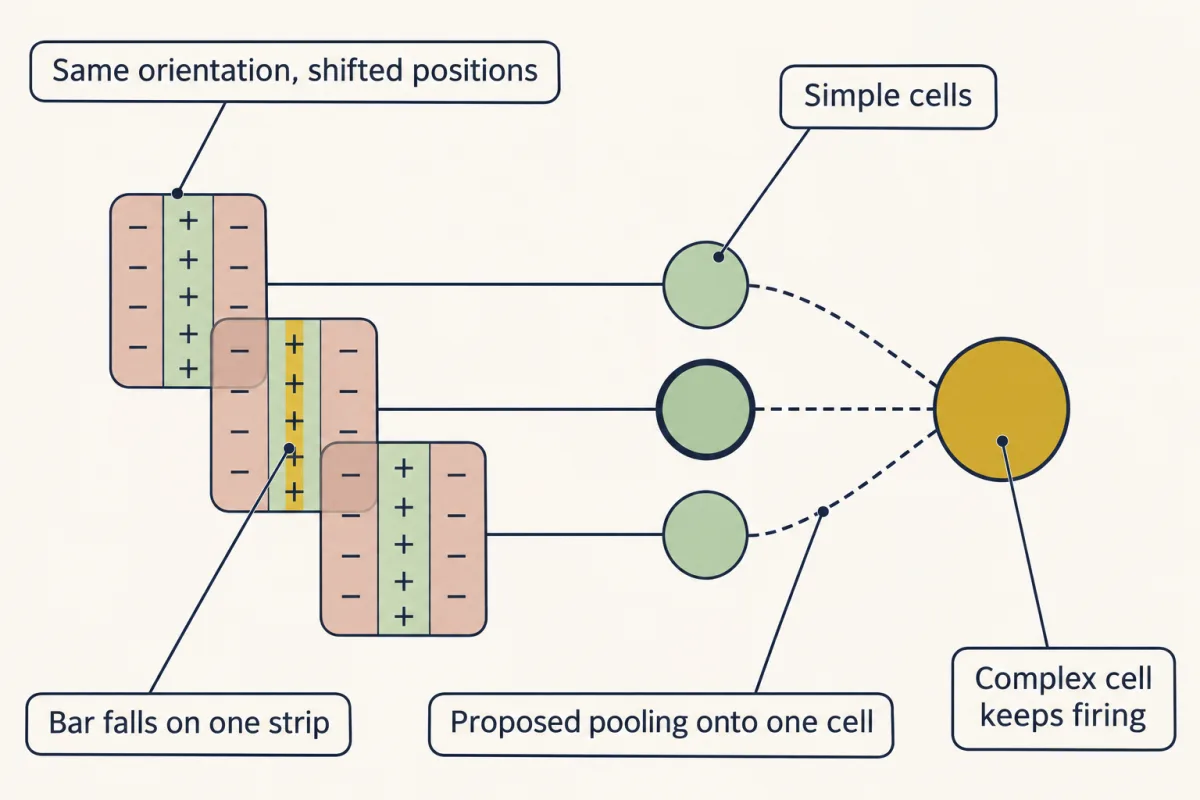
Hubel and Wiesel proposed that a complex cell pools simple cells of one orientation at shifted positions, so it keeps firing wherever the bar falls; how far every complex cell follows this is debated. AI-generated illustration -
The map: retinotopy, magnification and columns
-
Beyond V1: two streams
-
Going deeper
Where this lesson fits
Before thisReview first
- The Map: How the Nervous System Is OrganizedThis course · Lesson 1
You need the lesion logic and the map of pathways from there to predict what a cut removes.
- Principles of Sensory CodingThis course · Lesson 9
Receptive fields and lateral inhibition there set up the ON and OFF centre-surround idea this lesson builds on.
- The RetinaThis course · Lesson 10
The ON-centre and OFF-centre ganglion cells there are the inputs whose signals cortex adds up here.
After thisStudy next
- Attention, Executive Control and DecisionsThis course · Lesson 25
It returns to the dorsal and ventral streams and asks what higher visual areas do with attention.
- Recording Many Neurons: Imaging, Arrays and AtlasesThis course · Lesson 27
It shows how recording thousands of cells tests tuning and column maps like those seen in cat, monkey and rat.
- Plasticity, Networks and ConsolidationThis course · Lesson 23
Its optogenetic tagging of cells links to the ventral stream's route toward object memory.
Elsewhere on the siteFilms, simulations and method films in other courses
- Lineage tracingMethod film
Following transmitted marks along axons is how tract routes are traced; this lesson uses the pathway they reveal.
- One Cell, Two EyesFilm · Developmental Neuroscience
It shows how eye-specific columns in visual cortex are rewired by closing one eye.
- A Veto From the Null SideFilm · Sensory Systems
It shows a retinal cell computing a preferred direction, the kind of feature selectivity cortex builds on.
Suggested by an AI model from the lessons themselves, then checked. How we use AI