Sensory Systems · Skim version
Vagal Sensory Neurons: The Body Reports to the Brain
Read the full lesson → Skim the whole course →
The guiding idea
Light on one set of vagal sensory axons stops an anaesthetized mouse breathing, and light on another set makes it breathe fast and shallow. What does each set report, and how would you know?
To learn what a vagal sensory population does, ask three separate questions: what stimulus the cells answer, what channel turns that stimulus into current, and what output changes when you drive or remove them.
From the film: Three Questions, Not One
- To learn what a vagal sensory population does, ask three separate questions: what stimulus it answers, what channel turns that stimulus into current, and what output changes when you drive or remove it.
- Evidence for one question does not by itself answer the others.
- A genetic label is a handle on a population, not an answer about its stimulus, channel or output.
From the film: Two Ways to Stop Breathing
- Light on P2ry1 afferents suppressed breathing and light on Npy2r afferents produced rapid shallow breathing in anaesthetized mice; this shows what each population can do when driven, not what drives it in life.
- Airway protection and lung inflation are separate routes to a similar output, and most stretch-responsive neurons were Piezo2 positive and P2ry1 negative.
- An output alone does not identify which pathway produced it, so measure stimulus and output separately.
From the film: Which Channel, and What the Test Can Prove
- Deleting Piezo2 in adult mouse sensory neurons impaired the lung inflation reflex.
- For the baroreflex, deleting Piezo1 or Piezo2 alone showed no statistically detectable difference, while deleting both essentially abolished the drug-evoked reflex.
- That shows the channels are required collectively in the targeted population, not that each neuron carries both.
-
One nerve, many labelled lines: genetic access to vagal afferents
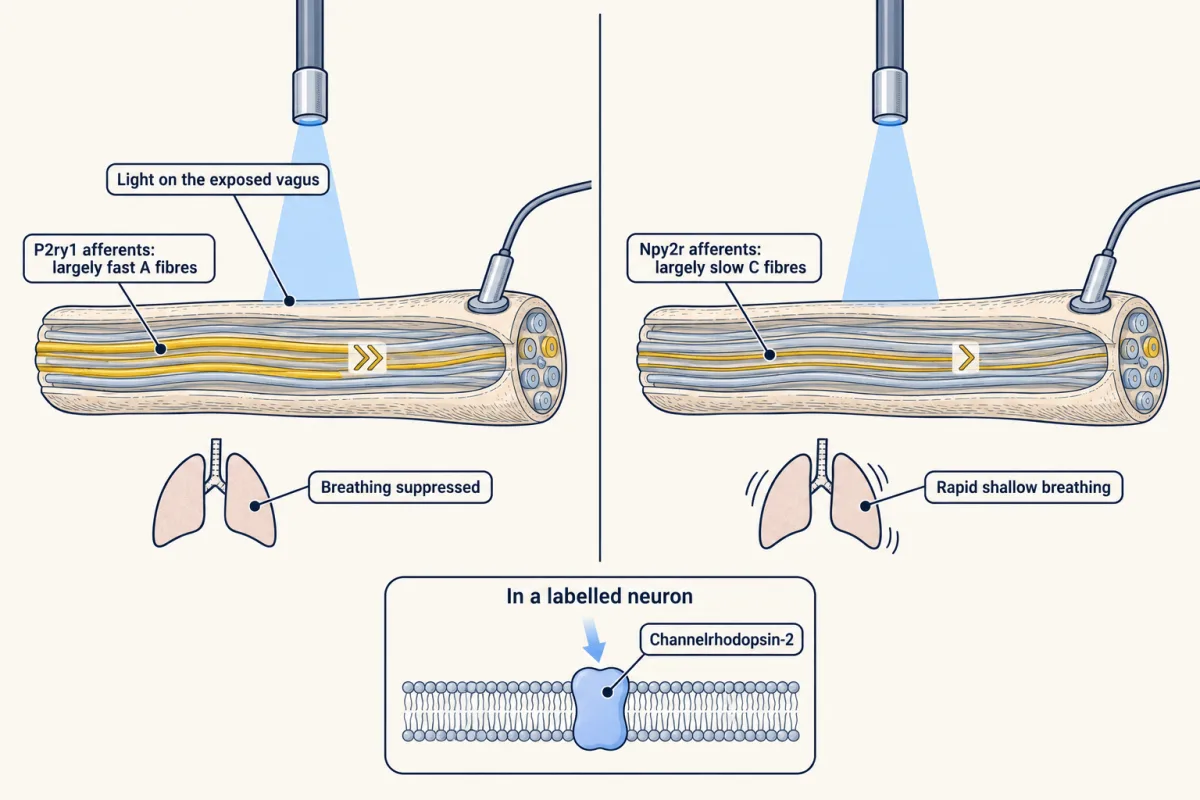
Chang and colleagues put channelrhodopsin-2 into P2ry1-labelled or Npy2r-labelled vagal neurons in mice and shone light on the exposed vagus under deep isoflurane. P2ry1 activation suppressed breathing and Npy2r activation produced rapid shallow breathing. This shows what the cells can do when driven, not what drives them in life. AI-generated illustration -
Two different populations, one outcome: breathing stops
-
What transduces force in the lung and the artery
-
A map of the organs in the brainstem, sharpened by inhibition
-
From afferent to behaviour: stretch, satiety and what the trial evidence covers
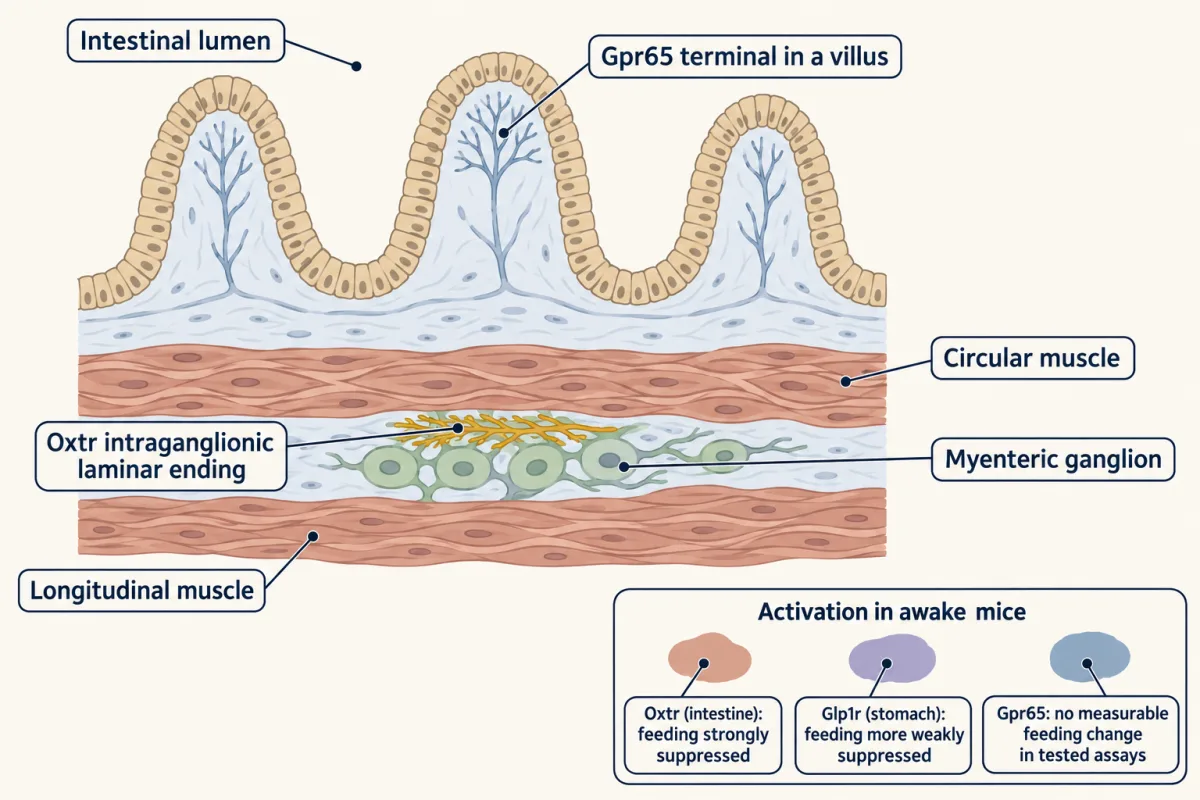
In awake mice, activating Oxtr-positive intestinal stretch afferents, whose intraganglionic laminar endings associate with myenteric ganglia between the muscle layers, strongly suppressed feeding. Activating Glp1r-positive afferents with gastric stretch endings suppressed feeding more weakly, while activating Gpr65-positive afferents, which innervate villi, did not measurably change feeding in the assays tested. The results do not exclude nutrient signalling through gut hormones. AI-generated illustration -
Going deeper
Where this lesson fits
Before thisReview first
- Piezo Channels and the Physics of ForceThis course · Lesson 2
You need to know how Piezo channels are gated by force to judge the Piezo1 and Piezo2 deletion results here.
- Sensory Neurons by Their Genes: the Atlas EraThis course · Lesson 3
The genetic labels, Cre lines and atlas clusters used for vagal populations here are introduced there.
- Five Ways to Turn a Stimulus into a CurrentThis course · Lesson 1
The question of which channel turns a stimulus into current builds on its general ways of making sensory current.
After thisStudy next
- Sensing the Gut: Enteroendocrine Cells and Nutrient SignalsThis course · Lesson 17
It takes the gut part of this lesson further, asking how gut cells and nutrient signals reach the vagus.
Elsewhere on the siteFilms, simulations and method films in other courses
- CSF turnoverSimulation · Neuroscience
It shows how the nervous system is laid out, including where vagal sensory fibres sit and project.
- What a Spike MeansFilm · Neuroscience
It shows how a sensory neuron's firing reports a stimulus, which underlies reading what a vagal population reports.
- Correction, Threshold and GainFilm · Neuroscience
It shows how autonomic control uses internal-body signals to drive corrections, the output side of vagal reports.
Suggested by an AI model from the lessons themselves, then checked. How we use AI