Correction, Threshold and Gain
Read the transcript of “Correction, Threshold and Gain”
Film transcript: Correction, Threshold and Gain
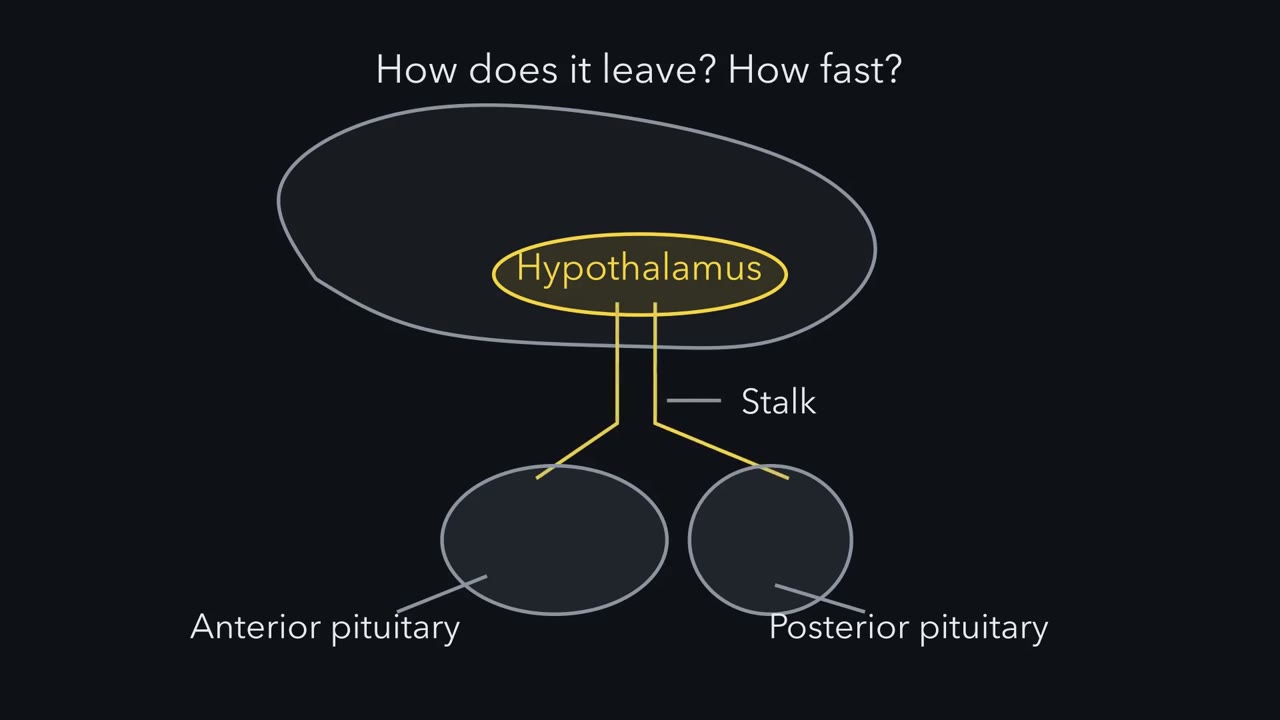
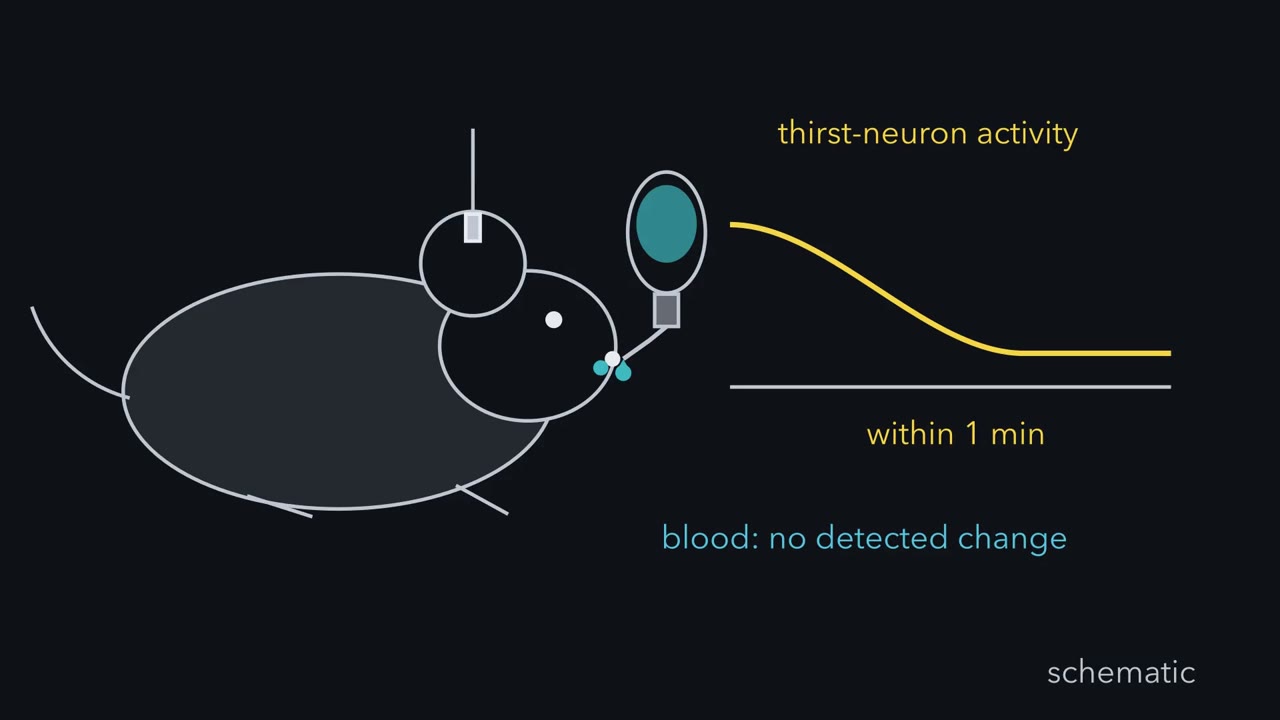
A thirsty mouse starts to drink. Within a minute, its thirst neurons go quiet. Yet its blood osmolality is still raised. What are they reading? Start with a loop. For water, the thing held steady is plasma osmolality, the concentration of dissolved particles in plasma. The SFO and OVLT sit in the front wall of the third ventricle. They sample the blood directly, where the blood-brain barrier is incomplete. A third site behind the barrier, the MnPO, integrates their signals. Two effectors push back. Vasopressin saves water at the kidney. Thirst takes water in. Both lower osmolality. The response opposes the error, so this is negative feedback.
Is there a separate comparator that judges the error? The comparison is spread across the sensing and integrating neurons. We summarize the result with a threshold and a gain. Raise osmolality in a controlled way and record vasopressin. The plot is flat, then rises in a straight line. The knee is the threshold. It says when release starts. The slope is the gain. It says how much release grows. Suppose osmolality rises, but stays below threshold. Does vasopressin change?
No. Below threshold there is no osmotic release. The line does not go negative. Now two made-up people. Person P has the lower threshold. Person Q has the steeper gain. Just above P's threshold, who releases more? And far above both thresholds?
Just above P's threshold, P does. Q has not even started. Far above both, Q does. The steeper line wins. So one number, a set point, cannot describe the loop. It takes at least two. For osmotic vasopressin, the line is measured. Output is the gain, times how far osmolality is past threshold. But water-balance circuits do not read the blood alone. Think of them as acting on an estimate. Feedback reads the blood. Feedforward adds what was just swallowed, or a learned cue. The hypothalamus acts through nerves, often in seconds. It also acts through hormones, whose effects usually build over minutes to hours. Threshold says when. Gain says how much.
Keep the word estimate. The thirst neurons will show why.
A thirsty mouse quiets its thirst neurons within a minute of drinking, while its blood osmolality is still raised five minutes later.
Continue in the lesson: Autonomic Control and the Hypothalamus →
2:58 · Free, with captions and a transcript. The lesson has the full text, the questions and the sources.
More films from this lesson
How this film was made. Narration: an AI narrator voice (Kokoro, af_heart) reading narration written from this lesson's text. Animation: AI-generated in code (Manim) by Claude, a schematic with no drawn molecular structures. Captions come from the narration script. See something wrong? Report it.