Cell Signaling · Skim version
Ubiquitin and Regulated Proteolysis as Signals
Read the full lesson → Skim the whole course →
The guiding idea
Why would a cell build a protein only to destroy it within minutes?
Signals change protein fate by changing what an E3 can recognize.
From the film: How a Signal Marks One Protein
- Signals change protein fate by changing what an E3 can recognize.
- E1 activates ubiquitin, E2 carries it and an E3 brings it to a recognized target.
- In oxygen sensing, PHD hydroxylation lets VHL recognize HIF-1α.
- When oxygen falls, HIF-1α is hydroxylated less often and accumulates.
From the film: One Tag, Different Destinations
- Ubiquitin marks route proteins; molecular glues change what an E3 grips.
- A single ubiquitin more often changes a protein's location than destroys it.
- A lysine-48 chain is a classic proteasome signal; a lysine-63 chain can assemble a complex.
- Auxin tightens TIR1's grip on a repressor, coupling detection to destruction.
-
One recognition step can change a protein’s fate
-
The bonds and branches behind the relay
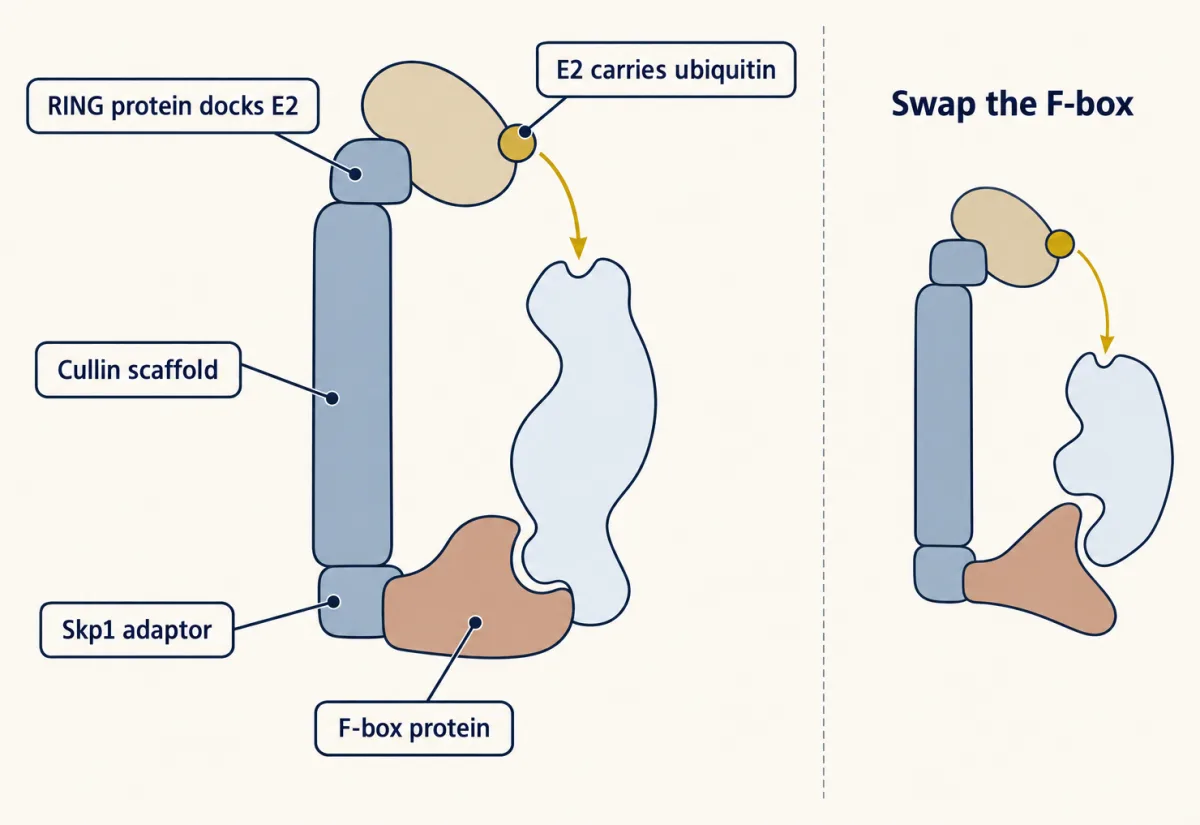
Swapping the F-box protein redirects the same SCF core toward a different degron and target. AI-generated illustration -
Signals write recognizable degrons
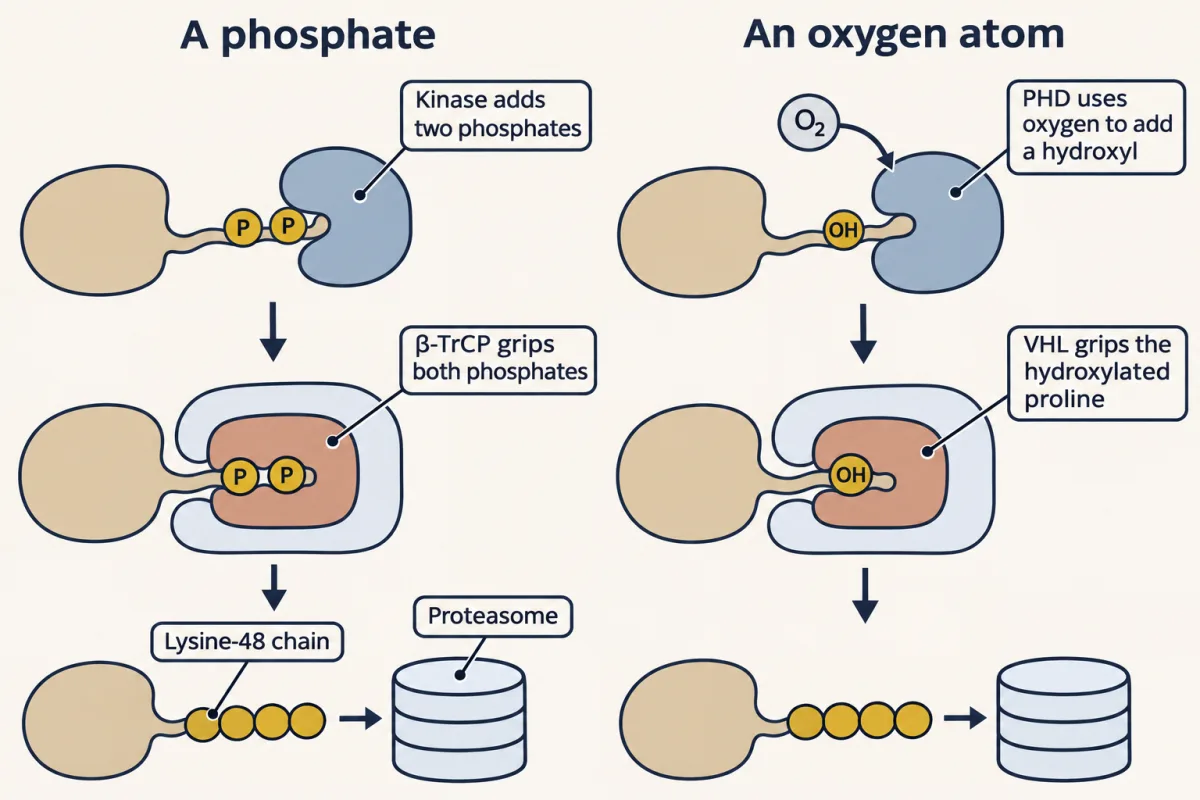
Phosphorylation lets β-TrCP recognize an inhibitor, while oxygen-dependent hydroxylation lets VHL recognize HIF-1α. AI-generated illustration -
Ubiquitin marks remain editable
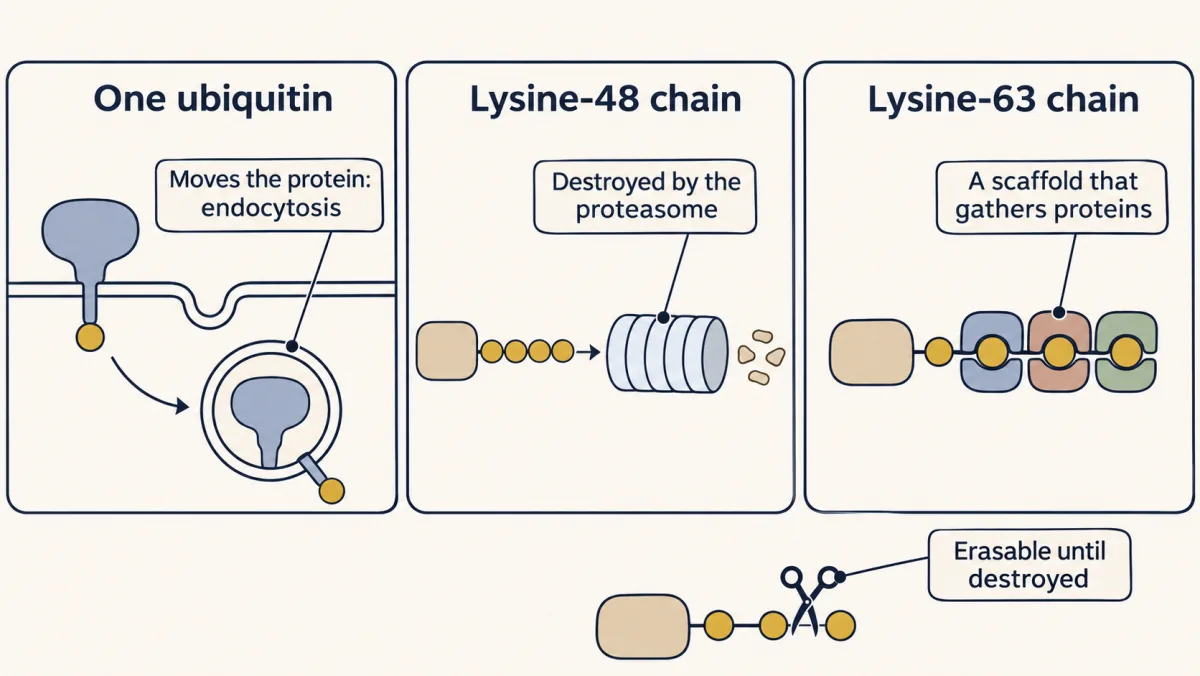
A single ubiquitin often changes location, a classic lysine-48 chain targets the proteasome, and a lysine-63 chain can assemble readers. AI-generated illustration -
Evidence that TIR1 is receptor and selector
-
Going deeper
Where this lesson fits
Before thisReview first
- Phosphorylation: Kinases and PhosphatasesThis course · Lesson 6
You need to know that a phosphate can be added and removed to see why destruction is a different, one-way switch.
- GTPase Switches: The TimerThis course · Lesson 7
It shows how a switch gets its timing, which helps you see why a pathway might use a timer or a one-way step.
After thisStudy next
- Wnt: β-Catenin and Planar PolarityThis course · Lesson 24
It applies the phosphate-then-destruction mark to β-catenin, where the signal works by stopping the phosphorylation.
- Innate Immunity: Toll-like Receptors and NF-κBThis course · Lesson 28
It uses the phosphorylated-inhibitor degron on IκB, which β-TrCP and an SCF ligase send to the proteasome.
- Stress Signals: p38 and JNK, p53, Unfolded Proteins and OxidantsThis course · Lesson 33
It takes up p53, which the cell builds and destroys rapidly until a signal protects it.
Elsewhere on the siteFilms, simulations and method films in other courses
- Choose, Recycle, SplitFilm · Biochemistry
It shows how E3 ligases give ubiquitin tagging its target specificity and how the proteasome handles tagged proteins.
- One Rise, One FallFilm · Cell Biology
Cyclin is destroyed at every division, a clear case of regulated destruction used as a one-way step.
- A Brake Wired to a SensorFilm · Cell Biology
Destruction of securin is a one-way trigger for the next cell-cycle step.
Suggested by an AI model from the lessons themselves, then checked. How we use AI