A Brake Wired to a Sensor
Read the transcript of “A Brake Wired to a Sensor”
Film transcript: A Brake Wired to a Sensor
This yeast cell lacks a gene called RAD9. Irradiate it, and it does not pause in G2. It keeps dividing for several generations, and dies. Hold it back with a drug for a few hours, and it repairs the damage. What was the gene for?
So repair could still happen. RAD9 was needed for waiting. Ted Weinert and Leland Hartwell found this in 1988. A year later, they named such controls checkpoints. A checkpoint makes one cell-cycle event wait for another. Without it, the cell divides on time, not on completion. Now run the logic the other way. What result would have said RAD9 is a repair gene after all?
If the held cells had still failed to repair, that would point to repair, though not prove it. But more time rescued them. First, the sensor. Broken DNA ends call in a kinase, ATM. Single strands at a stalled replication fork call in ATR. ATM mainly switches on Chk2, and ATR, Chk1. In G2, these messengers inhibit the Cdc25 phosphatases. So Cdk1 keeps its inhibitory phosphates and stays off. The cell waits. In this branch, nothing was destroyed; the brake is a shift in a phosphate balance. Once the signal is silenced, a cell able to recover moves on. Here is the whole idea. A checkpoint is a brake wired to a sensor. While the sensor sees an unfinished job, the brake holds back the next transition.
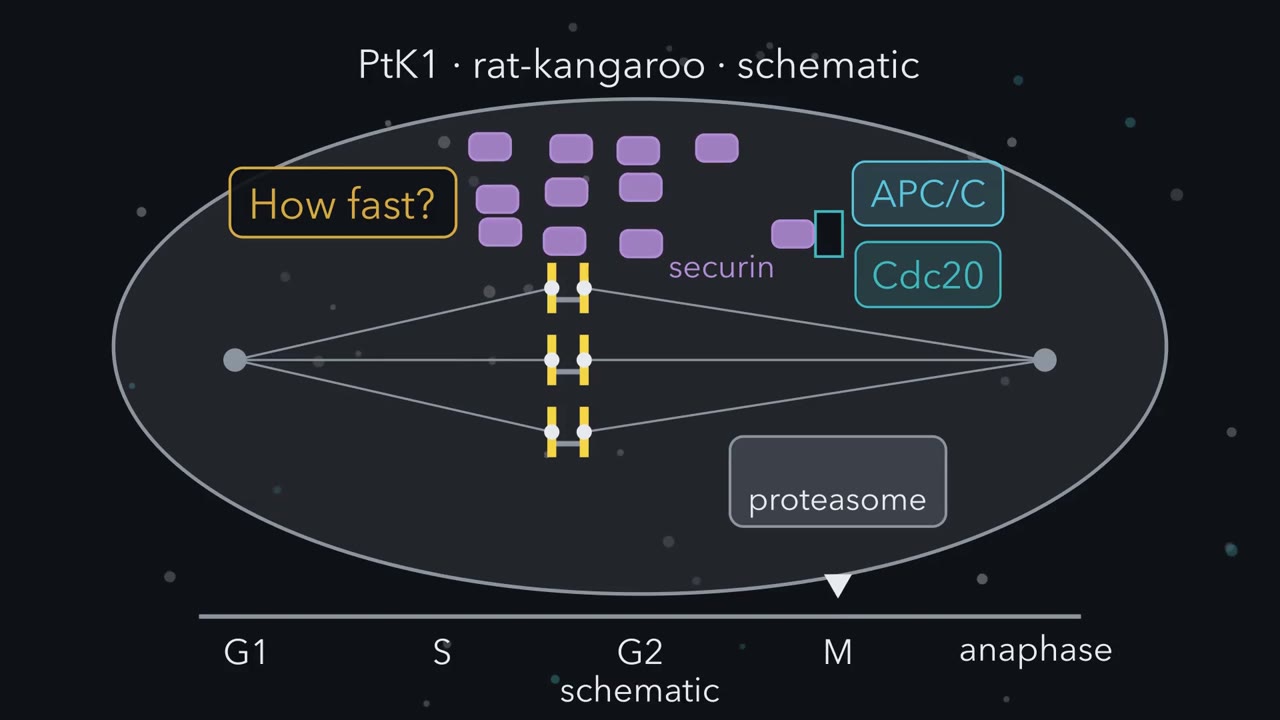
When the cell finally moves, the move is hard to undo. The same wiring guards anaphase. Each pair of sister chromatids should attach to opposite spindle poles, through structures called kinetochores. In flat rat-kangaroo cells, Conly Rieder's group found one chromosome attached to only one pole. They destroyed its unattached kinetochore with a laser. Does anaphase still wait?
No. Anaphase followed about twenty minutes later, though that chromosome never reached the middle. The wait signal came from the unattached kinetochore. Unattached kinetochores promote assembly of the mitotic checkpoint complex. It holds back the APC/C, or anaphase-promoting complex, a ligase that marks proteins for destruction. The complex is a decoy key. It fills the slots on Cdc20 that would grip a real target. Securin and cyclin B are kept out. When the last kinetochore attaches, the decoys stop coming and come apart. Then the APC/C tags securin and cyclin B, and the proteasome destroys them. Securin had held separase, a protease, inactive; in vertebrates, so had Cdk1.
Freed separase cuts the cohesin holding sister chromatids together, and anaphase begins. Losing cyclin B is a major way Cdk1 turns off. Why does it not run backwards? A phosphate can be put back within seconds to minutes, because the protein is still there. A destroyed protein must be made again. Potapova and colleagues forced cells out of mitosis with a Cdk1 inhibitor.
Cyclin B was kept. After washout, many went back into mitosis. Cells whose cyclin B was destroyed did not. Entry into mitosis also rests on feedback. Active Cdk1 switches on its activator and switches off its inhibitor. Once the rise starts, it feeds itself. Once on, this switch tends to stay on. That may be why the damage brake normally acts in G2, before the switch flips. The brake can leak, though. A cell held in mitosis can eventually slip out, because cyclin B is still slowly destroyed. So at each guarded step, a cell asks one question: is the job finished? Until it is, a sensor holds the brake. Then destruction or feedback carries it forward, and the step is hard to take back.
A yeast cell missing one gene keeps dividing after irradiation and dies. Hold it back with a drug, and it can repair the damage. What was the gene for?
Continue in the lesson: Checkpoints and Irreversible Transitions →
5:03 · Free, with captions and a transcript. The lesson has the full text, the questions and the sources.
More films from this lesson
How this film was made. Narration: written from this lesson's text and read by an AI narrator voice (Kokoro, af_heart). Animation: AI-generated in code (Manim) by Claude, a schematic with no drawn molecular structures. Captions come from the narration script. See something wrong? Report it.