Physiology · Skim version
Tubular Transport, Segment by Segment
Read the full lesson → Skim the whole course →
The guiding idea
Every stretch of the nephron has its own door for sodium, and most of those doors are drug targets. Block a different one and sodium, potassium, calcium and magnesium move in a different, largely predictable pattern.
Each nephron segment brings sodium in through its own apical protein, all driven by the same basolateral pump, and blocking each one has a different effect on potassium, calcium and magnesium.
-
One pump, five doors
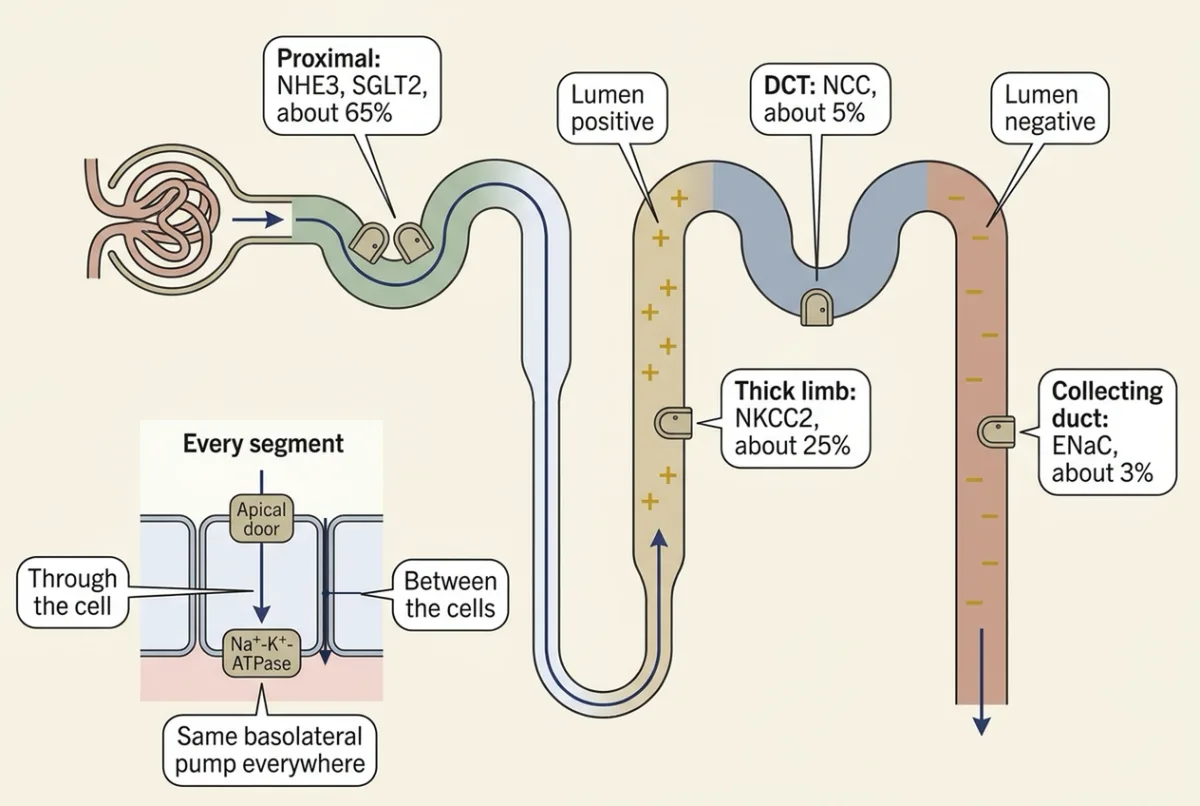
Each segment takes sodium through its own apical door, all powered by the same basolateral Na+-K+-ATPase; only the thick limb (lumen positive) and the collecting duct (lumen negative) build the voltages this lesson tracks. Shares are rounded human estimates. AI-generated illustration -
Blocking a door: look downstream, then locally
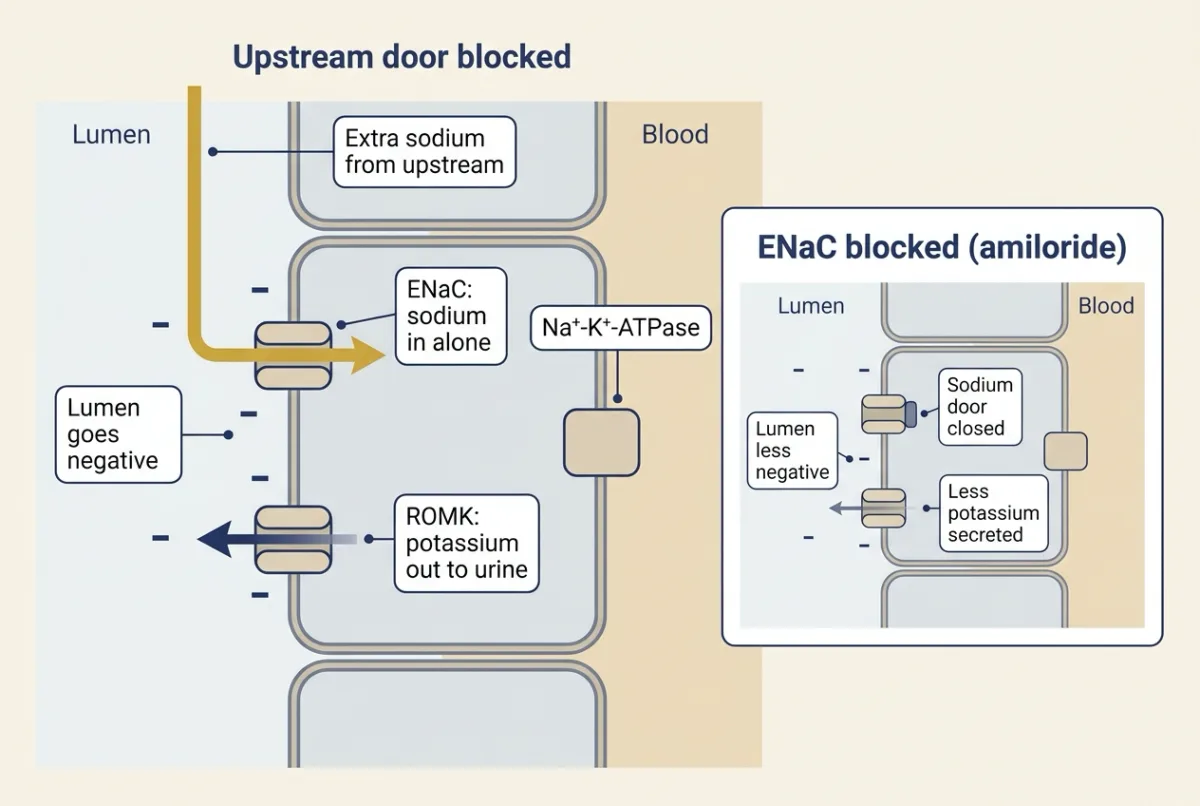
Block a door upstream and the extra sodium enters through ENaC, making the lumen more negative and pushing potassium into the urine; close ENaC itself, as amiloride does, and potassium secretion falls. The size of the potassium effect depends on how much sodium and flow arrive, and aldosterone amplifies it. AI-generated illustration -
Proximal tubule: the bulk door and the glucose door
-
Thick ascending limb: a salt pump that charges the lumen
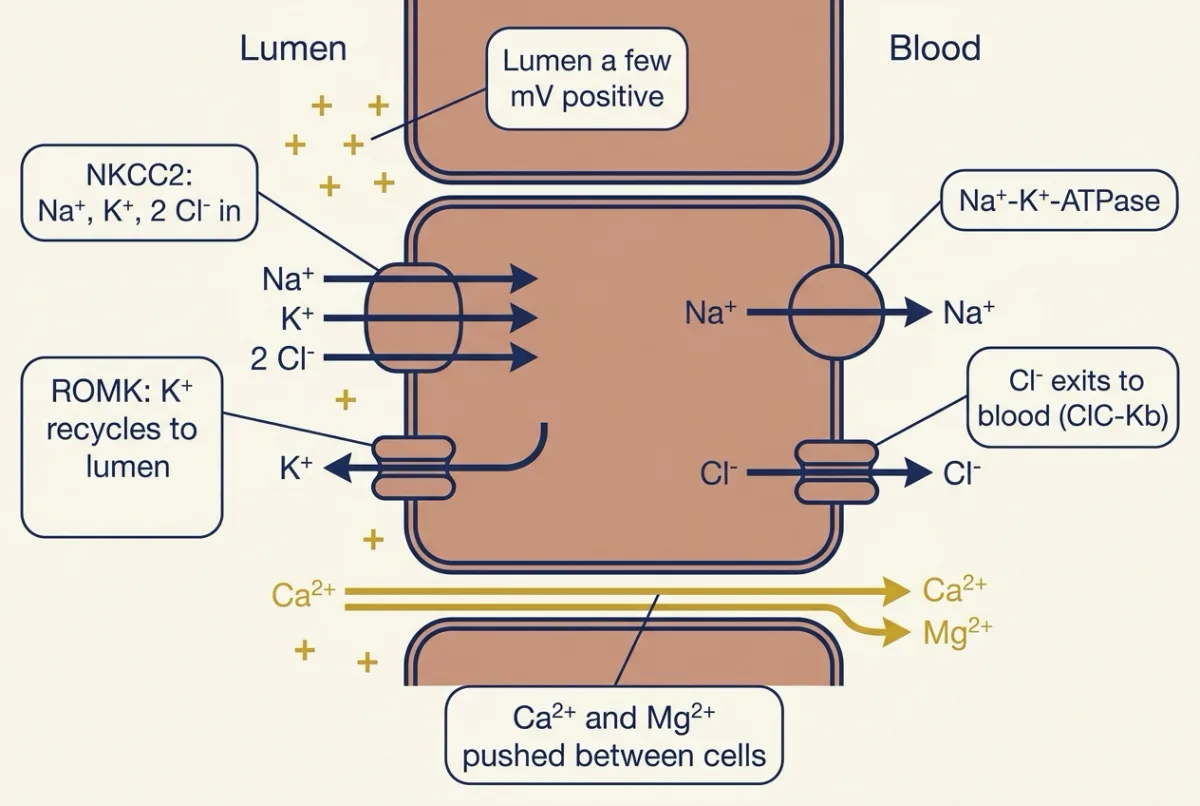
Potassium recycling to the lumen and chloride exit to the blood leave the thick-limb lumen a few millivolts positive, and that voltage drives calcium and magnesium between the cells. This is the classic one-cell picture; the segment actually contains several cell types. AI-generated illustration -
Distal convoluted tubule: the door with no voltage
-
Collecting duct: the channel that makes the lumen negative
-
The table, filled
-
Going deeper
Where this lesson fits
Before thisReview first
- The KidneyOrganismal Biology · Starting college
You need the nephron map and the segments' jobs from there before following each segment's sodium door.
- Transport Across MembranesCell Biology · College: the core
It teaches the Na+-K+-ATPase gradient and ion driving forces that every apical door here spends.
- Glomerular Filtration and Renal Blood FlowThis course · Lesson 15
You need filtered load and GFR from there to calculate the glucose titration curve.
After thisStudy next
- Water, Sodium and Potassium BalanceThis course · Lesson 17
It takes the downstream ENaC potassium secretion and aldosterone effect and shows how the kidney balances sodium, water and potassium.
- Acid-Base BalanceThis course · Lesson 18
It builds on proximal NHE3 hydrogen secretion and bicarbonate recovery to explain how the kidney handles acid.
- Calcium, Phosphate and BoneThis course · Lesson 22
It uses the thick-limb voltage and thiazide effects on calcium to explain how urinary calcium is set.
Elsewhere on the siteFilms, simulations and method films in other courses
- Which Way Does the Water Go?Film · Organismal Biology
It shows how water follows dissolved particles across tubule walls, which sets what tubules reclaim.
- Patch clampMethod film
The lesson's thick-limb and channel evidence rests on recording currents through transporters and channels.
Suggested by an AI model from the lessons themselves, then checked. How we use AI