Developmental Neuroscience · Skim version
Neurotrophins, Trk Receptors and p75
Read the full lesson → Skim the whole course →
The guiding idea
Many developing neurons live only if their target supplies enough of the right neurotrophin. How does the neuron read that factor, and how can the same factor sometimes kill?
A developing neuron survives when the neurotrophin its target supplies reaches a Trk receptor, a receptor tyrosine kinase that starts survival signals.
From the film: One Neuron, One Target
- The target supplies the factor, and the neuron's receptors decide what it means.
- A Trk receptor with its ligand usually reads a neurotrophin as stay alive, while p75 can read it as die in some cells.
- With sortilin, p75 reads the uncut precursor as die, and cutting the precursor changes which receptors the factor works through best.
From the film: Four Factors, Three Kinases
- A neurotrophin dimer can hold two Trk receptors together so that their kinase domains phosphorylate each other.
- The phosphorylated tyrosines start two survival branches, Ras to ERK and PI3K to Akt.
- Each neurotrophin prefers particular Trk receptors, so a neuron answers the factor whose Trk receptor it makes.
From the film: The Kinase from a Tumour
- The first neurotrophin receptor cloned, p75, bound NGF with low affinity and had no kinase.
- The trk gene was first found as an oncogene from a human colon tumour, and in 1991 two groups showed that NGF binds the Trk protein and causes its tyrosine phosphorylation.
- The original Trk protein is now called TrkA, because two relatives, TrkB and TrkC, were found soon after.
From the film: Delete One, Count the Survivors
- In mice lacking TrkA, sympathetic ganglion neurons were made and then died, leaving about half as many neurons as controls at birth.
- Each factor and receptor pair has its own pattern of neuron loss, and some populations need more than one factor at different stages.
- In many ganglia, mice lacking NT-3 lose more neurons than mice lacking TrkC, which fits NT-3 also acting through TrkA and TrkB.
From the film: The Receptor That Can Kill
- p75 can read a neurotrophin as die, as when NGF killed cultured oligodendrocytes, which lack TrkA.
- In the cells tested, uncleavable proNGF killed through p75 and needed sortilin, which grips the pro-domain.
- How much precursor killing adds to normal developmental death is less clear, and one group found proNGF could keep sympathetic neurons alive through TrkA, though less well.
From the film: Reading One Factor Two Ways
- At low NGF, a much larger fraction of the high-affinity Trk-linked sites fills than of the p75 sites, but at about 2 nM many p75 sites fill too.
- Binding arithmetic cannot explain the precursor, which adds a pro-domain that sortilin grips.
- Whether the ligand has been cut, which receptors the cell makes and how much of each go a long way toward deciding what one neurotrophin does.
-
The layout
-
How a Trk receptor turns on
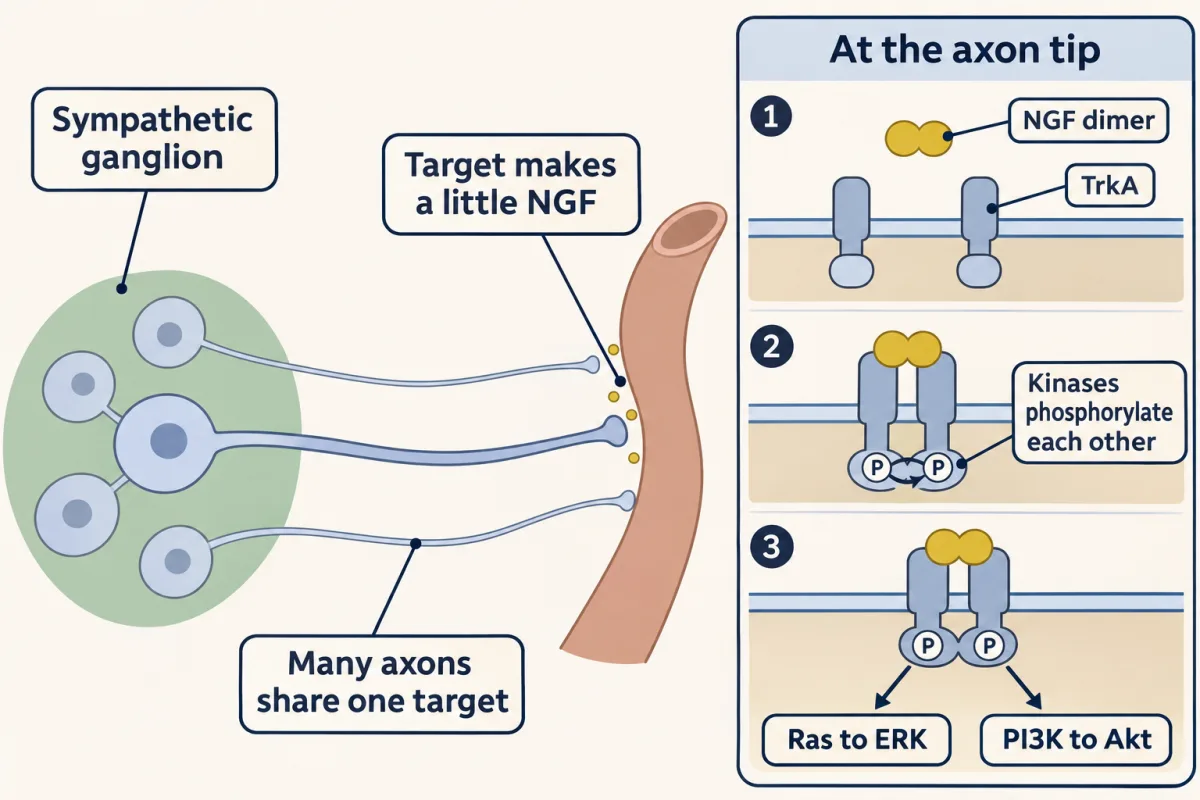
Many axons share one target that makes only a little NGF. At each axon tip the NGF dimer brings two TrkA receptors together, their kinase domains phosphorylate each other, and the Ras to ERK and PI3K to Akt survival branches start. AI-generated illustration -
Where the receptors came from
-
Three deletions, three populations
-
The receptor that can kill
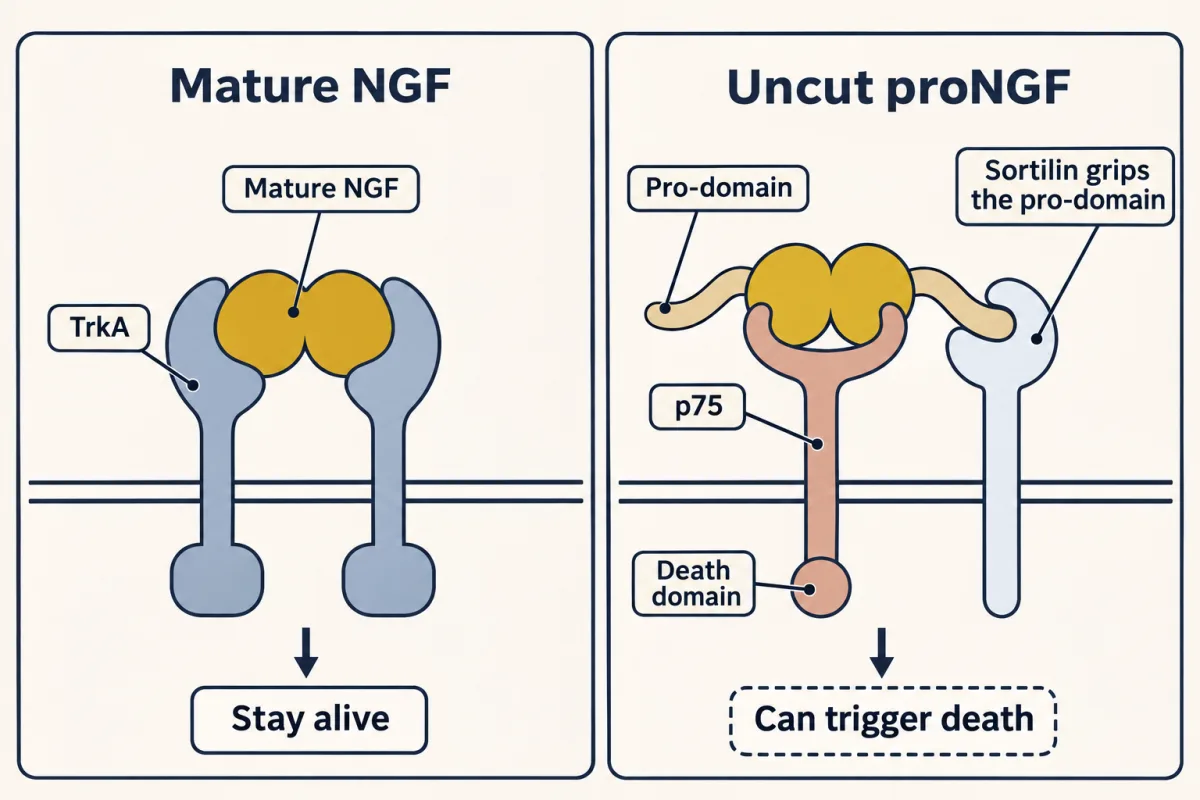
Mature NGF works best through TrkA and keeps a TrkA-carrying neuron alive. The uncut precursor keeps its pro-domain, which sortilin grips while p75 grips the mature part, and in cells with little TrkA this pair can trigger death. AI-generated illustration -
Reading one factor two ways
-
Putting it together
-
Going deeper
Where this lesson fits
Before thisReview first
- The Neurotrophic Hypothesis TestedThis course · Lesson 29
It sets out the rule that targets supply limited survival factor and neurons that get too little die, which this lesson follows to the receptors.
- Too Many Neurons: Naturally Occurring Cell DeathThis course · Lesson 28
It shows that many developing neurons die on schedule, the death that these receptors help decide.
After thisStudy next
- Competition: How Neurons Win a TargetThis course · Lesson 32
It uses p75 and TrkA signalling to explain how neurons that compete for limited NGF win or lose.
- The Signal from the Target Travels HomeThis course · Lesson 33
It traces how the neurotrophin signal received at the axon tip, via Trk receptors, gets back to the cell body.
- The Death Machinery in NeuronsThis course · Lesson 31
It picks up after the p75 death signal starts and follows the pathway to caspases.
Elsewhere on the siteFilms, simulations and method films in other courses
- Receptor pairingSimulation · Cell Signaling
Not a valid id; ignored.
- The EGF receptor kinase switches on when two copies touchFilm · Cell Signaling
It shows how a ligand brings two receptor copies together so their kinase domains switch each other on, as Trk does.
- Ras to MAPK: From Membrane to GenesFilm · Cell Signaling
It follows the Ras to ERK branch that Trk phosphotyrosines start for survival.
- A Membrane Address for AktFilm · Cell Signaling
It covers the PI3K to Akt branch, the second survival route started by Trk.
Suggested by an AI model from the lessons themselves, then checked. How we use AI