The EGF receptor kinase switches on when two copies touch
Read the transcript of “The EGF receptor kinase switches on when two copies touch”
Film transcript: The EGF receptor kinase switches on when two copies touch
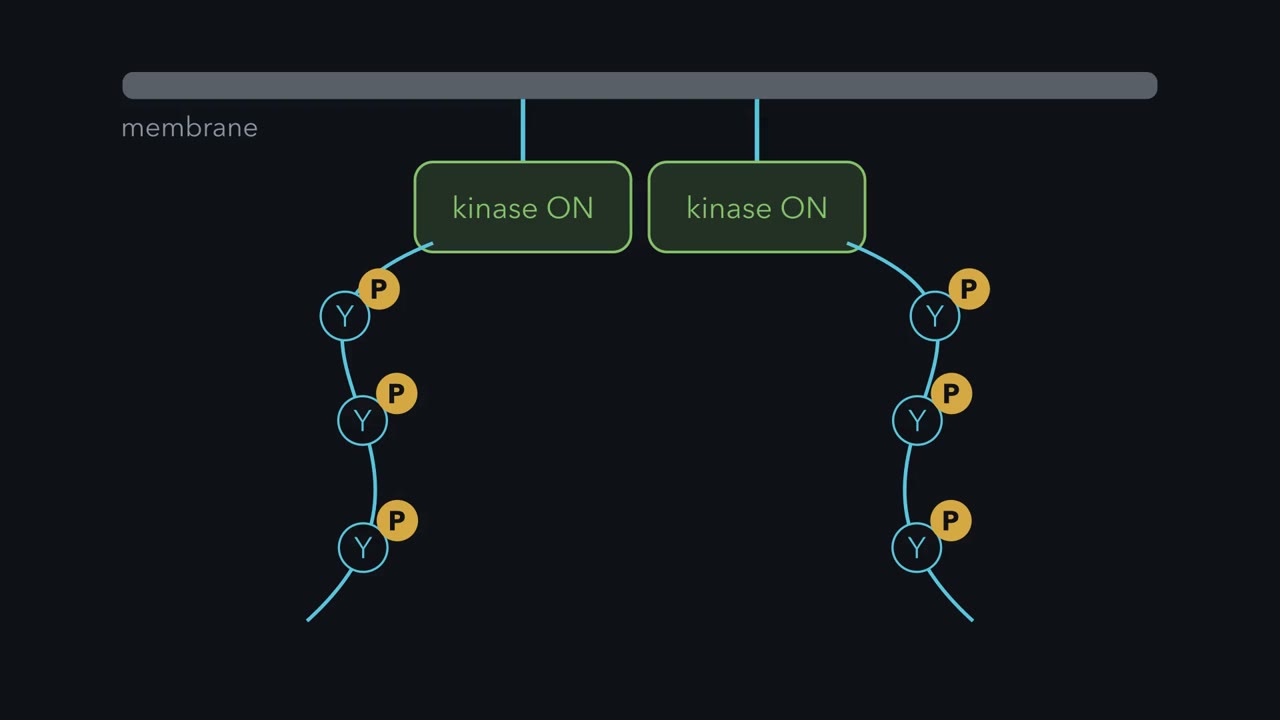
The year is 2006. You work in John Kuriyan's laboratory at Berkeley. You are studying the receptor for EGF (epidermal growth factor). Three facts about it are known. 1. The receptor has three parts: an outer part that binds EGF, one pass through the membrane, and an inner part that is a kinase. This is the kinase that Cohen found. On its own, the kinase is off. 2. EGF is one small protein. One EGF molecule binds one receptor. It cannot hold two receptors. 3. But the receptor responds only in pairs. When you add EGF, receptors come together two at a time, each with its own EGF bound, and the kinases switch on. A receptor with EGF bound but no partner stays off.
Answer three questions. 1. EGF cannot join two receptors. So what has EGF binding physically done to the receptor, so that receptors now hold on to each other? 2. Once two receptors are held together, what switches the kinase on? Say what one kinase must do to the other. 3. Predict: cut the inner kinase free from the membrane, the outer part and EGF. Then crowd many copies of it together in a tube, so that they touch each other. Will the kinase be on or off? Explain your prediction using your answer to question 2. You now have a kinase that stays off until another copy comes close. This page asks what the two copies do to each other when they meet, and whether both copies end up the same.
The EGFR kinase's off shape is one that two other enzymes also use. Src kinase and the cyclin-dependent kinases both fold into a resting shape that blocks their own activity. The isolated EGFR kinase, left alone, has the same kind of shape. Kuriyan's group solved the structure of the kinase pair. In the pair, the back lobe of one kinase presses against the front lobe of the other. So the two copies do different things. The pressing copy uses the shape of its back surface to push the other's active site into its working position. A cyclin protein switches on a cyclin-dependent kinase in the same way. The copy that is pressed is the one that switches on.
The same contact is used across the whole family of these receptors: EGFR, HER2, HER3 and HER4. So a cell can make different signals from the same set of parts by pairing different members. The signal depends on which member presses and which member is pressed.
One helix crosses the membrane. So how does a growth factor outside switch on a kinase inside?
Continue in the lesson: Receptor Tyrosine Kinases →
2:33 · Free, with captions and a transcript. The lesson has the full text, the questions and the sources.
More films from this lesson
How this film was made. Narration: an AI narrator voice (ElevenLabs, Brian) reading a passage Chris Deppmann wrote for his graduate signaling course. Animation: AI-generated in code (Manim) by Claude, a schematic with no drawn molecular structures. Captions come from the narration script. See something wrong? Report it.