Neuroscience · Skim version
Touch and Pain
Read the full lesson → Skim the whole course →
The guiding idea
Capsaicin carries no heat, yet it opens the same channel that heat above about 43 °C opens. What is the skin actually measuring?
Follow the line: a sensory neuron's firing tells the brain which line is active and how strongly, but not uniquely what activated it.
From the film: Why Capsaicin Feels Hot
- Capsaicin opens TRPV1 in cloned rat channels, the same channel that noxious heat above about 43 degrees Celsius opens, so it burns without carrying heat.
- Menthol feels cool because it opens TRPM8, a channel that cool temperatures also open.
- Knockout mice show TRPV1 is needed for capsaicin responses but only partly for painful heat, so a neuron's firing says which line is active, not for certain what drove it.
From the film: Two Lines, Two Crossings
- The touch line carries fine touch, vibration and position sense and crosses in the medulla, while the pain and temperature line crosses in the spinal cord within a segment or two.
- A hemisection of the cord therefore costs fine touch on the same side and pain on the opposite side, the core of the Brown-Sequard pattern.
- For these two routes, where a line crosses tells you where the damage is.
From the film: Turning the Report Up and Down
- The size of the pain report can be reset at the ending, in the dorsal horn and in the brainstem.
- In a simplified gate, touch fibres excite an inhibitory interneuron that damps the transmission cell, so rubbing can reduce pain.
- A nociceptor's firing is a report, and pain is what the nervous system makes of it.
-
What the skin is measuring
-
What a line reports: the channels
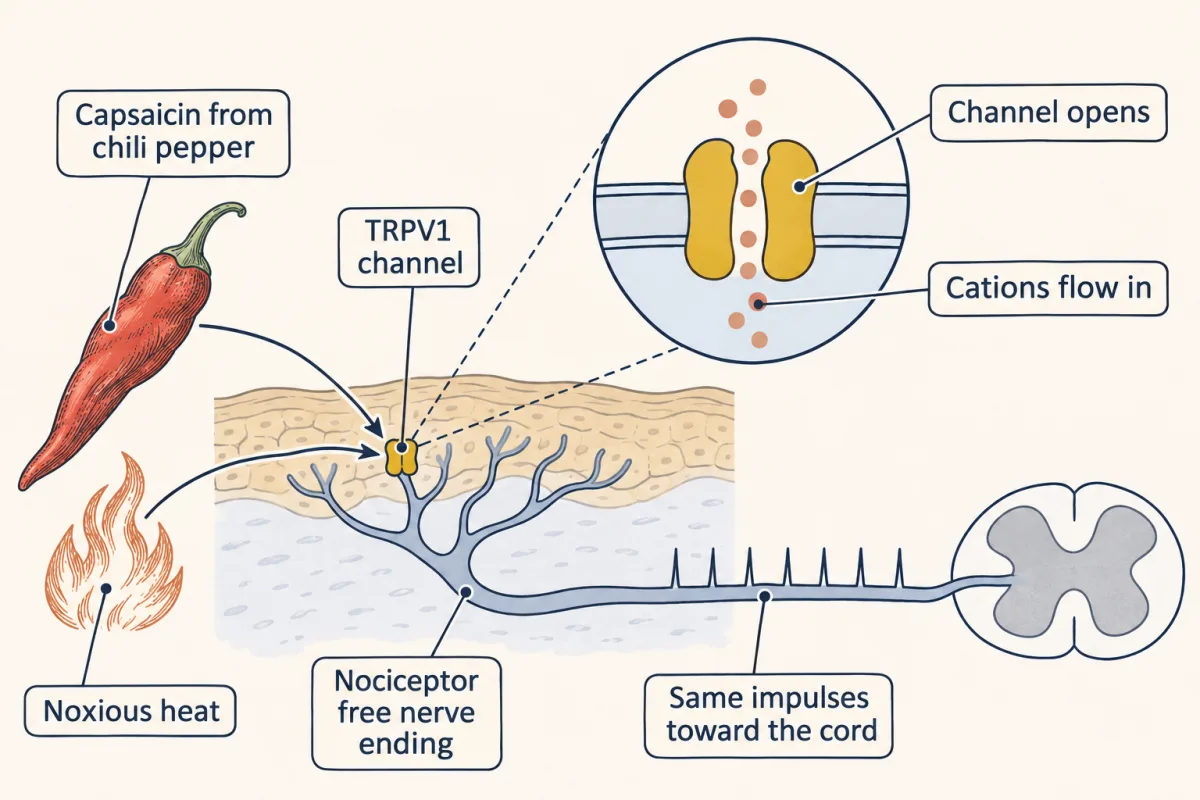
Capsaicin and noxious heat open the same channel, TRPV1, on the same nociceptors and send the same impulses toward the cord, so the firing alone cannot say which stimulus drove it. AI-generated illustration -
What touch afferents report: four receptors, three fibre sizes
-
Where each line crosses: two pathways
-
Turning the report up and down
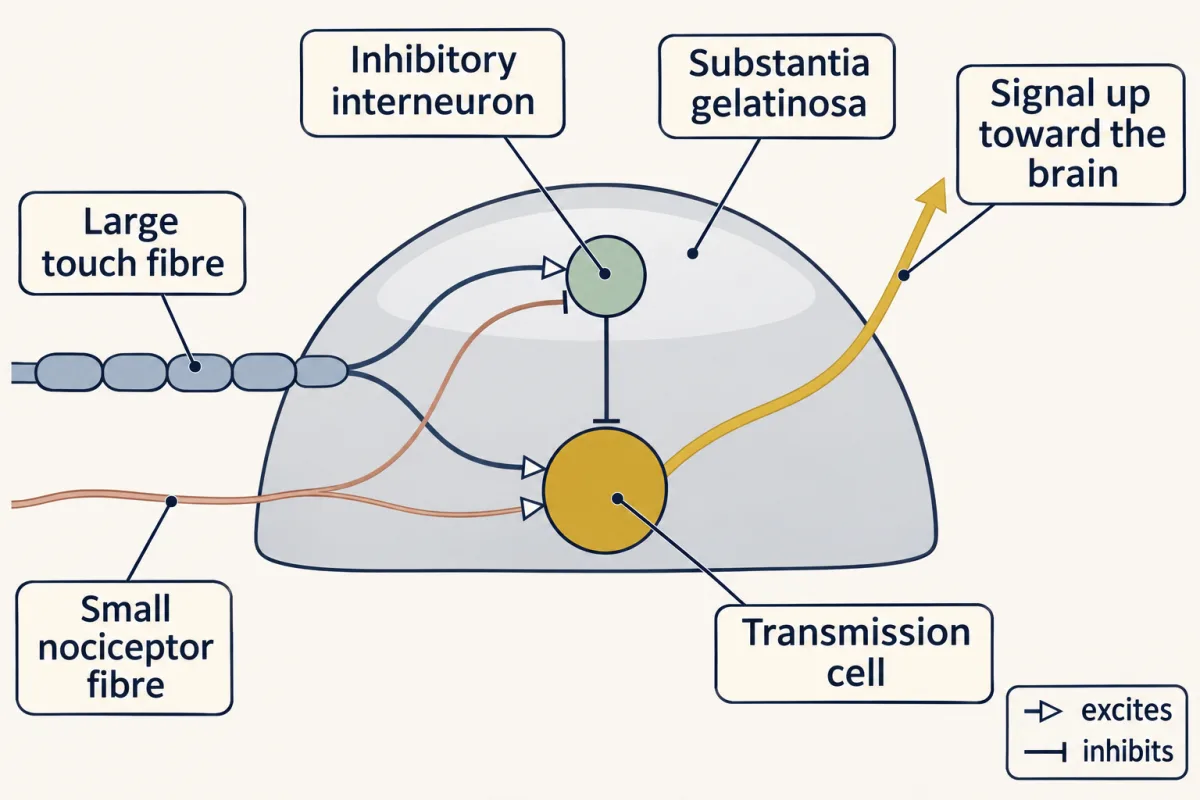
In a simplified version of Melzack and Wall's gate, large touch fibres excite both the transmission cell and an inhibitory interneuron that damps it, while small nociceptor fibres excite the transmission cell and suppress the interneuron. AI-generated illustration -
Going deeper
Where this lesson fits
Before thisReview first
- The Action Potential and ConductionThis course · Lesson 4
Conduction speed by fibre diameter and myelin, used here to sort Aβ, Aδ and C fibres, comes from there.
- Principles of Sensory CodingThis course · Lesson 9
Receptive field and adaptation rate, which sort the four touch afferents here, are introduced there.
- Synaptic PlasticityThis course · Lesson 8
Central sensitization here is a form of the NMDA-dependent plasticity taught there.
After thisStudy next
- Motor Units, Reflexes and LocomotionThis course · Lesson 15
The reflex circuits there build on the spinal relays and the withdrawal responses traced here.
- Descending Control and the Basal GangliaThis course · Lesson 16
It covers the descending tracts, including the corticospinal crossing used in the hemisection deficits here.
- Feeding, Motivation and RewardThis course · Lesson 19
It takes the idea that pain is what the nervous system makes of a nociceptor report into brain circuits of motivation.
Elsewhere on the siteFilms, simulations and method films in other courses
- Residual current at a bath concentrationSimulation · Sensory Systems
It takes the nociceptor's channels further, showing how a sodium channel sets whether pain signals fire at all.
- Who Opens the Touch Gate?Film · Sensory Systems
It tests the spinal gate with mouse circuit experiments, showing inhibitory neurons keeping touch from driving pain relays.
- A Fibre That Fires at RestFilm · Sensory Systems
It shows how skin temperature is read from several afferent lines at once, not one channel per feeling.
- One Press, Several ReportsFilm · Sensory Systems
It shows how different low-threshold touch neuron classes report different parts of one touch.
Suggested by an AI model from the lessons themselves, then checked. How we use AI