Who Opens the Touch Gate?
Read the transcript of “Who Opens the Touch Gate?”
Film transcript: Who Opens the Touch Gate?
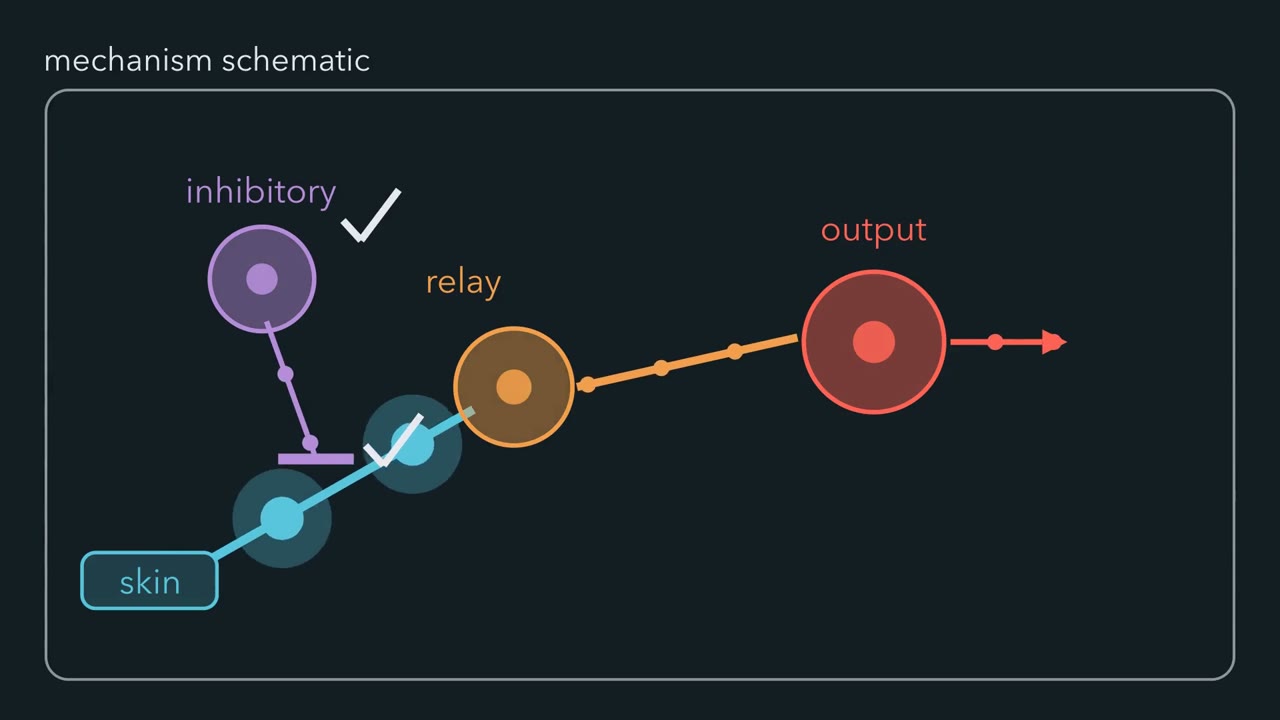
How can the same light touch recruit a pain pathway without changing the skin stimulus? Watch one blue touch signal enter the dorsal horn. It meets an orange relay, a purple inhibitory brake, and a red output route. First test the relay. In mice, removing the mostly excitatory somatostatin lineage weakens acute and injury-associated mechanical nocifensive behaviour. The result supports a relay role in the assays tested. It does not identify every route for mechanical pain. Now restore the relay and test its brake. Dynorphin-lineage inhibitory neurons restrict recruitment of superficial somatostatin neurons by large myelinated afferents. The blue input is unchanged.
Removing purple inhibition lets that input recruit many more orange cells. Predict the slice result. With the inhibitory population removed, does identical Aβ input recruit fewer superficial somatostatin cells, the same number, or more? Keep the incoming pulse fixed while you decide.
More. At the lamina II–III border, Aβ-evoked spiking rose from 5% to 40% percent of recorded neurons. The measurement locates a gated connection. The behaviour alone could not tell us where the circuit failed. Tools set the claim. Ablation removes captured cells, including cells marked by earlier expression. Tetanus toxin light chain can leave a neuron alive while blocking transmitter release. Activation asks whether added output can shift the measured behaviour. Opposite manipulations sharpen the relay claim. Somatostatin activation elicited nocifensive behaviour. Inhibition raised mechanical withdrawal thresholds and lengthened thermal withdrawal latency in naive mice.
Slice recordings confirmed that the light-driven neurons followed the stimulus trains. After spared nerve injury, permanent reporter counts of parvalbumin neurons did not fall significantly at 3, 5, or 8 weeks. Yet activating those neurons relieved injury-associated hypersensitivity.
The cells remained. The next question is what happened to their signal. Inhibitory populations are not interchangeable. Parvalbumin activation changed mechanical sensitivity without changing thermal sensitivity in the assays tested. Broader glycinergic manipulations changed mechanical, heat, and cold sensitivity together. One gate does not control every modality. So begin with behaviour, but do not stop there. Ask which cells were captured, what the tool changed, and which connection was measured. Behaviour identifies a failed gate.
Circuit measurements help locate the failure.
Light touch can start to hurt when a spinal gate fails. A gate can fail because the gatekeeper dies, or because the gatekeeper is still there and its signal has changed sign. In adult male rat lamina I, nerve injury was shown to do the second.
Continue in the lesson: Spinal Circuits That Gate Pain →
3:34 · Free, with captions and a transcript. The lesson has the full text, the questions and the sources.
More films from this lesson
How this film was made. Narration: written from this lesson's text and read by an AI narrator voice (Kokoro, af_heart). Animation: AI-generated in code (Manim) by Claude, a schematic with no drawn molecular structures. Captions come from the narration script. See something wrong? Report it.