One Press, Several Reports
Read the transcript of “One Press, Several Reports”
Film transcript: One Press, Several Reports
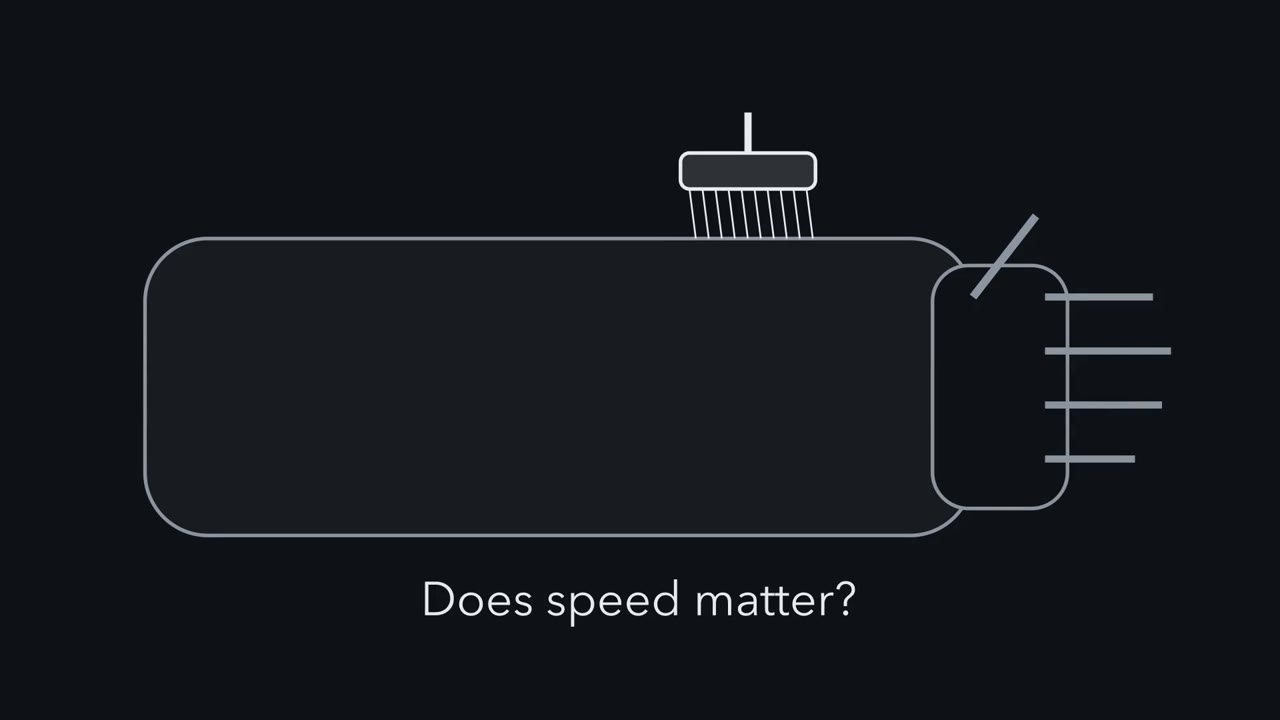
Press a fingertip and hold it. Is that one signal reaching your brain, or several? In Touch and pain, you sorted four touch afferents of the hand into a two-by-two table. You used firing alone. So what lies behind each box? And why split one touch into several signals at all? Start simple. A smooth probe presses into a fingertip, holds still for a second, then lifts. Record from each kind of touch afferent in turn, and line up its spikes under the probe. Which afferent keeps firing while the probe is held still?
The slowly adapting afferent that ends at Merkel cells. It fires going in, and keeps firing through the hold. It reports that something is there, and where its edges are. The rapidly adapting afferent in a Meissner corpuscle fires going in, and again on lifting. During the hold, it is quiet. The Pacinian afferent is silent during the hold. At most, it gives a brief burst as the probe goes in and lifts. Now make the probe vibrate fast, with tiny movements. Which afferent detects the smallest vibration?
The Pacinian afferent. It is the most sensitive to fast vibration. The slowly adapting afferent hardly responds. Each class has a band where it is most sensitive. A band of best sensitivity, not a cutoff. Same skin, same probe, different records. Each is one part of the touch. Here is the one idea to carry. Each class of low-threshold mechanoreceptor is most sensitive to a different part of a touch. Like overlapping filters, each class favours its own part. A held press. Skin motion. Fast vibration. The slightest bend of a hair. A slow stroke. The ending, with the neuron's own properties, shapes what a class responds to best. Axon size and myelin set how fast the report travels.
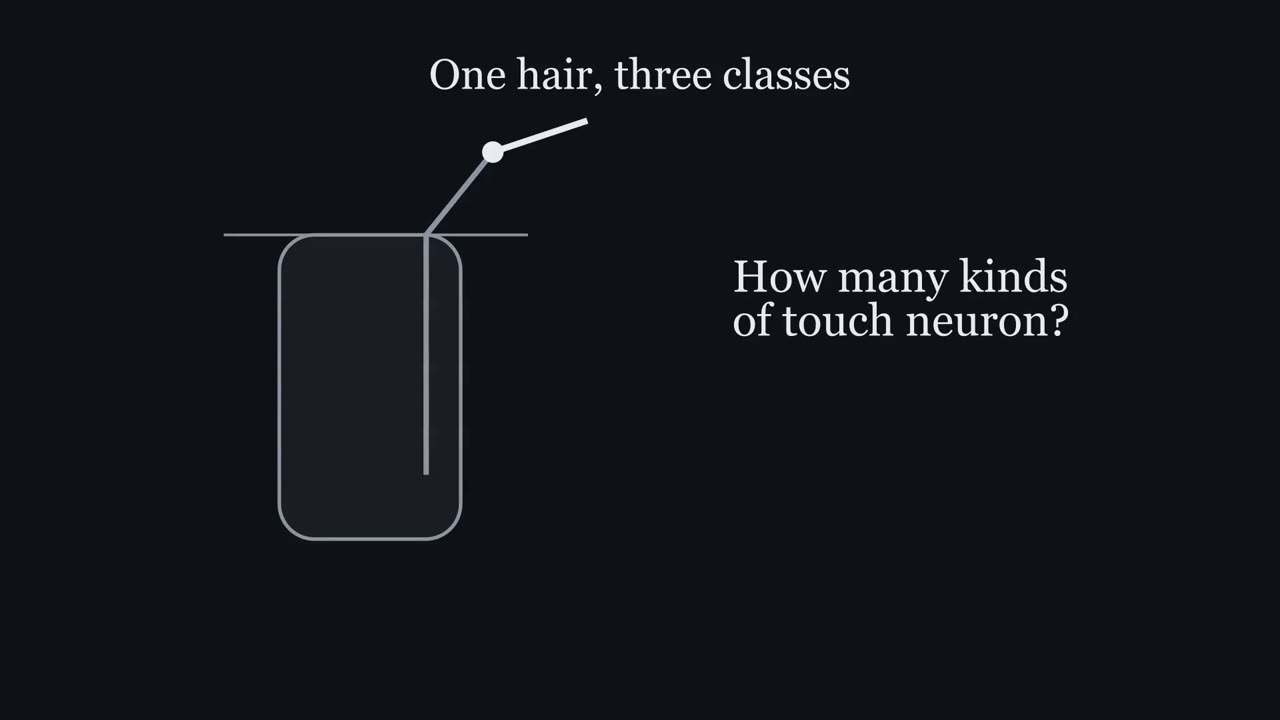
Why split at all? The recorded classes are complementary. One keeps reporting a held press. Another catches fast vibrations too small for the rest. No class reports the whole touch. So the nervous system reads the pattern across the classes that share the skin. This extends the Touch and pain rule. Endings help decide what a line can report, even within one sense. One press, several reports. Next, mouse hairy skin, where three classes can share a single hair.
A light stroke on your skin is not one signal. Different kinds of touch neuron are most sensitive to different parts of it: the motion, the steady press, the vibration, the slow stroke. On a mouse's back, three of these kinds can even share a single hair. Why build a sense that way?
Continue in the lesson: The Low-Threshold Mechanoreceptors: One Touch, Several Signals →
2:50 · Free, with captions and a transcript. The lesson has the full text, the questions and the sources.
More films from this lesson
How this film was made. Narration: an AI narrator voice (Kokoro, af_heart) reading narration written from this lesson's text. Animation: AI-generated in code (Manim) by Claude, a schematic with no drawn molecular structures. Captions come from the narration script. See something wrong? Report it.