Cell Signaling · Skim version
Stress Signals: p38 and JNK, p53, Unfolded Proteins and Oxidants
Read the full lesson → Skim the whole course →
The guiding idea
Your cells build p53 all day and destroy it almost as fast. Why make a guardian only to shred it?
How does a cell notice broken DNA, a reactive chemical or a backlog of unfolded protein, and answer quickly?
-
The idea: the responder is made all the time and held back
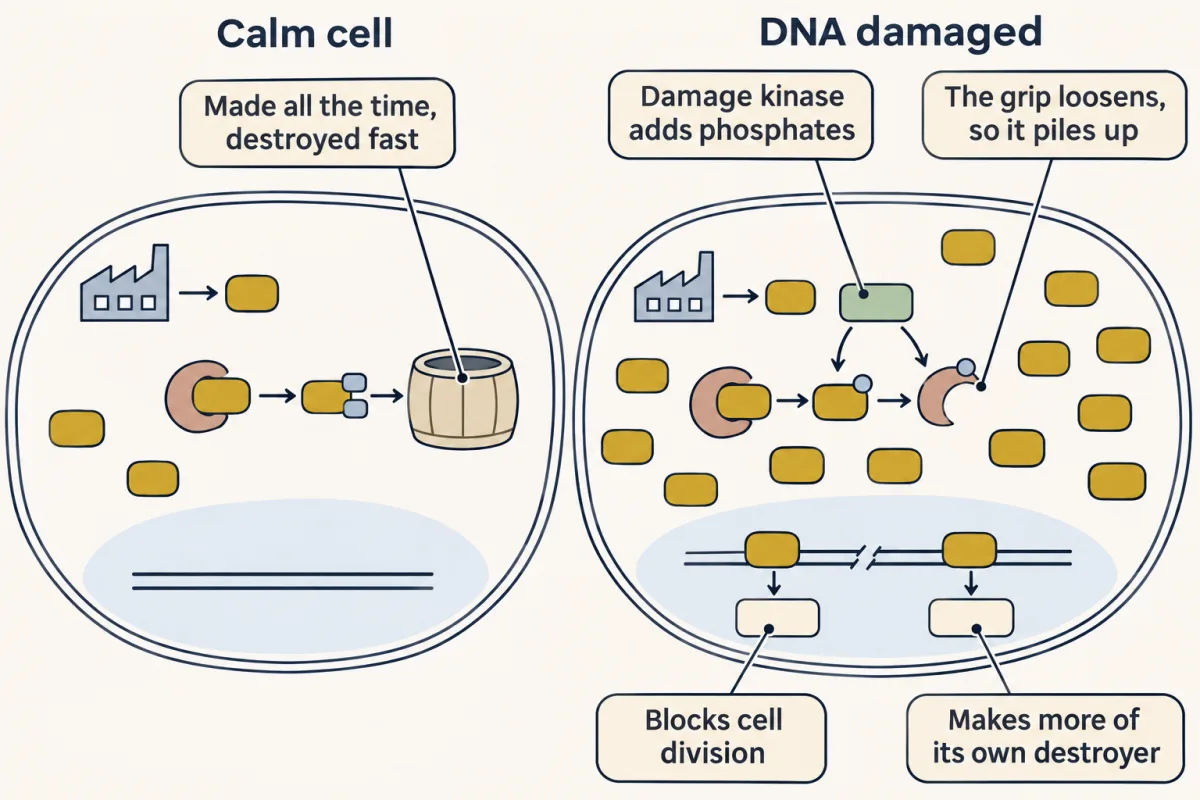
The responder is made all the time and held back, so the cell only has to let go. Damage switches on a kinase that marks both proteins, the grip loosens, and the responder piles up without any new gene being read. AI-generated illustration -
Pulses, not a dial: the timing of a signal carries information
-
The stress kinases: the three-tier plan again
-
A sensor that works by being attacked: Keap1 and Nrf2
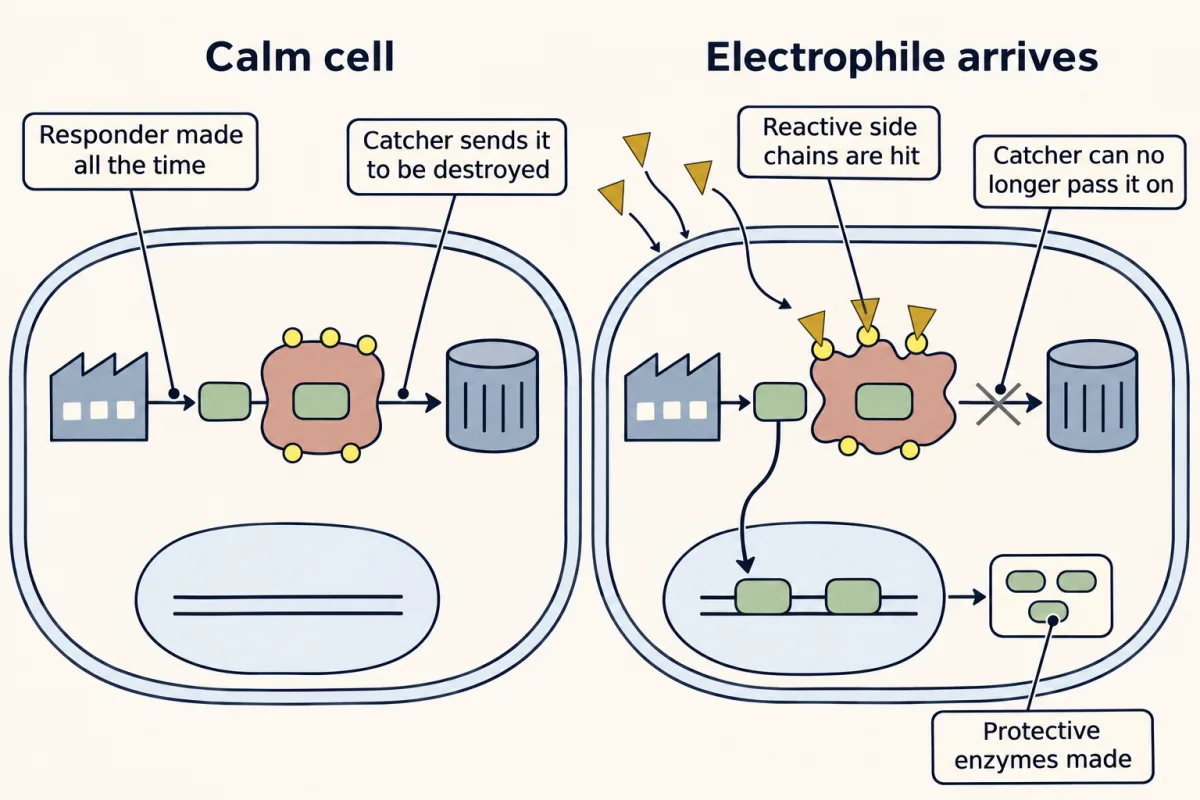
The sensor works by being attacked: an electrophile reacts with reactive side chains on the catcher, which can then no longer pass the responder on for destruction, so newly made responder goes to the nucleus instead. AI-generated illustration -
A sensor inside the folding compartment: repair first, then death
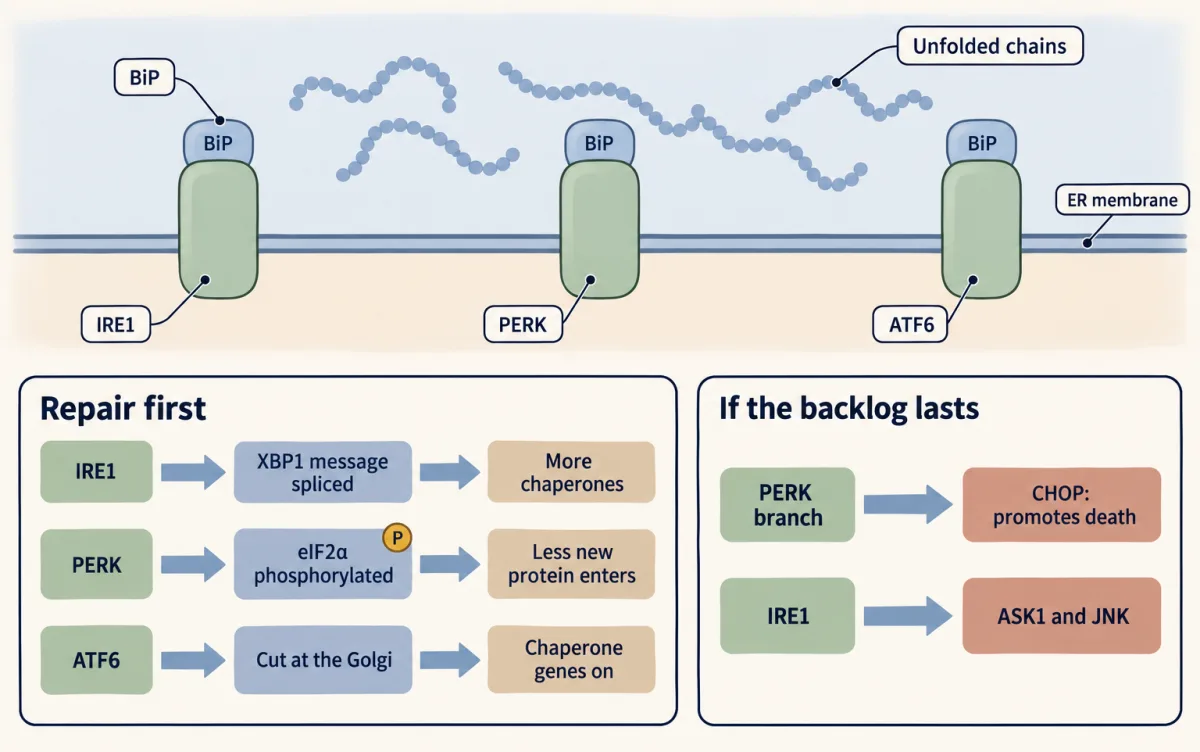
Three sensors span the ER membrane. At first each lowers the load or raises folding capacity. Long or severe stress can favour death-promoting outputs through the PERK branch and CHOP, and through IRE1 signalling to ASK1 and JNK; duration, stress strength and cell state all matter, and adaptive and death-promoting signals can overlap. AI-generated illustration
Where this lesson fits
Before thisReview first
- Ubiquitin and Regulated Proteolysis as SignalsThis course · Lesson 8
HIF made constantly and destroyed by ubiquitin is the model this lesson applies to p53 and Nrf2.
- Ras to MAPK: The Kinase CascadeThis course · Lesson 19
The three-kinase relay with double phosphorylation here is the plan p38 and JNK reuse.
- Circuits: Amplification, Feedback, Adaptation and SwitchesThis course · Lesson 5
You need negative feedback and adaptation from there to see why p53 orders its own destroyer and pulses.
After thisStudy next
- Death Receptors, BCL-2 and CaspasesThis course · Lesson 34
It takes up the cell death that p53, JNK and CHOP push toward when stress persists.
- The Shape of a Signal: Size, Duration, Frequency and PlaceThis course · Lesson 35
It takes the idea that signal timing carries information, shown by p53 pulses, further.
- Oncogenes: When the Switch SticksThis course · Lesson 41
Cancer-causing changes there connect to p53 loss and extra MDM2 copies in tumors.
Elsewhere on the siteFilms, simulations and method films in other courses
- Cell death assaysMethod film
The stress response ends in cell death when repair fails, and these assays show how that death is measured.
- Sealed or TornFilm · Cell Biology
It shows how a cell takes itself apart, the outcome when the unfolded protein or DNA damage response cannot repair.
Suggested by an AI model from the lessons themselves, then checked. How we use AI