Organismal Biology · Skim version
Size, Scale and Surface
Read the full lesson → Skim the whole course →
The guiding idea
A flatworm has no lungs and no heart. Why can't a mouse manage the same way?
When a body grows without changing shape, its middle ends up farther from its outer surface, and diffusion time grows with the square of that distance; in a simple model of a solid ball of tissue fed from air at its surface, oxygen runs out at the centre beyond a radius of about 1.5 mm for slow tissue and a few tenths of a millimetre for busy tissue, so bodies stay thin, add internal exchange surfaces or use bulk flow.
From the film: Why a Mouse Needs Plumbing
- When a body grows without changing shape, its surface grows four times for every eight times its volume, so each bit of inside has less surface.
- The inside also ends up farther from the surface, and diffusion is quick across a cell but slow across a body: twice the distance takes four times as long.
- In a simple model of a solid ball of tissue fed from its surface, oxygen from air runs out at the centre once the radius passes about 1.5 mm for slow tissue, or a few tenths of a millimetre for busy tissue.
- For the same shape fed only from outside, a bigger body means a longer path, so bodies stay thin, add inner surface or pump fluid; in thick, busy animals, bulk flow does most of the carrying and diffusion finishes the last few micrometres.
From the film: Does Every Gram Cost the Same?
- Rubner found that bigger dogs make more heat in total but less heat per kilogram.
- Metabolic rate is fitted as a constant times body mass to a power b, and b is positive but below 1 in most comparisons of adult mammals and birds: bigger burns more in total, but less per kilogram.
- On the widely used fit with b = 3/4, a mouse burns about seven times as much per kilogram as a human: a fitted prediction, not a single measurement.
- The exponent is a fitted number that changes with the animals, their state and the method, and its cause is still debated.
-
A bigger cube has less skin per unit of inside
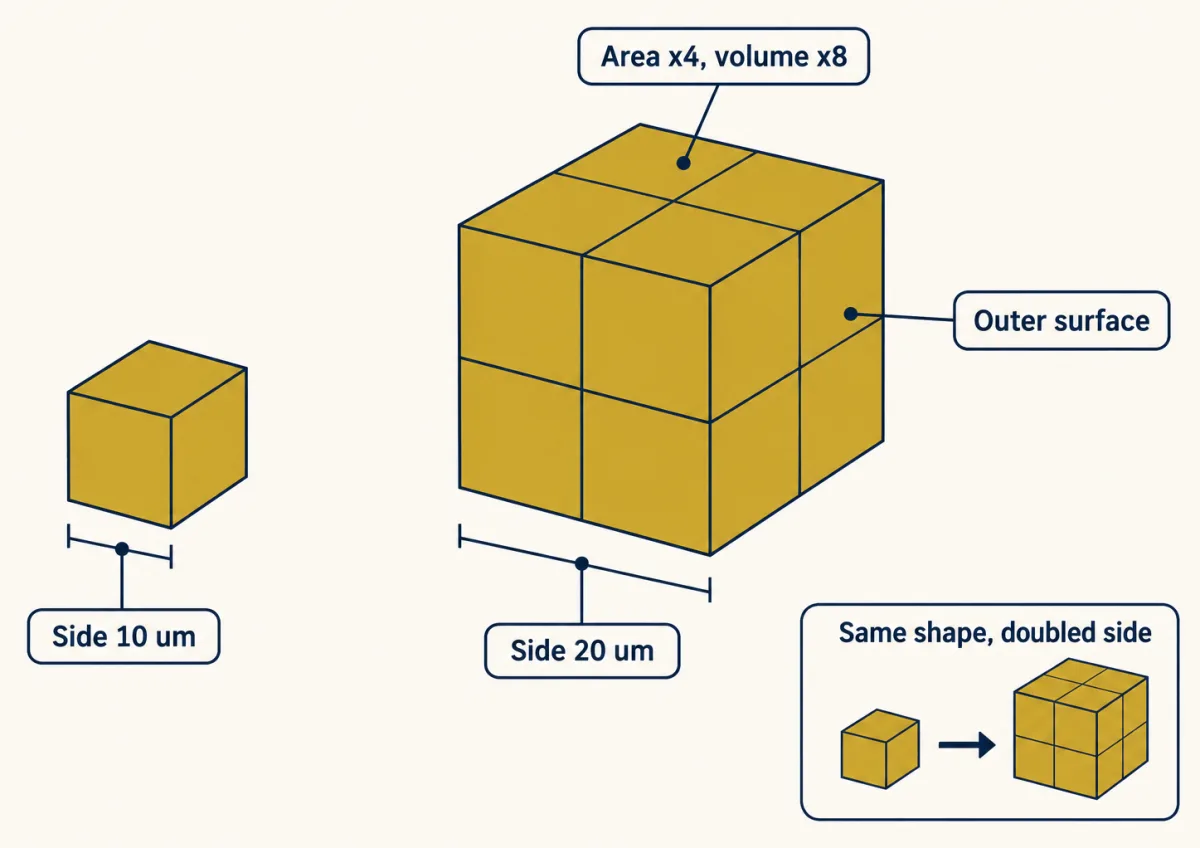
An ideal cell of side 20 um holds eight times the volume of one of side 10 um but only four times the outer surface, so the surface-area-to-volume ratio halves. These cubes are illustrative, not measured cells. AI-generated illustration -
Diffusion: fast over micrometres, slow over centimetres
-
How deep can diffusion reach?
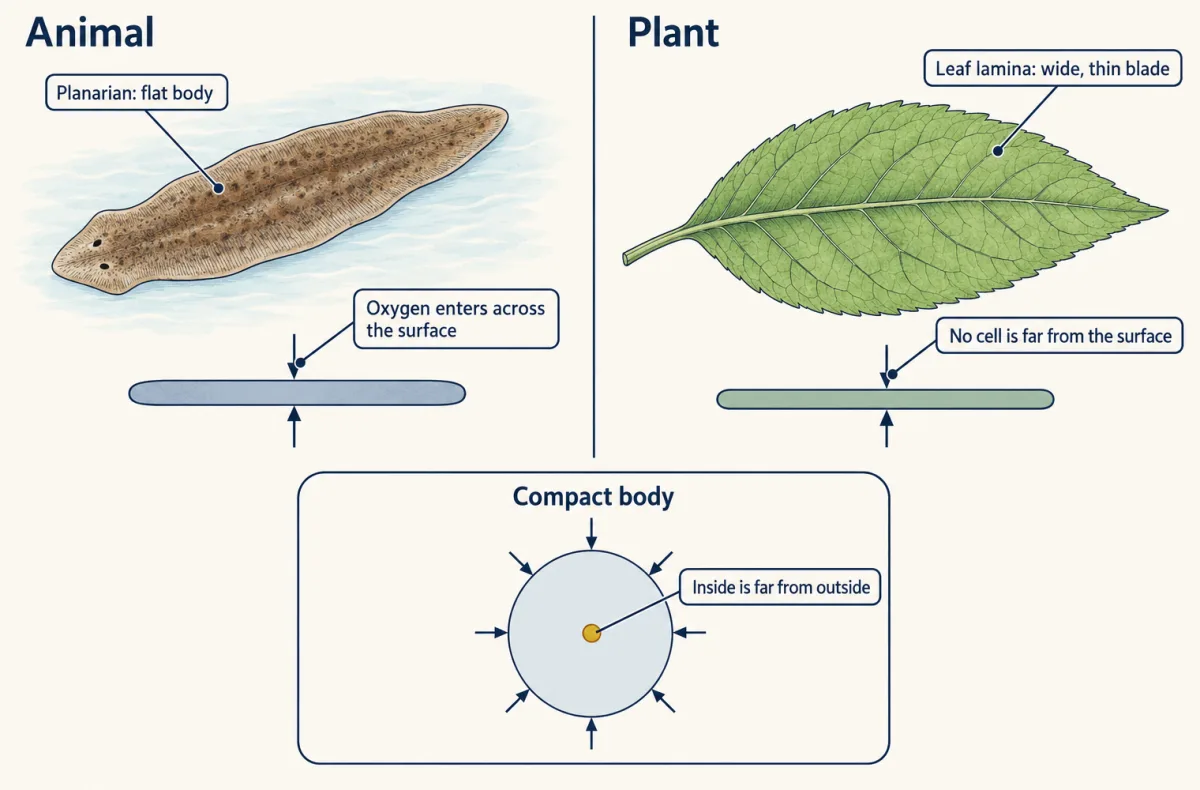
Flattening answers the surface problem in both kingdoms: in a planarian and in the lamina of a leaf, no cell is far from the outside. A compact, rounded body of the same material would leave its inside far from any surface. AI-generated illustration -
Four answers in two kingdoms
-
Body mass and metabolism: Rubner, Kleiber and the debate
-
Does a lower rate per kilogram rescue a big body?
-
Going deeper
Where this lesson fits
Before thisReview first
- What an Organism Has to DoThis course · Lesson 1
It sets out the exchange problem organisms face, including water lost for carbon dioxide, which this lesson turns into numbers.
- Diffusion and OsmosisLife Science · Grade 7
You need the idea of net movement down a concentration gradient from there before timing diffusion here.
After thisStudy next
- Gas Exchange and BreathingThis course · Lesson 12
Folded and branched exchange surfaces, such as gills and lungs, are worked out there using area, thickness and diffusion.
- Heat Balance and Body TemperatureThis course · Lesson 9
Metabolic rate against body mass and surface carries straight into heat balance and the cost of staying warm.
- Circulation and the HeartThis course · Lesson 10
Bulk flow as the answer to long diffusion distances is developed there in the heart and blood flow.
Elsewhere on the siteFilms, simulations and method films in other courses
- Build an energy pyramidSimulation · Biology
It shows how rate of energy use per unit of body size shapes how much energy an animal needs.
- One Tug, Many JobsFilm · Biology
It shows how heat is stored and lost, which bears on surface-driven heat loss from a body.
Suggested by an AI model from the lessons themselves, then checked. How we use AI