One Tug, Many Jobs
Read the transcript of “One Tug, Many Jobs”
Film transcript: One Tug, Many Jobs
Could one fact about one tiny molecule explain three puzzles? An insect stands on a pond, a paper towel drinks water upward, and salt vanishes into a glass. Start with one water molecule: one oxygen atom and two hydrogen atoms. Each hydrogen shares electrons with the oxygen in a covalent bond. The molecule is bent, like a wide letter V.
Oxygen pulls the shared electrons closer. So the oxygen end becomes slightly negative shown in red. Each hydrogen end becomes slightly positive shown in blue. A molecule with charged ends is polar. Bring in a neighbor. Opposite charges attract, so the blue end of one molecule is drawn to the red end of the next. That weak pull between molecules is a hydrogen bond, drawn as a dashed gold line. Liquid water holds countless jostling molecules.
Gold lines snap on, break, and form again with new partners. The grey bonds inside each molecule stay put, because they are much stronger. Here is the one idea. Water's charged ends tug on its neighbors, on ions, and on other polar molecules. Now watch it do three jobs. Job one is dissolving. Salt is made of charged particles called ions, positive sodium and negative chloride. Water's red ends face each sodium, and its blue ends face each chloride. That pull of opposite charges lifts each ion off the crystal. So water is a solvent. Now add some oil. Oil molecules are mostly nonpolar, with few charged spots to grab. Water molecules tug on each other more than on oil, so the oil stays in its own drop.
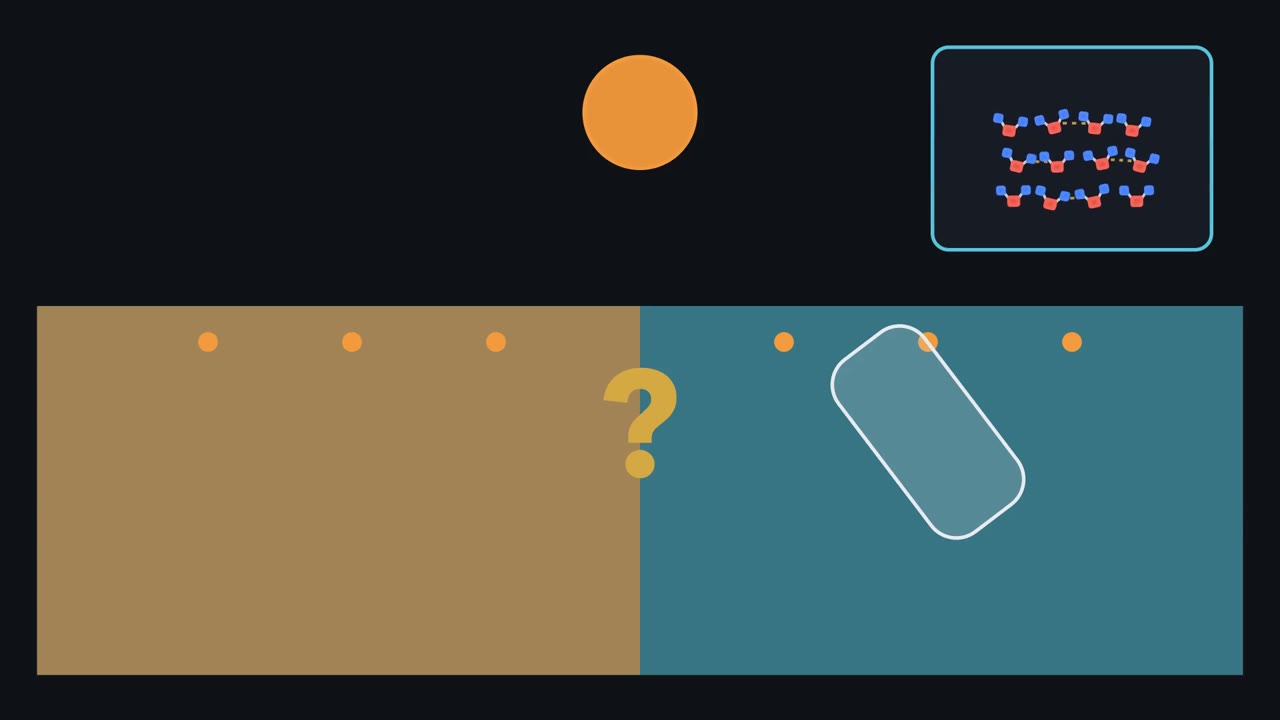
Job two is sticking to itself, called cohesion. At the surface, neighbors pull each molecule sideways and down. So the surface resists being stretched. That is surface tension, and it is still liquid water, not a skin. Job three is sticking to other things. Paper is made of cellulose fibers, with many polar parts. Water clings to them, and that is adhesion. Each climbing molecule pulls its neighbors up by cohesion. Together they give capillary action. Back to the strider. Its legs are covered in tiny water-repellent hairs. Will water climb those hairs like it climbs the towel? Pause and decide.
No. Water clings only weakly to water-repellent hairs, so it pulls itself into beads. Surface tension, plus those hairs, lets a small strider stand. So one molecule's bent shape and charged ends help explain all three jobs. The same tug helps make water slow to warm, as film two shows.
On a hot July day in the Chesapeake Bay, why did the air swing by about 8 degrees Celsius while the water changed by less than 1.5?
Continue in the lesson: Water and Life →
3:30 · Free, with captions and a transcript. The lesson has the full text, the questions and the sources.
More films from this lesson
How this film was made. Narration: written from this lesson's text and read by an AI narrator voice (Kokoro, af_heart). Animation: AI-generated in code (Manim) by Claude, a schematic with no drawn molecular structures. Captions come from the narration script. See something wrong? Report it.