Cell Signaling · Skim version
Signals and How Far They Travel
Read the full lesson → Skim the whole course →
The guiding idea
Cut every nerve to a loop of gut, drip acid on it, and the pancreas still answers. Who told it?
How does a cell learn anything about the world outside its membrane?
-
A message with no wire
-
Three questions and one idea
-
Diffusion punishes distance
-
Five modes, five answers to the same physics
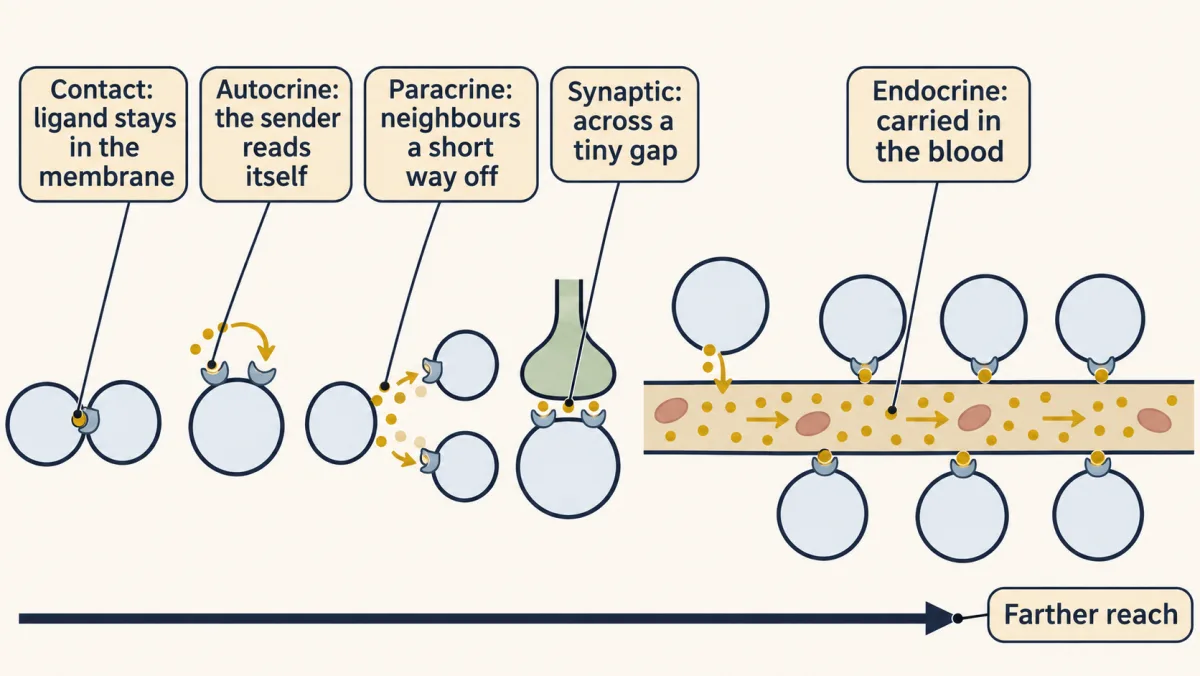
Five ways a signal reaches its target: by contact, back onto the sender (autocrine), to neighbours a short way off (paracrine), across a synaptic gap tens of nanometers wide, or through the blood (endocrine), which exposes every cell the blood reaches. Real tissues mix and match them, so treat them as a vocabulary. AI-generated illustration -
Lifetime buys reach and costs tempo
-
Ending the message: clearance sets τ
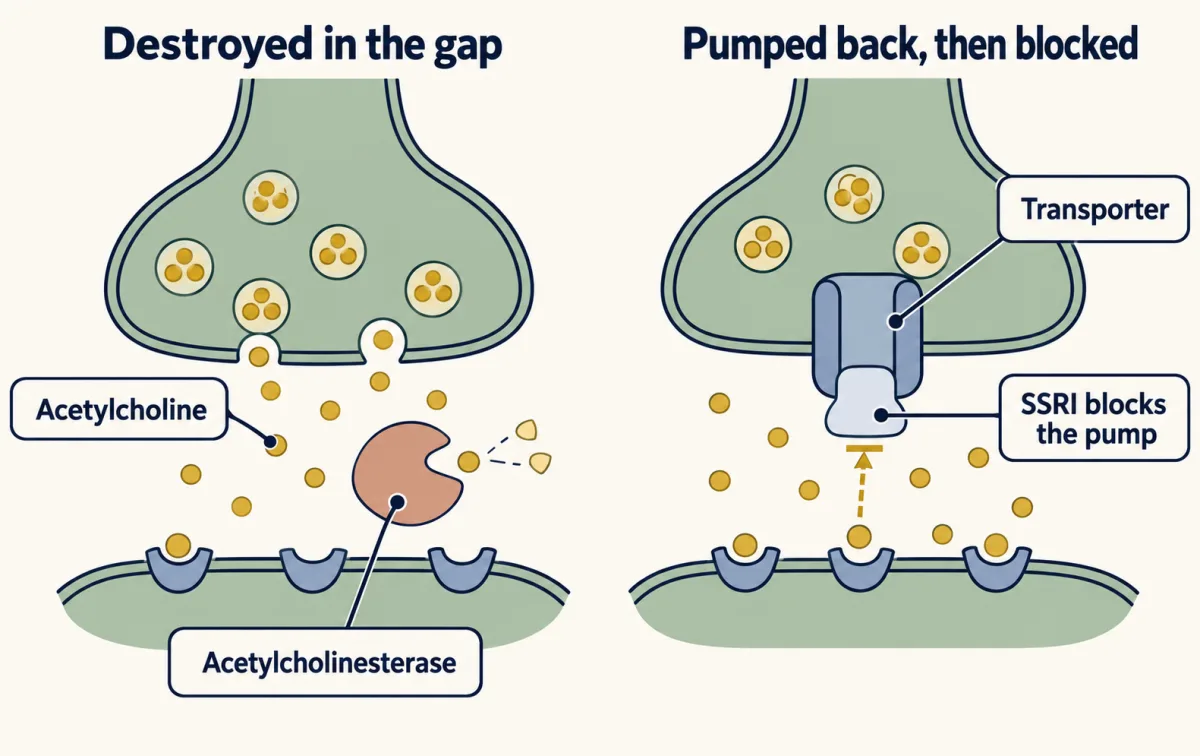
Two clearance routes end transmitter signals: acetylcholinesterase breaks down acetylcholine outside the cell, while a transporter takes serotonin back into the sending neuron. An SSRI inhibits that transporter, so serotonin lingers longer in the gap and surrounding fluid. The drawing is schematic, and this early drug action does not by itself explain the delayed benefit in depression. AI-generated illustration -
Who answers: the receptor
-
Can the messenger cross? Where the receptor sits
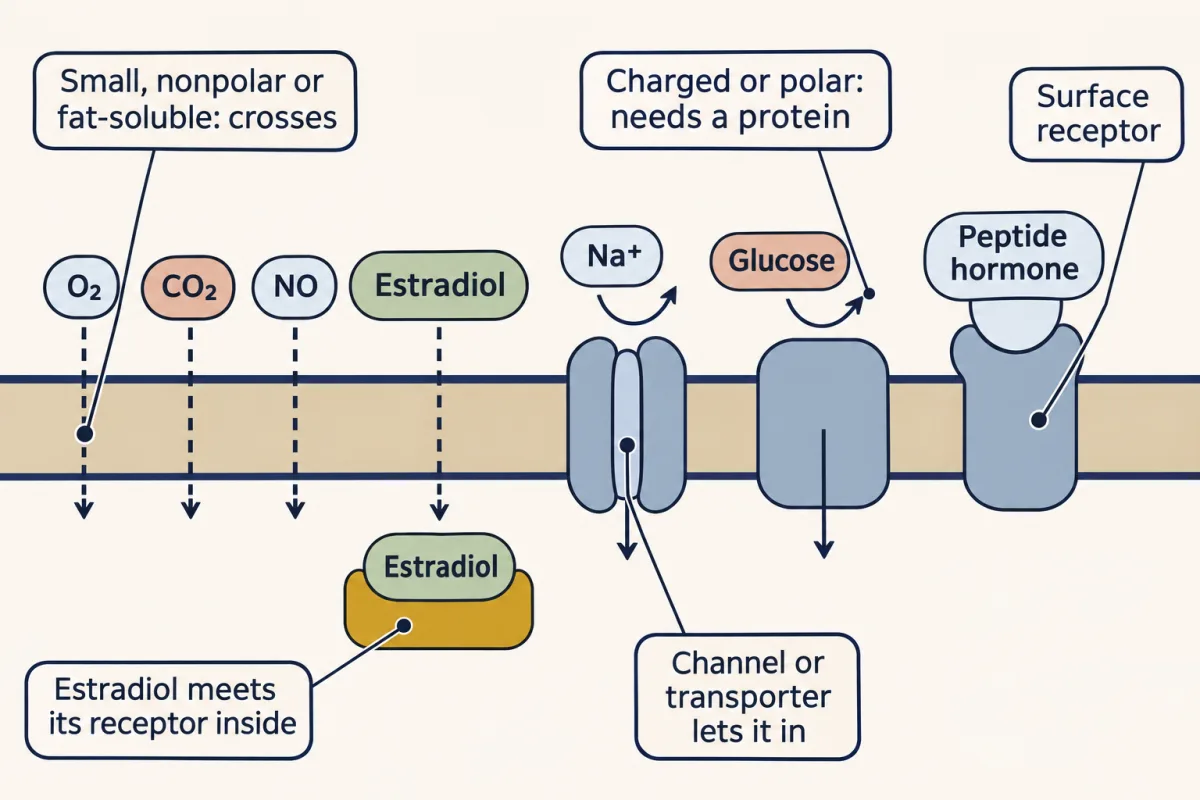
Whether a messenger can cross the membrane largely decides where its receptor sits. Small molecules that are uncharged and not very polar, such as O₂, CO₂ and NO, and fat-soluble ones such as estradiol, slip through and can be sensed inside. Ions, glucose with its polar hydroxyl groups, and peptides need a surface receptor, a channel or a transporter. AI-generated illustration -
Going deeper
Where this lesson fits
Before thisReview first
- Crossing the MembraneBiology · High school
You need to know which molecules cross the lipid bilayer on their own, which decides where a receptor sits.
After thisStudy next
- Binding: Affinity, Occupancy and Dose–ResponseThis course · Lesson 3
It takes the receptor's answer further, with affinity and occupancy deciding how much of a signal a cell detects.
- A Field Guide to ReceptorsThis course · Lesson 4
It builds on who answers by showing how receptor families let one messenger mean different things to different cells.
- Turning the Signal Off: Arrestins, RGS Proteins and PhosphodiesterasesThis course · Lesson 16
It takes clearance and signal lifetime further by showing how cells switch off the receptor and the second messenger.
Elsewhere on the siteFilms, simulations and method films in other courses
- Counting failuresSimulation · Neuroscience
It shows transmitter release and quantal packets at a synapse, the short-range mode of signaling classified here.
- Half-life and plasma levelSimulation · Organismal Biology
It shows hormone level in plasma over time, the long-range endocrine mode with dilution and clearance.
- Tap, Drain and a SensorFilm · Organismal Biology
It shows a hormone released into blood and carried to distant receptor cells, the endocrine mode.
Suggested by an AI model from the lessons themselves, then checked. How we use AI