Cell Signaling · Skim version
Circuits: Amplification, Feedback, Adaptation and Switches
Read the full lesson → Skim the whole course →
The guiding idea
How can one photon change a rod's current without letting the signal spread or run forever?
Circuit architecture and kinetics shape a signal's size, duration, and reversibility.
From the film: How One Photon Becomes a Cellular Signal
- Simple cascades multiply gain; high gain needs shutoff and sometimes insulation.
- In a simple unsaturated cascade, the total gain is the product of the step gains.
- Catalytic rate and active lifetime help set how many downstream molecules one active molecule reaches.
- Downstream shutoff or feedback can shorten a high-gain output, so size and duration are not locked together.
- Local binding, anchoring and destruction can keep a diffusible messenger near its intended targets.
From the film: Three Ways a Signal Changes with Time
- Feedback can limit duration, sharpen decisions, or restore resting output.
- Delayed negative feedback can make output fall while an input remains present.
- Sufficiently strong positive feedback can add bistability and memory to an ultrasensitive response.
- Integral feedback, a negative feedback that corrects until the error is zero, can make adaptation precise even when protein amounts change.
-
Gain is a product, within a simple model
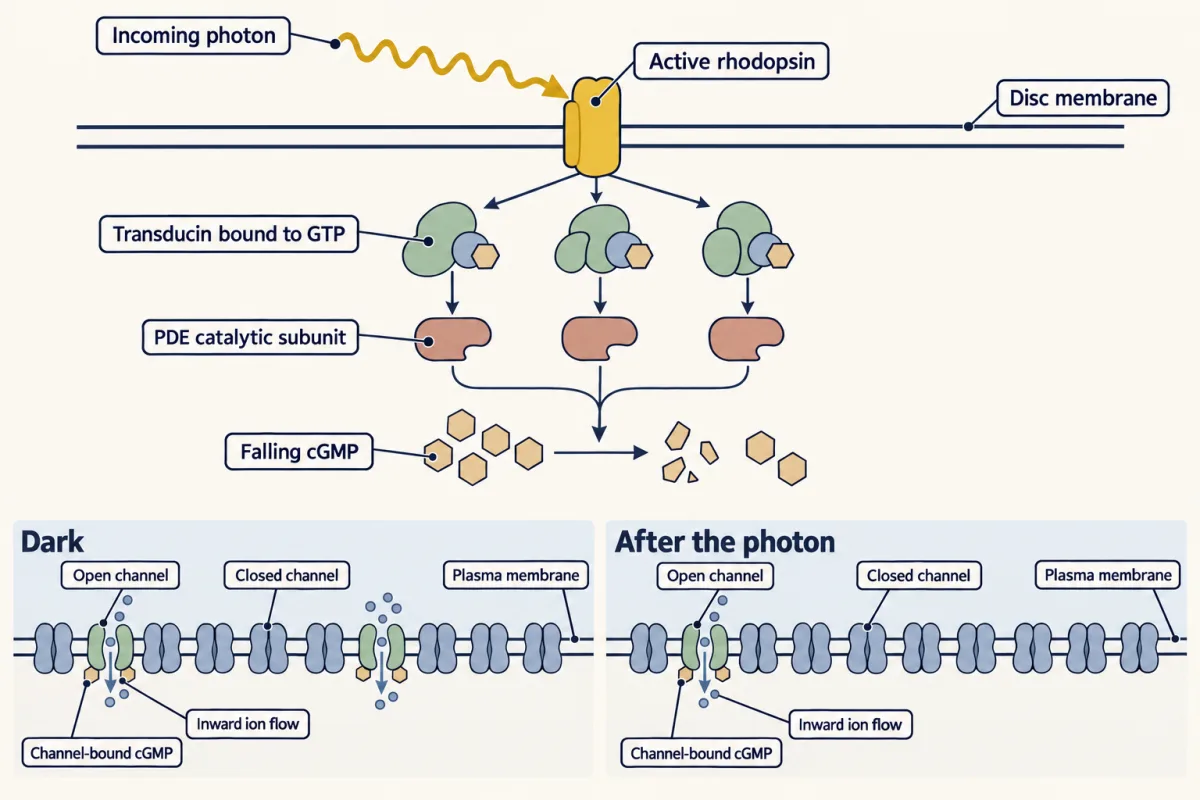
One photon activates a multiplying relay that lowers cGMP, closes some channels and reduces the dark current. AI-generated illustration -
Amplification sends a bill
-
Negative feedback can set how long a signal lasts
-
Positive feedback turns a dial into a switch
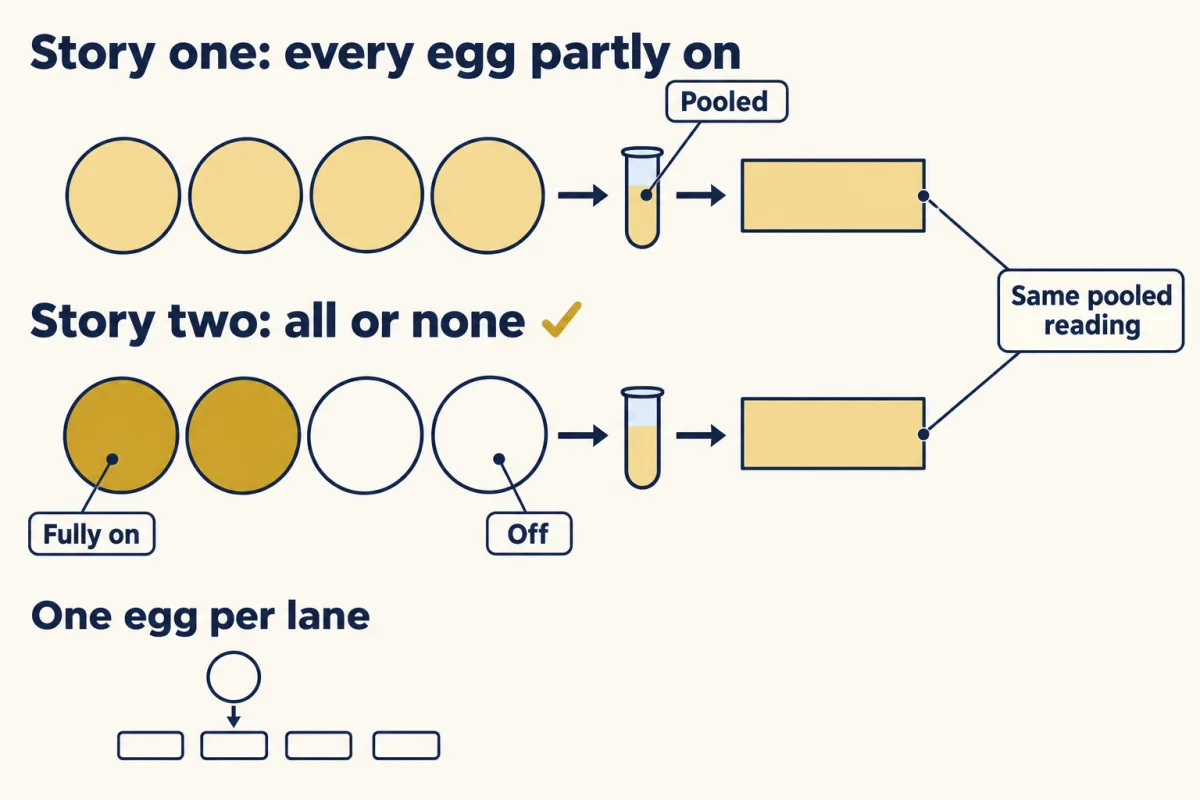
The same population average can hide partly active cells or a mixture of fully on and off cells, so single-cell measurements are decisive. AI-generated illustration -
Adaptation: returning to rest while the signal is still on
-
Put the circuit words to work
-
Going deeper
Where this lesson fits
Before thisReview first
- Binding: Affinity, Occupancy and Dose–ResponseThis course · Lesson 3
Hill coefficients and dose-response curves are used here to describe how steeply a response turns on.
- A Field Guide to ReceptorsThis course · Lesson 4
You need to know what receptors, G proteins and their outputs are before following the rhodopsin-to-current chain.
After thisStudy next
- GTPase Switches: The TimerThis course · Lesson 7
Transducin's self-timed switch-off is the timer that sets how long this cascade stays loud.
- Turning the Signal Off: Arrestins, RGS Proteins and PhosphodiesterasesThis course · Lesson 16
Rhodopsin kinase, arrestin and RGS9 are the shut-off steps this lesson only names.
- Ras to MAPK: The Kinase CascadeThis course · Lesson 19
The three-tier kinase relay here is where the steep, switch-like response comes from.
Suggested by an AI model from the lessons themselves, then checked. How we use AI