Developmental Neuroscience · Skim version
Ventral to Dorsal: Sonic Hedgehog and BMP in the Neural Tube
Read the full lesson → Skim the whole course →
The guiding idea
Graft a second notochord beside a chick neural tube, and the tube grows a second floor.
The neighbours supply a slope of signal; the progenitors draw the lines, deciding whether a dividing cell's daughters become motor neurons or relay neurons for body sensation.
From the film: The Tube Gains a Second Floor
- In chick, a notochord grafted beside the neural tube gave the nearby neural cells floor-plate properties.
- Removing the notochord early stopped the normal floor plate forming, so in these assays the notochord is both sufficient and necessary.
- The floor plate then recruits its neighbours, so the bottom of the tube is told, and once told, it recruits.
From the film: Naming the Signal
- The signal is Sonic hedgehog, made in the notochord and floor plate, and one protein at different doses gave different ventral fates in explants.
- Patched is a brake on Smoothened; Sonic hedgehog lifts the brake, and a progenitor reads the balance of Gli activator against repressor.
- In mice, much of what Sonic hedgehog does in the spinal cord is to block Gli3 repressor.
From the film: A Code in Two Classes
- A level of Shh signal becomes an address, written as a combination of transcription factors.
- Class I factors are switched off by Shh and class II factors are switched on, and their borders sit at different heights.
- Each domain makes one class of neuron, and Pax7, Olig2 and Nkx2.2 serve as landmarks.
From the film: Level and Time
- A progenitor reads both how much Shh signal it gets and for how long.
- In chick neural cells, signaling adapts partly through rising Patched1, so higher doses keep signaling going longer.
- In chick explants, longer exposure at a fixed dose gave more ventral identities, and cutting the signal off let cells fall back to more dorsal ones.
From the film: Drawing the Lines
- The slope sets roughly where each line falls, and pairs of repressing factors such as Pax6 and Nkx2.2 make each line sharp.
- Forcing Nkx2.2 on in the motor neuron domain suppressed motor neurons and gave V3 neurons instead.
- Sharp is not the same as accurate: a large or lasting misreading can tip a cell to the wrong side.
From the film: The Top of the Tube
- BMPs from the epidermis and roof plate pattern the top of the tube, and the roof plate also makes Wnts.
- In mice, removing the roof plate early meant the three dorsal-most interneuron classes later failed to form.
- The wall sits between a signal from below and one from above, and BMP signaling alters the response to Shh.
-
The layout
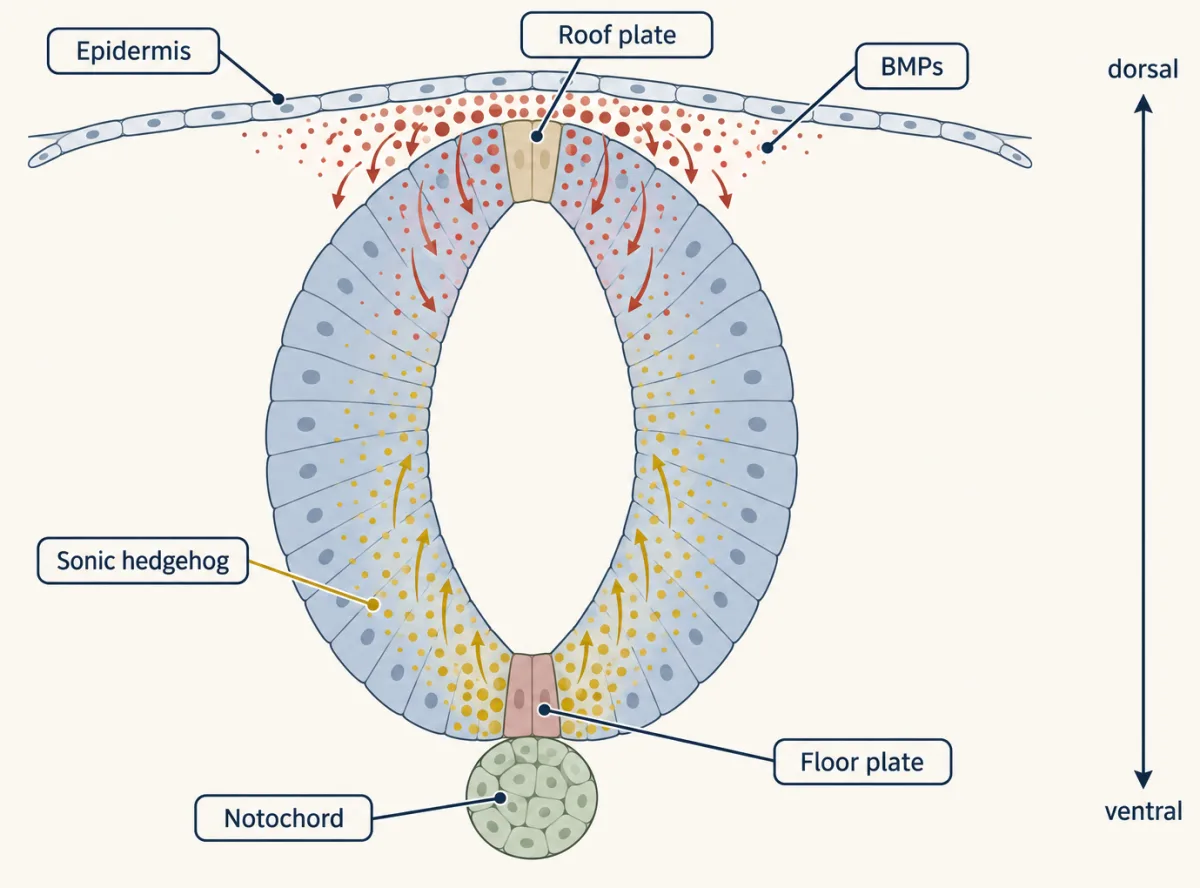
A transverse section of the neural tube. Sonic hedgehog comes from the notochord and floor plate below, BMPs from the epidermis and roof plate above, and the two systems work against each other across the wall where progenitors sit. AI-generated illustration -
Who marks the bottom?
-
Naming the signal
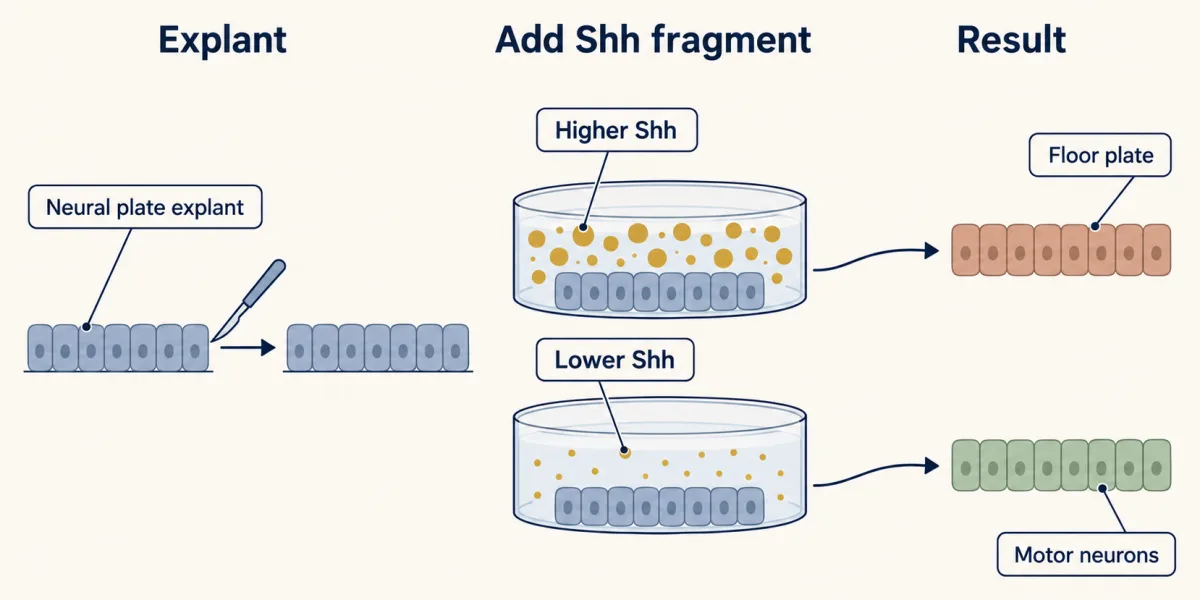
An explant is a small piece of tissue grown in a dish. Given purified Shh amino-terminal fragment, separate neural plate explants showed floor-plate markers at higher concentrations and motor-neuron markers at lower ones. The coloured rows are a qualitative schematic of marker induction, not a conversion of every cell. AI-generated illustration -
Reading the slope: a code written in two classes
-
Level and time
-
Drawing the lines: cross-repression
-
The top of the tube: BMPs from the epidermis and roof plate
-
Putting it together
-
Going deeper
Where this lesson fits
Before thisReview first
- The Organizer: Spemann and MangoldThis course · Lesson 5
The notochord's power to induce neural tissue in grafts is the same kind of experiment extended here.
- Neural Induction: The Default ModelThis course · Lesson 6
You need the BMP-inhibition default model from there to see why BMP returns at the top of the tube.
- Neurulation and Neural Tube DefectsThis course · Lesson 7
It shows how the neural plate rolls into the tube whose floor, roof and wall are mapped here.
After thisStudy next
- Transcription Factor Codes: Building a Motor NeuronThis course · Lesson 11
It takes the pMN domain and shows how Olig2 and other factors build a motor neuron from it.
- Crossing the Midline Once: Slit, Robo and CommThis course · Lesson 24
Commissural axons here grow toward the floor plate that this lesson shows is induced by Shh.
- Hedgehog and the Primary CiliumCell Signaling · Graduate school and beyond
It takes the Patched, Smoothened and Gli signalling used here further, through the primary cilium.
Elsewhere on the siteFilms, simulations and method films in other courses
- A Late Part Reads Signal LengthFilm · Cell Signaling
It shows how a cell reads both the size and the duration of a signal, as progenitors do with Shh.
Suggested by an AI model from the lessons themselves, then checked. How we use AI