A Late Part Reads Signal Length
Read the transcript of “A Late Part Reads Signal Length”
Film transcript: A Late Part Reads Signal Length
How can one kinase carry two different orders? In a rat cell line called PC12, epidermal growth factor, or EGF, says divide. Nerve growth factor, or NGF, says stop dividing and grow nerve-like processes. Both switch on the same kinase, ERK. The molecule is the same, so the difference must lie in something else about the signal. EGF switches ERK on briefly, and the cell divides. NGF keeps ERK on much longer, and the cell stops dividing and grows processes. Engineered cells carry extra EGF receptors. Given EGF, they keep ERK active for longer, and they differentiate. So length matters, and the pathway's wiring shapes it. A cell has no stopwatch.
What it can do is compare the signal with a delayed product of that same signal. In fibroblasts, ERK switches on a gene called c-fos. The c-Fos protein takes time to make, and once made it is quickly destroyed. So the test is simple: is ERK still on when the new protein appears? Think of a clinic that calls your name a while after you sign in. Only the people still in the waiting room are seen. If ERK is still active when c-Fos appears, phosphates are added near one end of the protein. ERK adds them, and so does a kinase that ERK activates. Those phosphates protect c-Fos. After a brief signal, ERK is already off when c-Fos appears. So c-Fos is made and lost.
After a long signal, ERK is still on, and c-Fos builds up. As a transcription factor, it can then switch on later genes. So in fibroblasts, c-Fos lets the cell tell a brief signal from a long one. The signal reaches c-Fos by a fast route and a slow route, and c-Fos needs both. It needs phosphates from ERK, and it needs the new protein, which takes time to make. This was shown for c-Fos in fibroblasts, and later for several other early gene products. Do not assume every long signal is read this way. Keep this rule: a part that arrives late can time a signal.
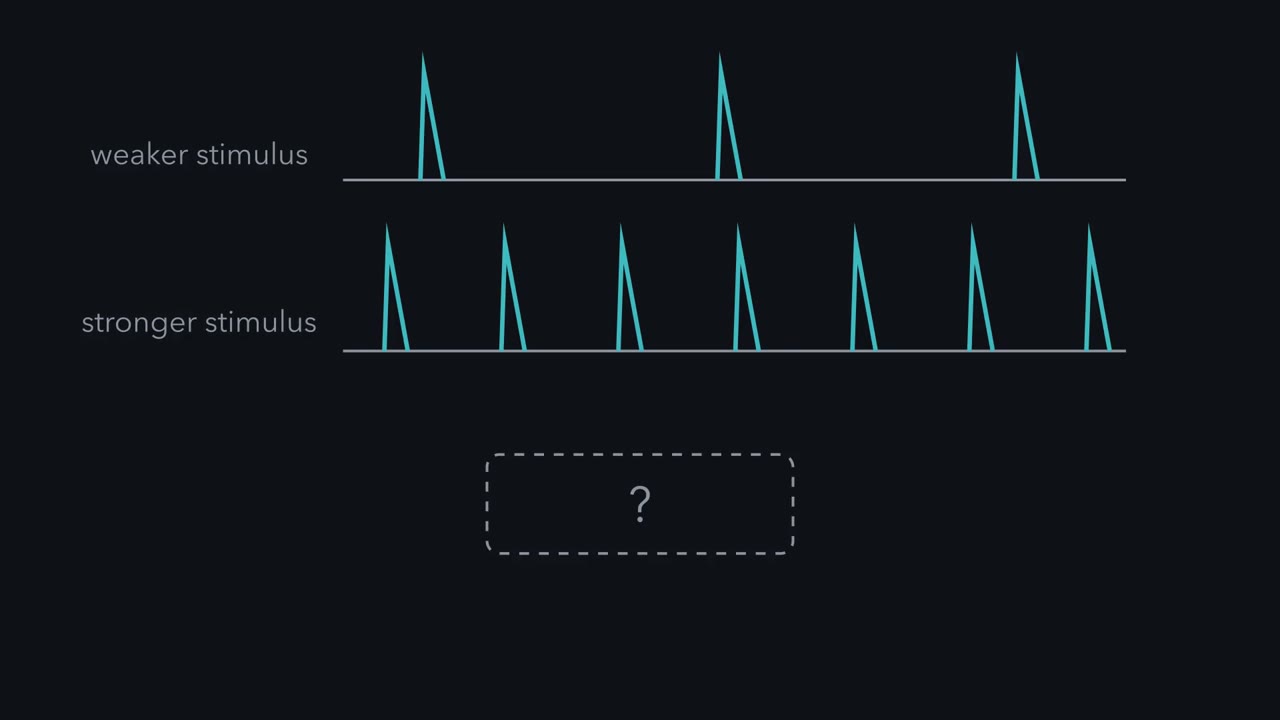
EGF and NGF both switch on ERK in the same cell. How does the cell tell them apart? It reads the shape of the signal: how much, how long, how often and where.
Continue in the lesson: The Shape of a Signal: Size, Duration, Frequency and Place →
2:20 · Free, with captions and a transcript. The lesson has the full text, the questions and the sources.
More films from this lesson
How this film was made. Narration: an AI narrator voice (Kokoro, af_heart) reading narration written from this lesson's text. Animation: AI-generated in code (Manim) by Claude, a schematic with no drawn molecular structures. Captions come from the narration script. See something wrong? Report it.