Genetics and Molecular Biology · Skim version
Sequencing and Genomes
Read the full lesson → Skim the whole course →
The guiding idea
A deeply sequenced genome can have almost no random gaps and still break at one repeat. How can both be true?
Genome results depend on what each read records and where it fits.
From the film: How Chemistry Becomes a Read
- Sequencing turns molecular events into ordered base calls.
- Sanger sequencing reads permanent stops sorted by fragment length.
- Short-read sequencing records one reversible pause per cycle across many clusters.
- Long-read methods follow single molecules and preserve longer-range context.
- Genome results depend on what each read records and where it fits.
From the film: When Reads Become a Genome
- More reads fill sampling gaps; reads that span a repeat place it.
- Coverage is a mean, so random sampling can leave some bases unread.
- An internal read from an exact repeat may fit more than one place.
- A reference helps place reads but also shapes which differences are reported.
- Genome results depend on what each read records and where it fits.
-
Reading DNA one base at a time: Sanger’s stopped copies
-
Reading millions at once, short and long
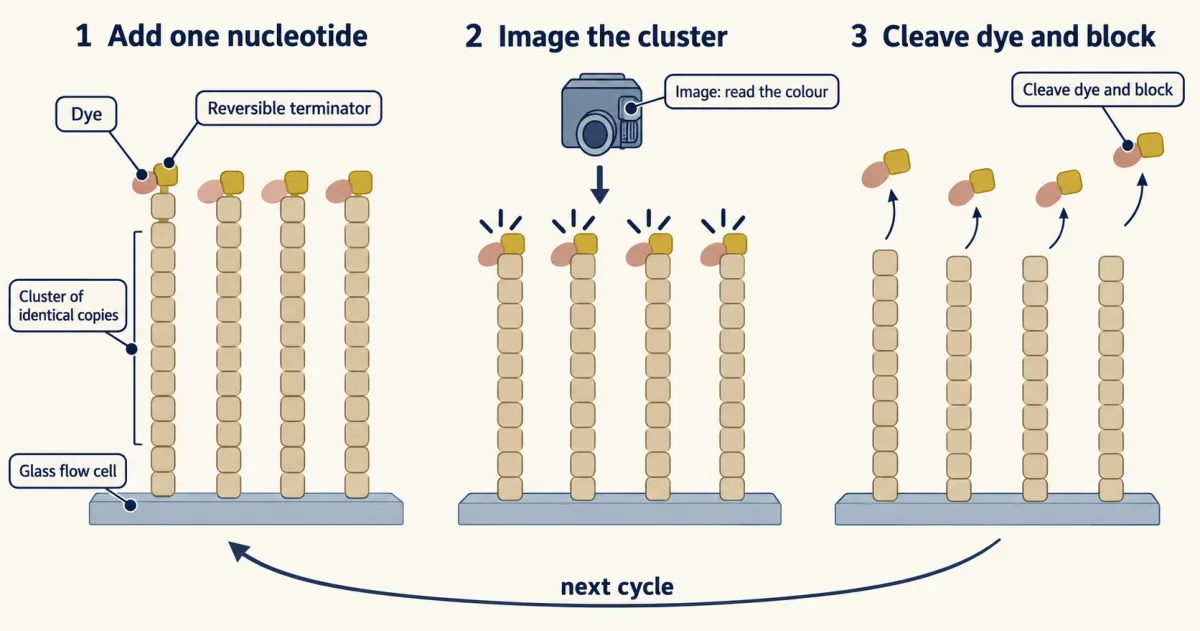
A removable dye and block let every cluster report one base, reset and begin the next sequencing cycle. AI-generated illustration 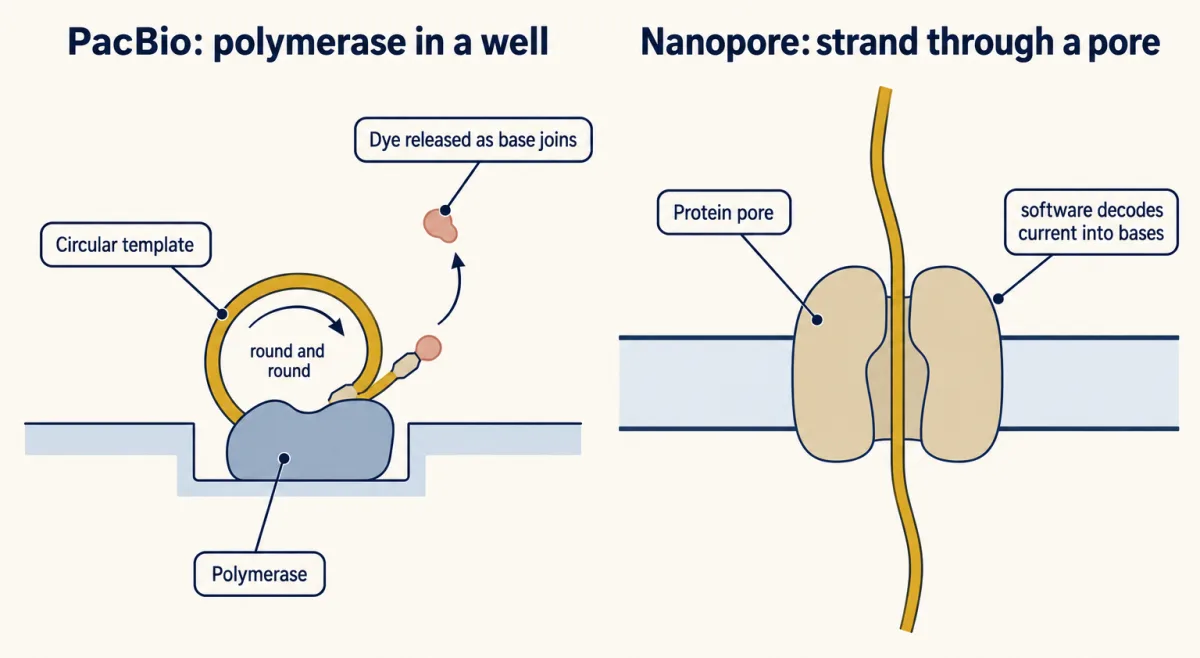
Single-molecule methods preserve longer-range context: PacBio follows one polymerase round a circular template many times, and Oxford Nanopore reads the current as one strand passes through a pore. AI-generated illustration -
Coverage and assembly: two different limits
-
The human reference: gaps, a finished genome and a pangenome
-
What varies between two genomes, and why the reference matters
-
Going deeper
Where this lesson fits
Before thisReview first
- DNA Replication: Semiconservative Copying and Its MachineryThis course · Lesson 13
Sanger and short-read sequencing both rely on polymerase extending a primer, so you need how new strands are built here.
- Recombinant DNA, Cloning and PCRThis course · Lesson 22
Library preparation and amplification of DNA fragments use the cloning and PCR ideas taught there.
- Mutation: Where Variation Comes FromThis course · Lesson 14
Variants called against a reference are the mutations whose origins and types are described there.
After thisStudy next
- Forward and Reverse Genetics: Screens, RNAi and CRISPRThis course · Lesson 24
Genome sequence and reads are used there to find which gene to target and to read what an edit leaves.
- Population Genetics: Hardy-Weinberg and Evolutionary ForcesThis course · Lesson 25
Variants found by sequencing many genomes are the allele frequencies this lesson analyses.
- Complex Traits, Heritability and GWASThis course · Lesson 26
GWAS builds on genotypes and variant calls from sequencing, and on the reference used.
Elsewhere on the siteFilms, simulations and method films in other courses
- Molecular clock datingMethod film
Sequence differences between genomes accumulate over time, and this method dates splits from them.
- Radioactive and stable isotope tracersMethod film
Radioactive labels were used to read the classical four-lane Sanger gel fragments.
Suggested by an AI model from the lessons themselves, then checked. How we use AI