Developmental Neuroscience · Skim version
Sensitive Periods in Behavior: Song, Language and Sight
Read the full lesson → Skim the whole course →
The guiding idea
A young songbird that never hears an adult sing grows up singing a simple, abnormal song. Why can't it catch up later?
The same experience can have a lasting effect at one age and little effect at another.
From the film: One Input, Many Ages
- The same experience can leave a strong, lasting mark at one age and little mark at another.
- In white-crowned sparrows, song heard early is copied well months later, while recordings played to older birds had little effect.
- To define a window, measure what lasts against the age at which the input was given.
From the film: Who Closes the Window?
- In zebra finches, hearing a tutor seems to help close the window, though later studies gave mixed results.
- Missing input delays the closing of the window but does not abolish it.
- NMDA receptors in the anterior forebrain are needed while the song is memorized, but where the memory is stored is not shown.
From the film: What Lasts Is Not What Can Be Learned
- Delayed access to a first language does affect later proficiency, and missing early language, not only age, seems to leave a lasting mark.
- In second-language grammar, scores fall steadily with later age of arrival from childhood, a graded outcome rather than a sudden step.
- What lasts can start to fall before the ability to learn does, so a curve of what lasts is not a curve of learning ability.
- Different visual abilities have separate sensitive periods.
-
Song: listen first, practice later
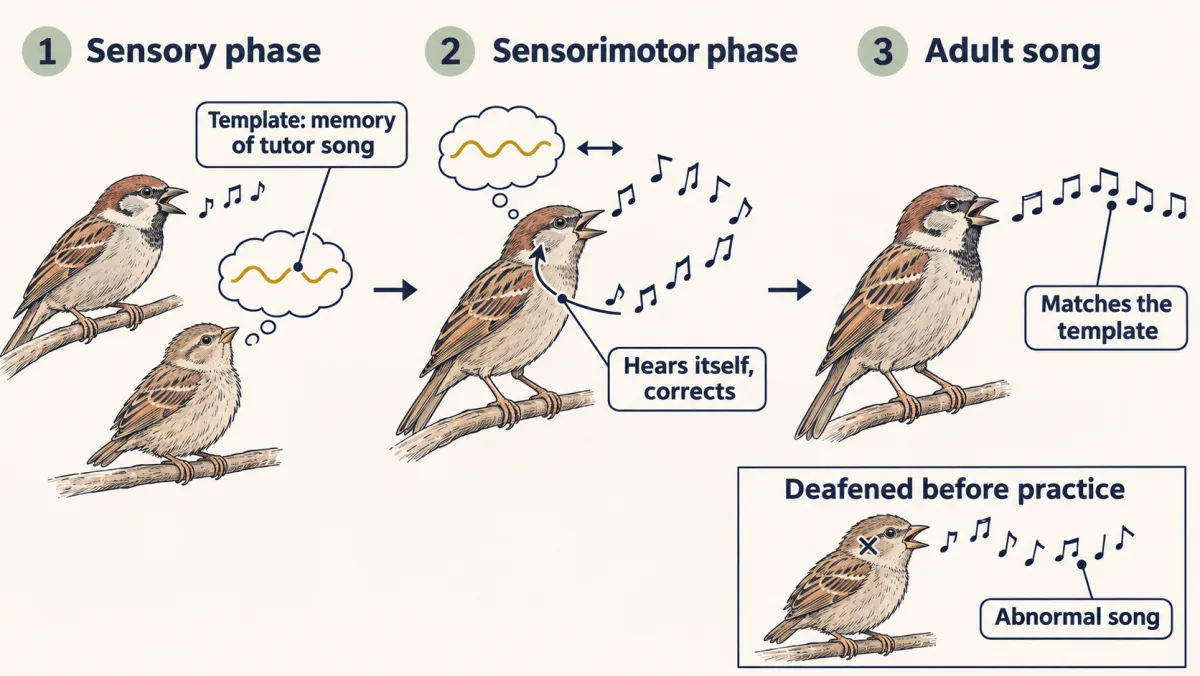
Song learning splits into a sensory phase, when the bird memorises a template, and a sensorimotor phase, when it practises and corrects itself. A bird deafened before practice sings abnormally even though it heard a tutor: it must hear itself. AI-generated illustration -
How sharp is the window?
-
Who closes the window?
-
Which circuit matters while song is learned?
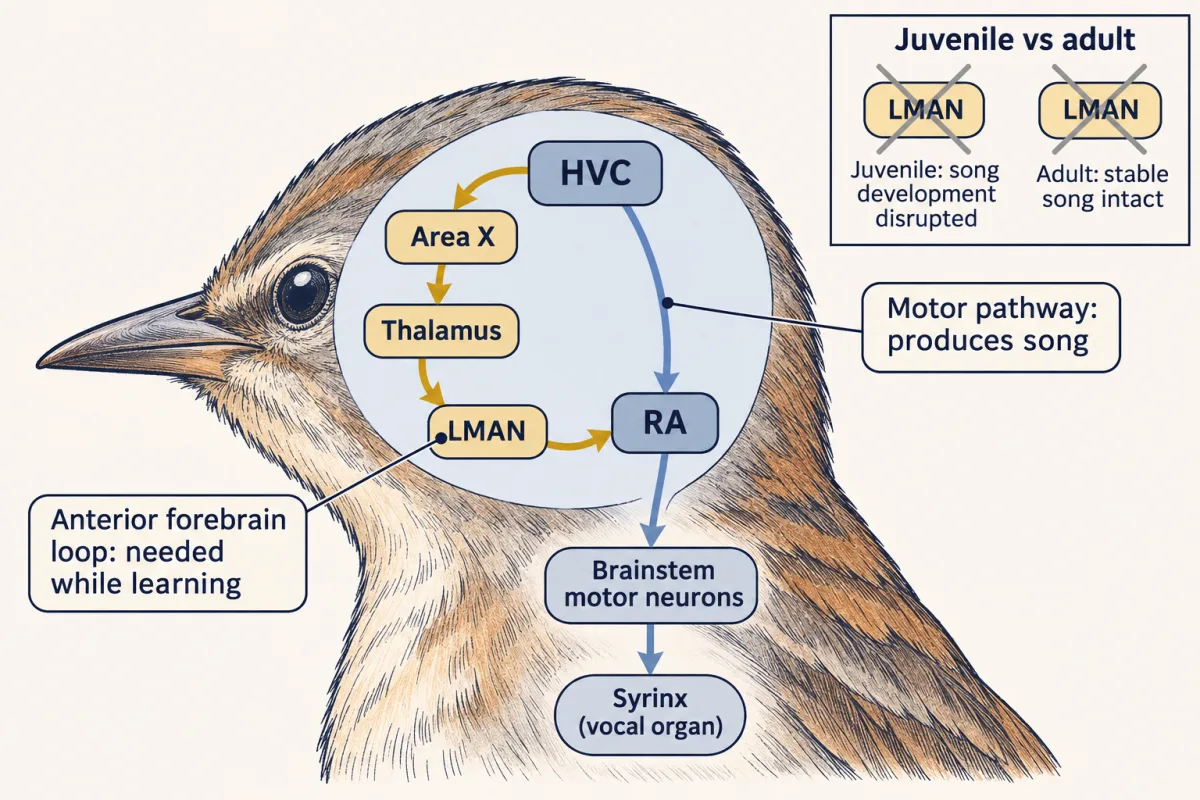
Two routes leave HVC: a motor pathway that produces song, and an anterior forebrain loop through area X, the thalamus and LMAN that rejoins it at RA. LMAN lesions disrupted song development in juveniles but not stable song in adults, so this loop matters while song is learned. AI-generated illustration -
Language: what the age effects do and do not show
-
Sight: separate windows for separate abilities
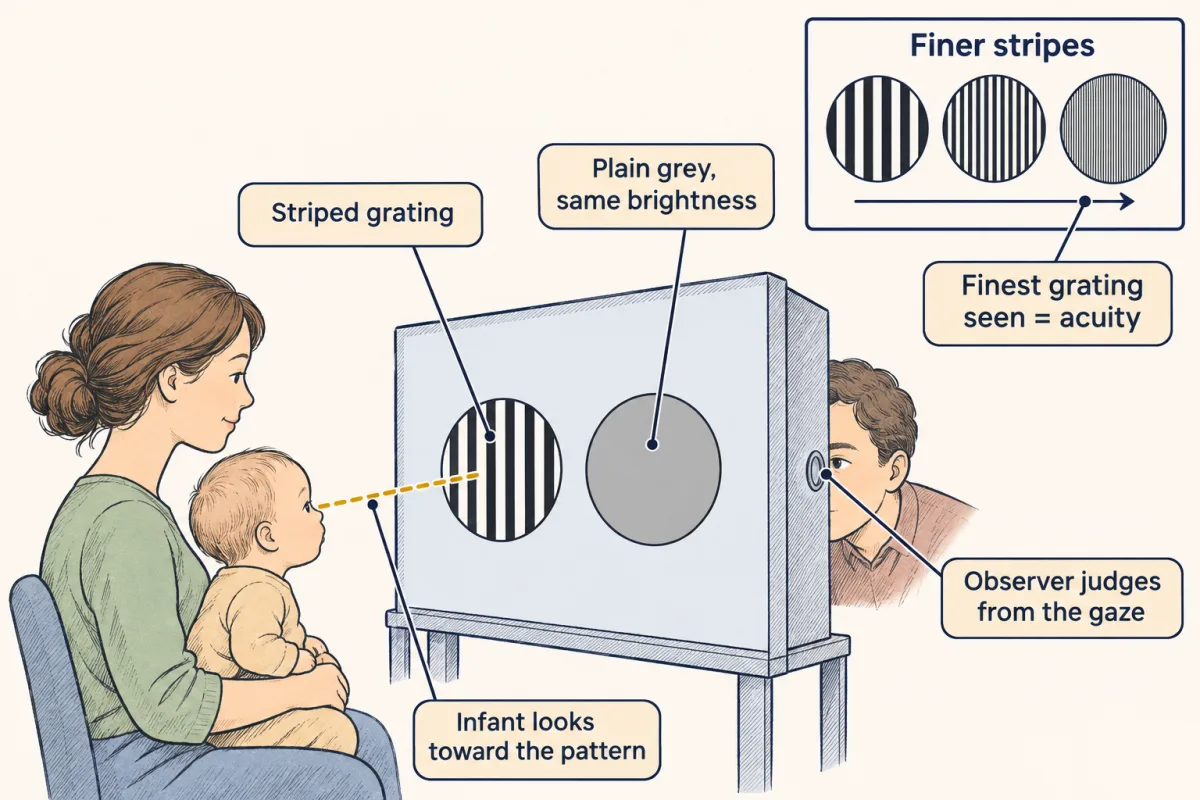
In forced-choice preferential looking, an observer who cannot see which side holds the stripes judges from the infant's gaze, and the finest grating the infant reliably looks at gives its acuity. AI-generated illustration -
Putting it together
-
Going deeper
Where this lesson fits
Before thisReview first
- Ocular Dominance and the Critical PeriodThis course · Lesson 39
You need the kitten monocular-deprivation results and the critical period idea from there, which this lesson extends to song, language and sight.
- Opening and Closing a Critical PeriodThis course · Lesson 40
It explains the cortical brakes that close windows, which this lesson compares with the song window and its NMDA-receptor evidence.
- Activity Before Experience: Spontaneous Retinal WavesThis course · Lesson 38
It shows how activity before experience prepares the circuit that later input refines, which this lesson assumes.
After thisStudy next
- Where Glia Come FromThis course · Lesson 43
It starts the next unit, but only loosely continues this lesson's themes.
Suggested by an AI model from the lessons themselves, then checked. How we use AI