Ecology and Evolution · Skim version
Natural Selection in Ecological Context
Read the full lesson → Skim the whole course →
The guiding idea
On lichen-covered trees, birds find dark moths more easily than pale ones. Is that evolution yet, and what else would you need to know?
Natural selection is a difference in reproductive success among variants that already exist, caused by an agent in an environment; inheritance carries the sorting forward, so it becomes evolution only when that variation is inherited.
From the film: Selection Has an Agent
- Natural selection is a difference in reproductive success among variants that already exist, caused by an agent in an environment, such as a predator.
- Which variant is favoured depends on the environment: on sooty bark birds took more pale moths, on lichen more dark ones.
- Fitness is relative: what matters is how one morph does compared with another in the same place.
- Selection sorts within one generation; inheritance carries the sorting forward, so it becomes evolution only if the sorted variation is inherited.
From the film: Two Enemies, One Gall
- For a trait with a range of values, plotting relative fitness against the trait shows the mode of selection.
- Favouring one end is directional, favouring the middle is stabilizing, and favouring both ends is disruptive.
- In goldenrod galls, wasps took more larvae in small galls and birds more in large ones, so intermediate galls survived best.
- Because wasp attack outweighed bird attack in those fields, selection also favoured larger galls: one trait carried two components.
-
Measuring the fitness difference
-
Peppered moths and birds
-
Gall flies: two modes in one trait
-
Disruptive: crowded sticklebacks
-
Frequency-dependent: rare guppies
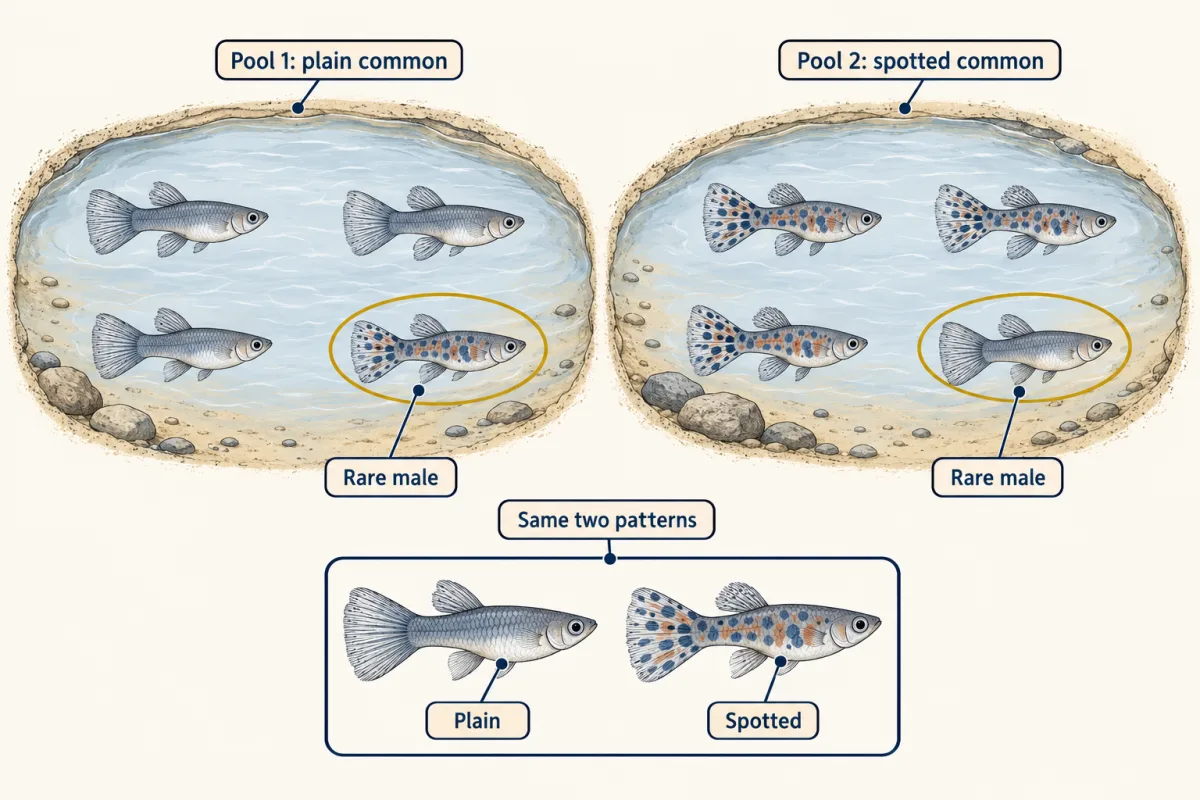
Reversing which pattern was rare between pools, with male guppies set at about 3 common to 1 rare, let rarity be told apart from the pattern itself. The drawing simplifies the study's two tail-colour patterns to plain and spotted. AI-generated illustration -
Sexual selection: the widowbird tail
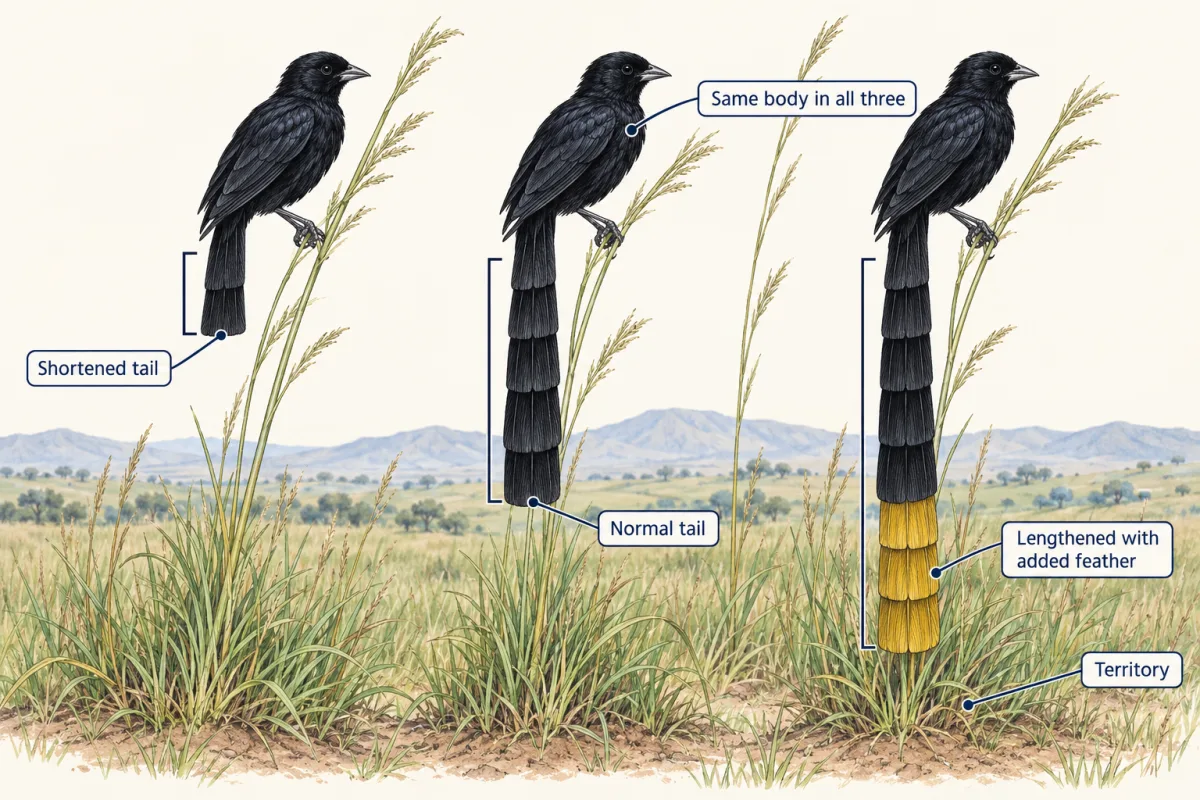
Random assignment made the tail the one planned difference: in Andersson's experiment in Kenya, males matched in groups of four had tails shortened, left normal (two control groups), or lengthened with added feather. AI-generated illustration -
Going deeper
Where this lesson fits
Before thisReview first
- How to Test an Evolutionary ExplanationThis course · Lesson 1
It separates selection within a generation from evolutionary response, the distinction this lesson uses throughout.
After thisStudy next
- Drift, Gene Flow and Competing ExplanationsThis course · Lesson 4
It sets chance change in morph share against selection, so you can judge which explains a data set.
- Life Histories and Evolutionary Trade-offsThis course · Lesson 10
It reads fitness components such as survival and fecundity as trade-offs, using the fitness idea built here.
- Predation and Community EffectsThis course · Lesson 17
It follows predators as the agent of selection on prey into effects on whole communities.
Elsewhere on the siteFilms, simulations and method films in other courses
- Moths and birdsSimulation · Life Science
The peppered moth case shows how a bird predator changes the share of dark and pale moths.
- Beak depth and a riverSimulation · Biology
A drought acts as the agent of selection, sorting finches by beak depth.
- How Populations ChangeFilm · Biology
It shows how inherited variation affecting reproductive success changes a population across generations.
Suggested by an AI model from the lessons themselves, then checked. How we use AI