Cell Biology · Skim version
The Secretory Pathway
Read the full lesson → Skim the whole course →
The guiding idea
Label a pancreas cell's new proteins for a few minutes, then watch them move: what route do they take, and how do you know?
A secreted glycoprotein travels from the rough ER through the Golgi stack to the cell surface, and its sugar chains are trimmed and rebuilt along the way, so they record which processing enzymes it has met.
From the film: Forward Is the Default
- A pulse-chase labels one batch of new protein, the cohort: in the guinea-pig pancreas it lay over the rough ER at about 5 minutes, the Golgi at about 20 and the storage granules at about an hour.
- The sugar chain goes on whole in the ER and is cut and rebuilt step by step by overlapping Golgi enzymes, so it records which enzymes a protein has met: a rough odometer, not an address.
- Endo H, added to samples taken over a chase, cuts chains not yet rebuilt past mannosidase II; as the cohort is processed, the faster cut band gives way to the uncut one.
- For soluble cargo in animal cells, forward is the default destination: in COS cells, the ER chaperone grp78 lost its KDEL tag and was secreted, while tagged proteins are fetched back.
- For the soluble cargo compared here, the trans-Golgi network can release it at once by constitutive secretion (the door) or store it in granules of regulated secretion (the shelf) until a stimulus.
From the film: Crossing the Golgi Stack
- Golgi enzyme populations stay enriched at different levels—early enzymes toward cis and later ones toward trans—even as cargo moves through.
- In the stable-compartment model, each cisterna keeps its enzymes and small vesicles carry cargo from one to the next.
- Rothman's cell-free assay inferred VSV G transfer between donor and acceptor Golgi from a sugar readout and needed ATP and cytosol; it did not observe transport within one stack.
- In the cisternal maturation model, the cisterna carries the cargo from cis to trans, and its enzymes are carried back in COPI vesicles to the younger cisterna behind.
- For the stacked mammalian Golgi the question is open; maturation has been proposed as the best candidate for a shared core.
-
The route, station by station
-
The odometer: what the sugar chain records
-
Fetched back: the KDEL signal
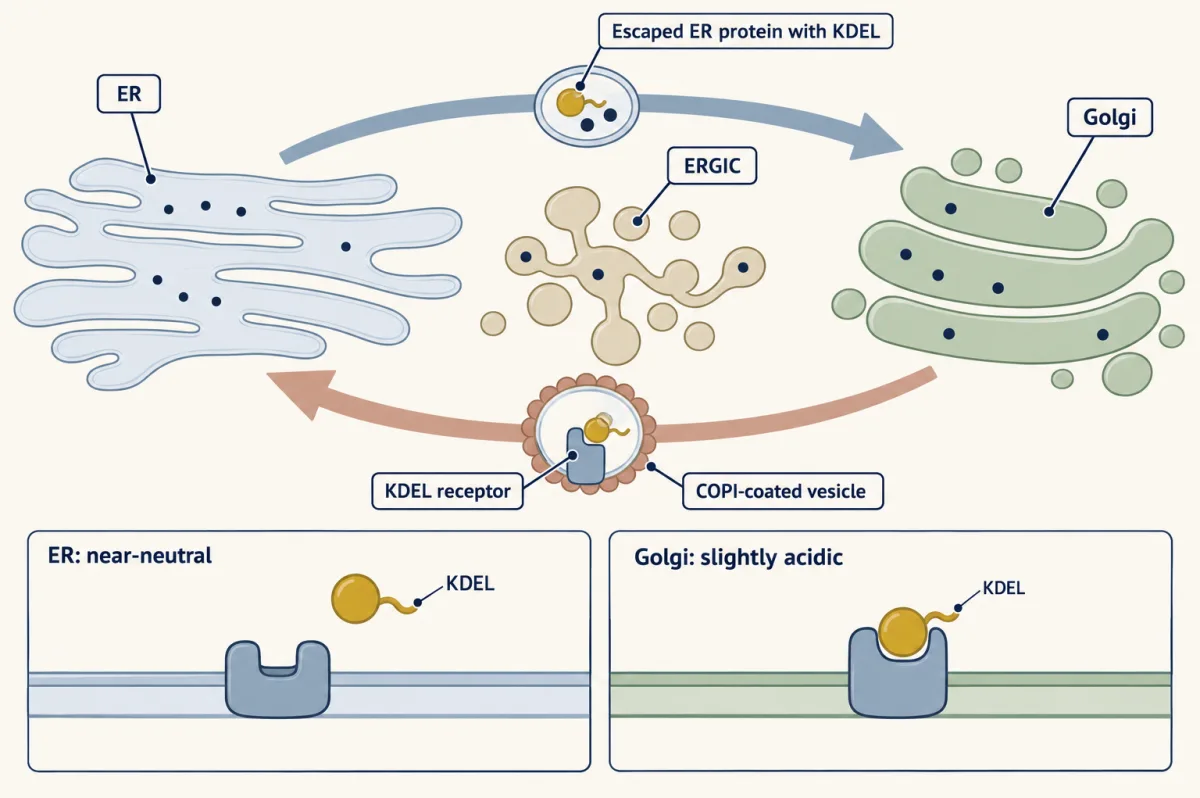
A return-to-sender label. A KDEL receptor binds the tag on an escaped ER protein in the slightly acidic ERGIC and Golgi, rides back to the ER in a COPI-coated vesicle, and lets go at the near-neutral pH of the ER. AI-generated illustration -
Crossing the Golgi: residents carried backward
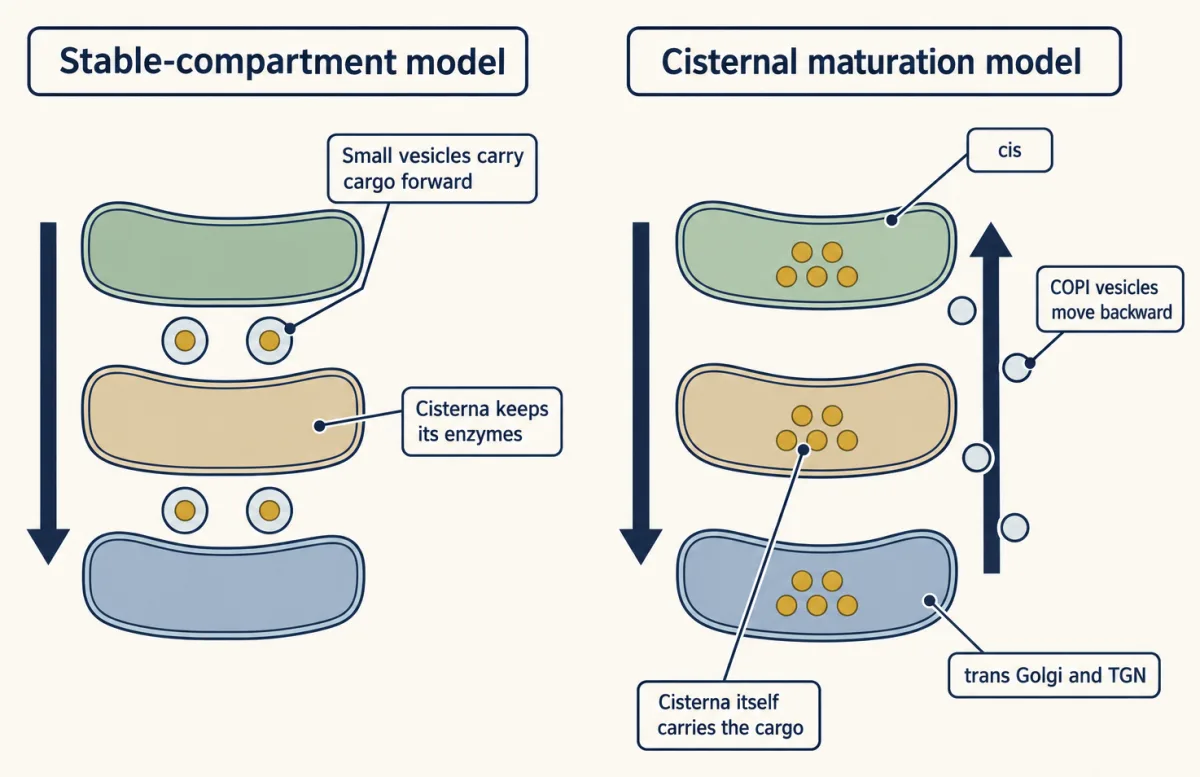
Two pictures of how cargo crosses the Golgi. In the stable-compartment model, cisternae keep their enzymes and vesicles carry cargo forward; in the cisternal maturation model, the cisterna carries the cargo and changes character from cis to trans, while COPI vesicles move enzymes backward. AI-generated illustration -
Two exits: the door and the shelf
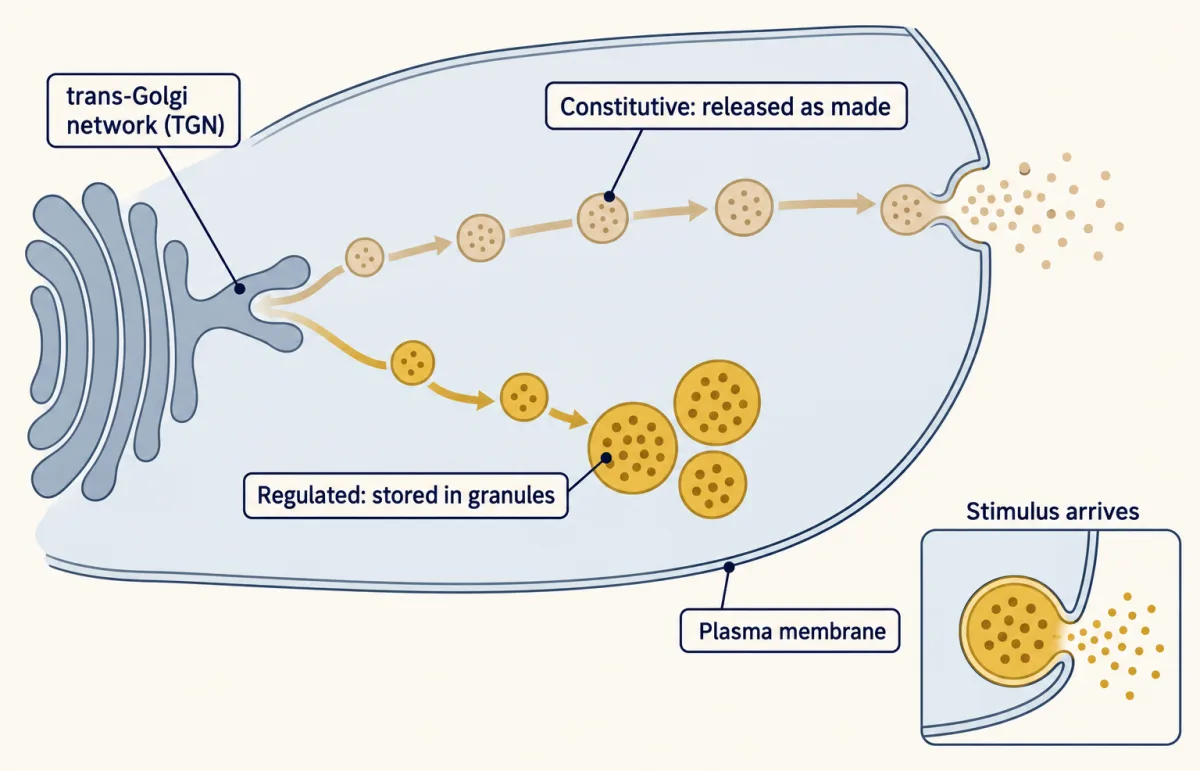
The routes split at the trans-Golgi network, and sorting can continue in immature granules. Constitutive secretion releases protein as fast as it is made; regulated secretion stores it in granules until a stimulus arrives. Nearly every eukaryotic cell has the first route, and endocrine, exocrine and nerve cells, among others, add the second. AI-generated illustration -
Going deeper
Where this lesson fits
Before thisReview first
- Protein Sorting into CompartmentsThis course · Lesson 7
You need signal sequences and SRP entry into the ER from there before following the protein onward.
- Vesicle Budding, Targeting and FusionThis course · Lesson 11
COPII and COPI carriers and SNARE fusion are used here without being re-taught.
- Experiments That Distinguish MechanismsThis course · Lesson 3
Pulse-chase logic and fractionation are used here to read order and timing.
After thisStudy next
- Endocytosis, Recycling and DegradationThis course · Lesson 13
Cargo that reached the surface by this route is taken back in and sorted to recycling or degradation.
- Cell Identity, Cell State and DiseaseThis course · Lesson 25
Secretory capacity and secretion routes feed into how cell identity and cell state shape what a cell exports.
Elsewhere on the siteFilms, simulations and method films in other courses
- Build a big molecule from small blocksSimulation · Biology
Building large molecules from blocks shows how sugar chains are put onto and trimmed from a protein.
- One Cell, One Shipping LineFilm · Biology
It follows insulin from nucleus through rough ER and Golgi to secretion, the same route traced here.
- A Room With No Way OutFilm · Biochemistry
It shows how membrane-bound compartments keep a lysosomal enzyme's cargo in its own room, as the Golgi stack does.
Suggested by an AI model from the lessons themselves, then checked. How we use AI