Genetics and Molecular Biology · Skim version
RNA Processing: Caps, Tails and Splicing
Read the full lesson → Skim the whole course →
The guiding idea
Why is a message copied from more than 5,000 nucleotides of DNA only 737 nucleotides long?
Processing marks transcript ends and chooses which segments join into messenger RNA.
From the film: From Transcript to Message
- Processing marks transcript ends and chooses which segments join into messenger RNA.
- A cap marks the 5' end, while cleavage and a poly(A) tail form the 3' end.
- The branch-point adenosine starts a two-step reaction that joins the exons.
- The spliceosome uses small nuclear RNAs and proteins to recognize sites and rearrange the transcript.
From the film: When the Joins Change
- Coding-length changes keep the downstream frame only in multiples of three.
- Alternative splicing lets one gene make mRNAs with different combinations of exons.
- A weakened splice site most often causes exon skipping; less often a cryptic site takes over or the intron is retained.
- The frame rule applies to net changes in coding sequence; sequence decides the protein outcome.
-
One transcript, three processing decisions
-
Marking the two ends
-
The evidence for split genes
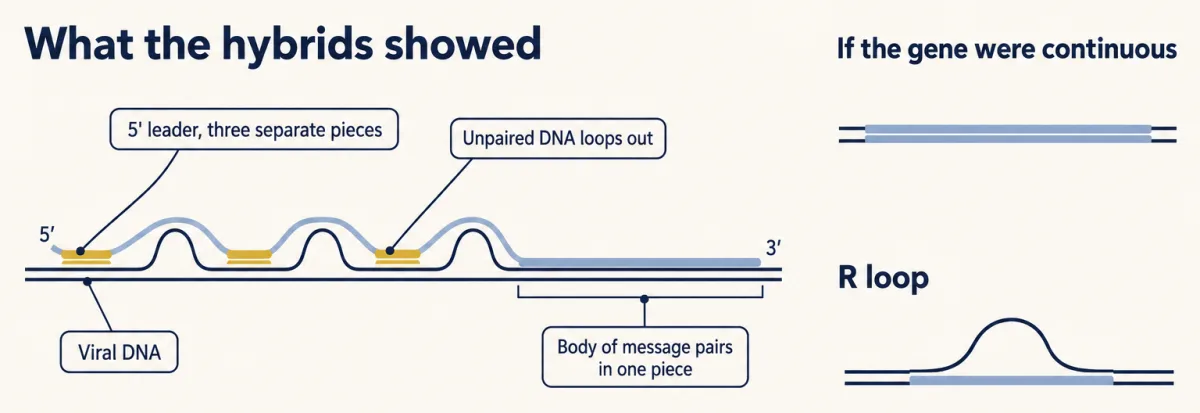
A message from a continuous gene would pair with one unbroken DNA stretch, but adenovirus 2 leaders paired with separated regions and left the intervening DNA looped out. AI-generated illustration -
How the spliceosome joins exons
-
One gene, several messages
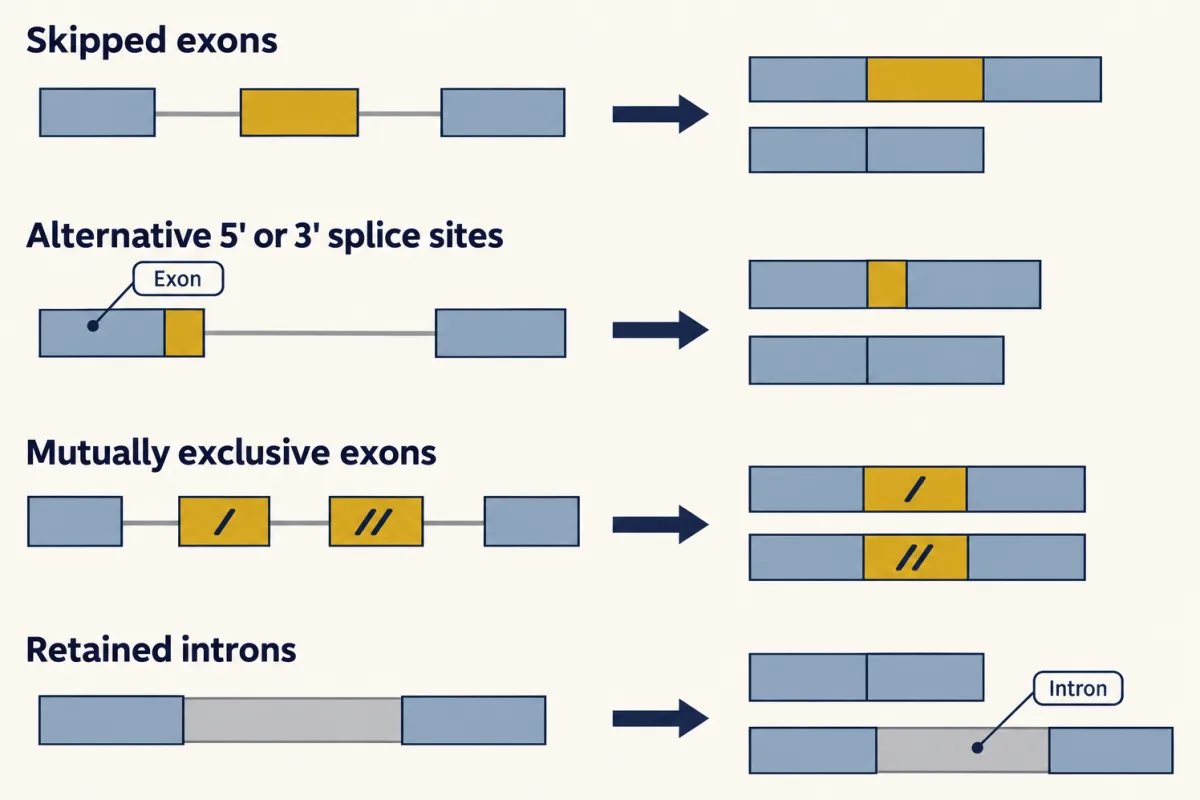
Splice-site choices let one gene make messages with skipped exons, alternative 5' or 3' splice sites, mutually exclusive exons or retained introns. AI-generated illustration -
What a splice-site mutation can do
-
Going deeper
Where this lesson fits
Before thisReview first
- Transcription: From DNA to RNAThis course · Lesson 16
You need to know how RNA polymerase makes the primary transcript that gets capped, tailed and spliced here.
- DNA Is the Genetic MaterialThis course · Lesson 12
This lesson assumes you know DNA carries the gene, so a gene's length can be compared with its message.
After thisStudy next
- The Genetic Code and TranslationThis course · Lesson 18
The reading-frame rule for splice changes builds directly on how codons are read in triplets.
- Eukaryotic Gene Regulation and EpigeneticsThis course · Lesson 20
Alternative splicing and the cap-and-tail steps are regulated there as part of gene control in eukaryotes.
- Sequencing and GenomesThis course · Lesson 23
Reading spliced transcripts, such as junction reads joining exon 1 to exon 3, depends on sequencing methods taught there.
Elsewhere on the siteFilms, simulations and method films in other courses
- From Gene Copy to Protein ChainFilm · Biology
It shows how a gene copy is made into mRNA and read, which the processed message feeds.
- Where the Reader WorksFilm · Cell Biology
It shows how a signal sequence in a processed message's protein directs it to its compartment.
- One Cell, One Shipping LineFilm · Biology
It follows an mRNA copy leaving the nucleus to a ribosome, the step that export of a capped, tailed message enables.
Suggested by an AI model from the lessons themselves, then checked. How we use AI