Where the Reader Works
Read the transcript of “Where the Reader Works”
Film transcript: Where the Reader Works
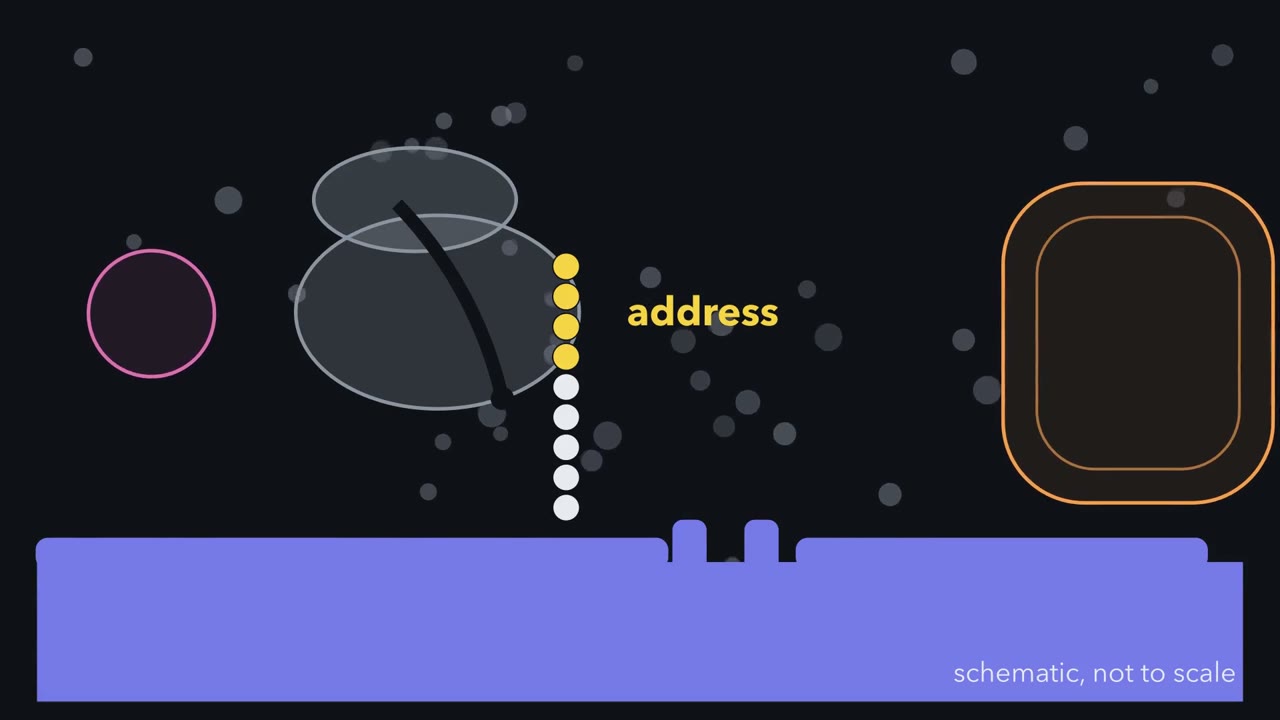
A secretory protein made in a test tube with no membranes comes out longer than the one cells secrete. What is the extra piece, and why does the cell lose it? The extra piece is an address, a stretch of the protein's own chain called a signal sequence. A ribosome builds a chain from its amino-terminal end and hides the newest part in a tunnel. So that end, here the address, emerges first. SRP binds near the ribosome's exit and reads the address as it emerges. In the classic preprolactin experiment, translation slowed or stopped until ER membranes arrived. SRP docks on its receptor, next to Sec61, the channel into the ER. Like two hands gripping only while both hold GTP, they hand the ribosome to the channel.
The chain begins threading in, and GTP hydrolysis opens both hands. The chain enters unfolded, as it is made. Signal peptidase snips off the address: the piece the test tube kept, with no membrane. Back to the test tube. Add the membranes only after the chain is finished and released. Does the protein get inside?
In this test it stays outside, and long: a released chain gives SRP no ribosome to steer. Some ER proteins enter after release, by other routes. So here is the idea. An exposed address helps specify where a protein goes.
Where and how its reader works helps decide when it is read: as the chain grows, or after release. A mitochondrial address also comes out first. But its reader, TOM, the outer membrane's import gate, sits on the mitochondrion. Most of these chains are released before TOM reads them. And a ribosome sitting on the mitochondrion? Hold that question. Released chains may start to fold, though helper proteins called chaperones often keep them loose. To cross TOM and the inner membrane's TIM23 complex, a chain must be at least partly unfolded. The membrane potential, a voltage across the inner membrane, pulls on the positive address. Inside, the chaperone Hsp70 uses ATP to grip the chain.
Put that address on a mouse enzyme, and the enzyme goes in too. Lock the enzyme folded with the drug methotrexate, and import stops. It had to unfold. A peroxisomal address is often the last three amino acids, such as SKL. They leave the tunnel only as the chain is released, so they are read afterwards. Its reader, PEX5, is a receptor free in the cytosol. It carries the finished protein in. Unlike mitochondria, peroxisomes can import cargo that stays folded. How it crosses is still debated. So the address points the way, and where its reader works shapes the timing. SRP meets growing chains; other readers mostly meet finished ones. Mitochondria need those unfolded; peroxisomes can take them folded.
Made in a test tube with no membranes, a secretory protein comes out longer than the one the cell secretes. Why?
Continue in the lesson: Protein Sorting into Compartments →
3:45 · Free, with captions and a transcript. The lesson has the full text, the questions and the sources.
More films from this lesson
How this film was made. Narration: written from this lesson's text and read by an AI narrator voice (Kokoro, af_heart). Animation: AI-generated in code (Manim) by Claude, a schematic with no drawn molecular structures. Captions come from the narration script. See something wrong? Report it.