Genetics and Molecular Biology · Skim version
Population Genetics: Hardy-Weinberg and Evolutionary Forces
Read the full lesson → Skim the whole course →
The guiding idea
If a trait is dominant, why does it not take over a population?
Mating reshuffles alleles; dominance alone does not change their frequency.
From the film: Why Dominance Does Not Spread an Allele
- Mating reshuffles alleles; dominance alone does not change their frequency.
- At a two-allele autosomal locus, allele frequency counts copies across the population.
- With equal allele frequencies in eggs and sperm, random mating gives expected genotype proportions p squared, two p q and q squared.
- Hardy-Weinberg is a null model, not proof that no evolutionary force acts.
From the film: What Moves Allele Frequencies?
- Forces change allele frequencies in distinct, testable ways.
- Selection changes which genotypes contribute copies; migration mixes populations.
- Mutation creates alleles, while drift samples them without a preferred direction.
- Non-random mating alone rearranges genotypes without changing allele frequencies.
-
The idea: with nothing acting, frequencies stay put
-
Counting alleles and testing equilibrium
-
What can move a frequency?
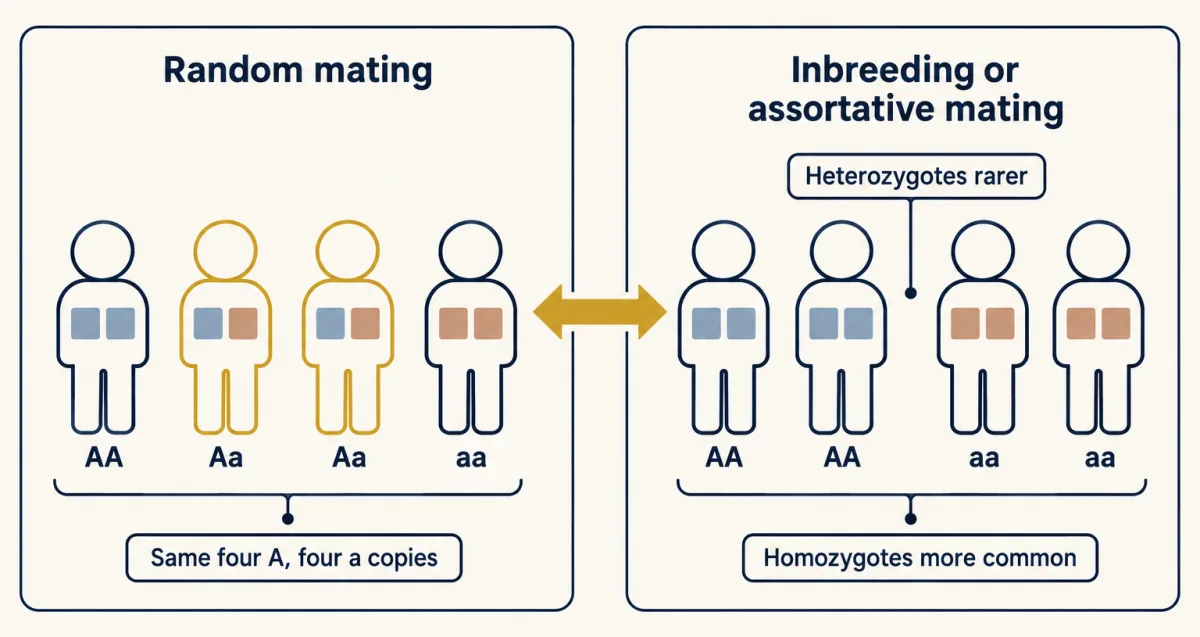
Inbreeding and assortative mating pair the same allele copies differently: homozygotes become more common and heterozygotes rarer, so genotype frequencies change while p and q stay where they were. AI-generated illustration -
Drift and founders: chance in small populations
-
Balanced polymorphism: sickle cell and malaria
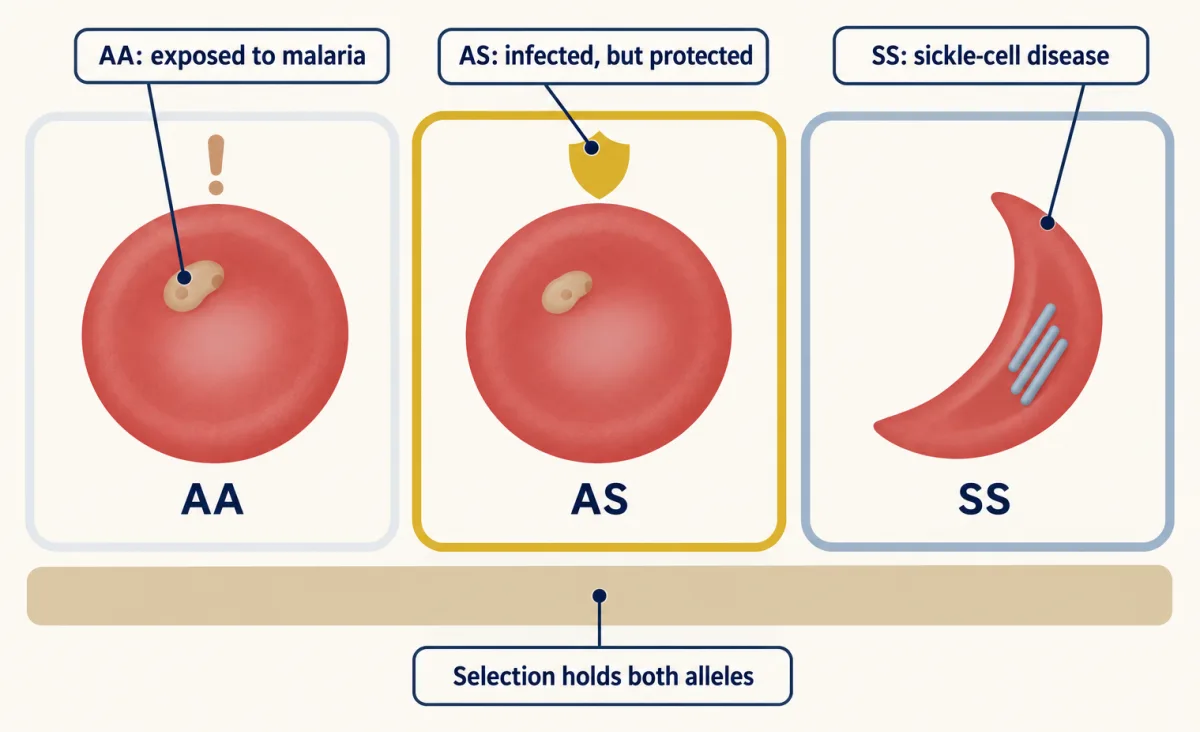
Sickle-cell trait (AS) does not give immunity to malaria, but it was associated with protection against mild, admitted and severe malaria. AS outsurvives AA through malaria and SS through the disease, so selection holds both alleles. AI-generated illustration
Where this lesson fits
Before thisReview first
- Probability, Crosses and the Chi-Square TestThis course · Lesson 3
You need the product and sum rules and the chi-square test from there to derive and test Hardy-Weinberg proportions.
- Mendel's Peas: Segregation and Independent AssortmentThis course · Lesson 1
Segregation of two alleles into equal gametes is what lets random mating give p squared, 2pq and q squared.
- Mutation: Where Variation Comes FromThis course · Lesson 14
Mutation as the source of new alleles is the force you weigh against selection and drift here.
After thisStudy next
- Complex Traits, Heritability and GWASThis course · Lesson 26
It uses the same allele counts and frequencies across many loci to link variants to complex traits.
Elsewhere on the siteFilms, simulations and method films in other courses
- The Drought Sorts a PopulationFilm · Biology
It shows selection sorting inherited traits in a real population, the force that changes allele frequencies here.
- How Populations ChangeFilm · Biology
It shows how mutation, gene flow and selection change allele frequencies across generations, as in the forces discussed here.
- Mean and SpreadFilm · Ecology and Evolution
It shows drift as chance sampling of parents' alleles, with migration moving the mean and drift spreading replicate populations.
- Selection Has an AgentFilm · Ecology and Evolution
It shows selection as unequal reproductive success caused by an environmental agent, as with malaria and the sickle allele.
Suggested by an AI model from the lessons themselves, then checked. How we use AI