Mean and Spread
Read the transcript of “Mean and Spread”
Film transcript: Mean and Spread
An allele is common on an island and rare on the mainland. Did something favour it there, or was it luck? Or did migrants bring it? Picture one generation's gene pool as a bag of beads. Gold beads carry one allele, and blue beads carry the other. Half of them are gold. To make the next generation, a hand draws beads at random, and puts each one back after noting its colour. A small draw is rarely a perfect copy of the bag. This one came out heavy on gold. Nobody chose gold. The sample was just small. Change in allele frequency from chance sampling of parents is called genetic drift. It needs no difference in fitness. One bag tells you little.
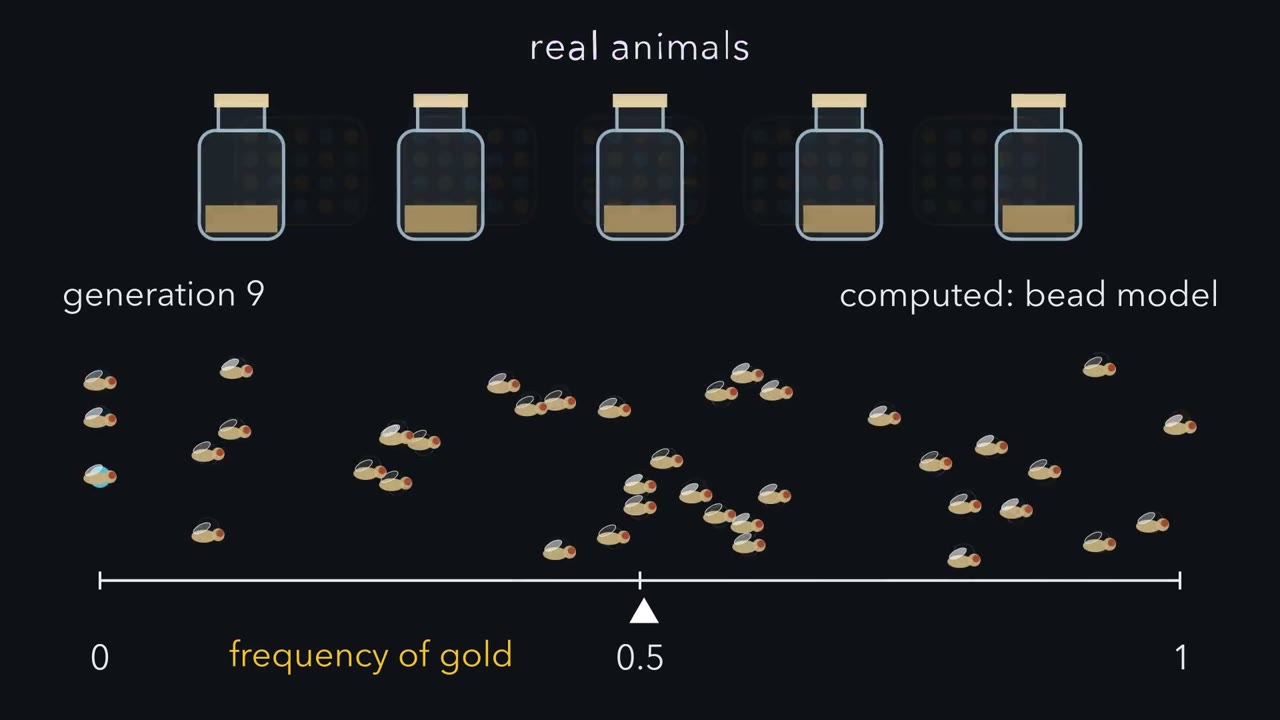
So run many bags side by side, all starting half gold. Each bag is a replicate population. Generation after generation, each bag wanders on its own. Some climb and some fall. A few reach all gold or all blue, and then they stay there. Now watch the white triangle. It marks the average across all the bags. The bags spread apart, but the triangle stays close to where it started. That is drift's signature across replicates. It spreads them apart without pushing their average. Chance favours no direction, so the triangle only wobbles. Now make every bag ten times bigger, and start again. The dots still spread, but far more slowly. Bigger pools scatter less.
What sets the scatter is not simply the number of animals you count. It is the effective population size, the size of an ideal population that drifts as fast. Back to small bags, all half gold. Now pour beads from outside into every bag, mostly blue ones. That is gene flow. Every bag started at one half and got the same pour. So every dot slides the same distance toward the immigrants. The triangle slides with them. Unlike drift, this happens the same way every time. Last, let gold carriers leave slightly more offspring, in every bag. That is consistent selection. What happens to the triangle? And what happens to the spread?
The triangle creeps toward gold, so consistent selection pushes the average. But while both alleles remain, the dots keep scattering around it. Here is the test. Compare the replicate average with what chance alone would give. Then, for selection, check whether carriers really do better. For gene flow, track the migrants. One population's frequency, on its own, cannot tell luck from cause.
Replicates give it an average to compare with.
Sixteen flies bred each generation, yet the flies drifted as if there were only nine. Why?
Continue in the lesson: Drift, Gene Flow and Competing Explanations →
3:27 · Free, with captions and a transcript. The lesson has the full text, the questions and the sources.
More films from this lesson
How this film was made. Narration: written from this lesson's text and read by an AI narrator voice (Kokoro, af_heart). Animation: AI-generated in code (Manim) by Claude, a schematic with no drawn molecular structures. Captions come from the narration script. See something wrong? Report it.