Cell Signaling · Skim version
PI 3-Kinase, Akt and Insulin
Read the full lesson → Skim the whole course →
The guiding idea
Insulin never crosses the cell membrane. So how does it move glucose transporters to the surface within minutes?
Insulin never crosses the cell membrane, yet within minutes a muscle cell is taking up glucose and storing it.
-
Recruitment of AKT: the receptor writes an address on the membrane
-
PI3K–AKT regulation of metabolism: one kinase, three substrates
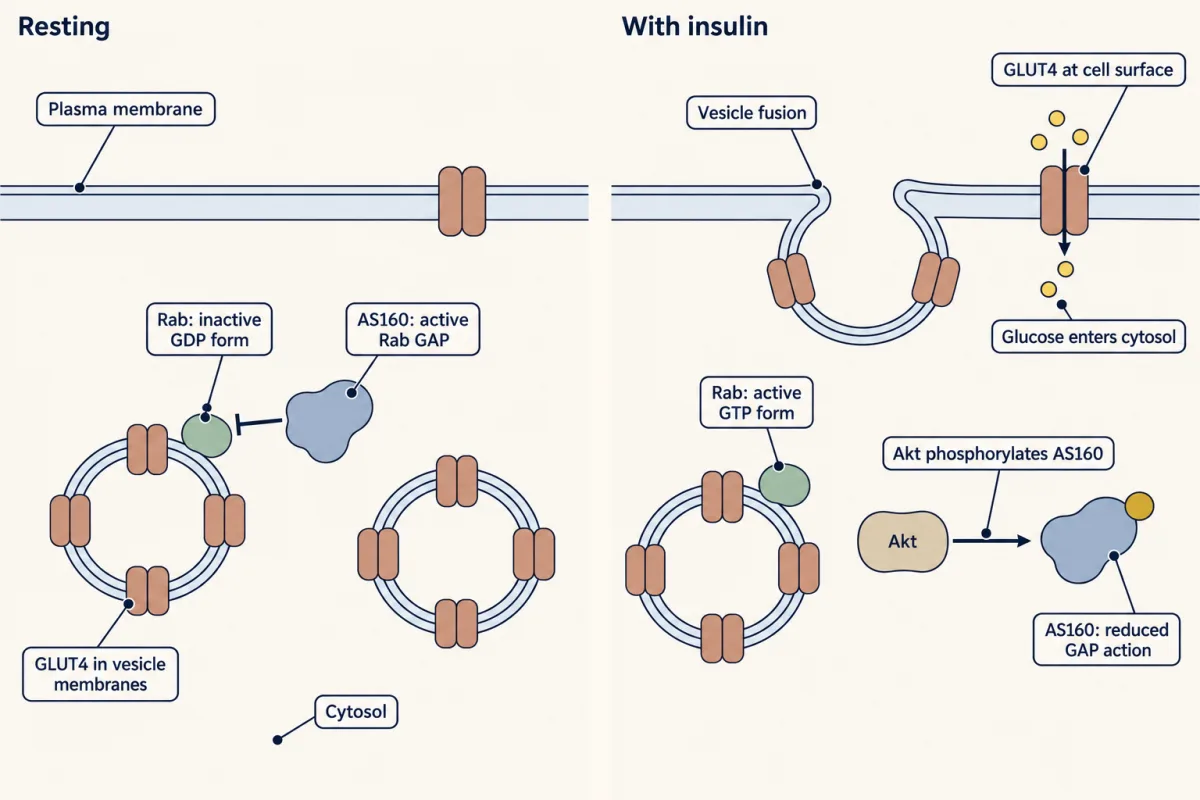
Akt phosphorylates AS160, reducing its GAP action and allowing the relevant Rabs to remain in their GTP form. With help from other insulin-regulated proteins, GLUT4 vesicles reach and fuse with the plasma membrane. The inserted GLUT4 transports glucose into the cytosol. This mechanism was worked out mostly in fat cells. AI-generated illustration 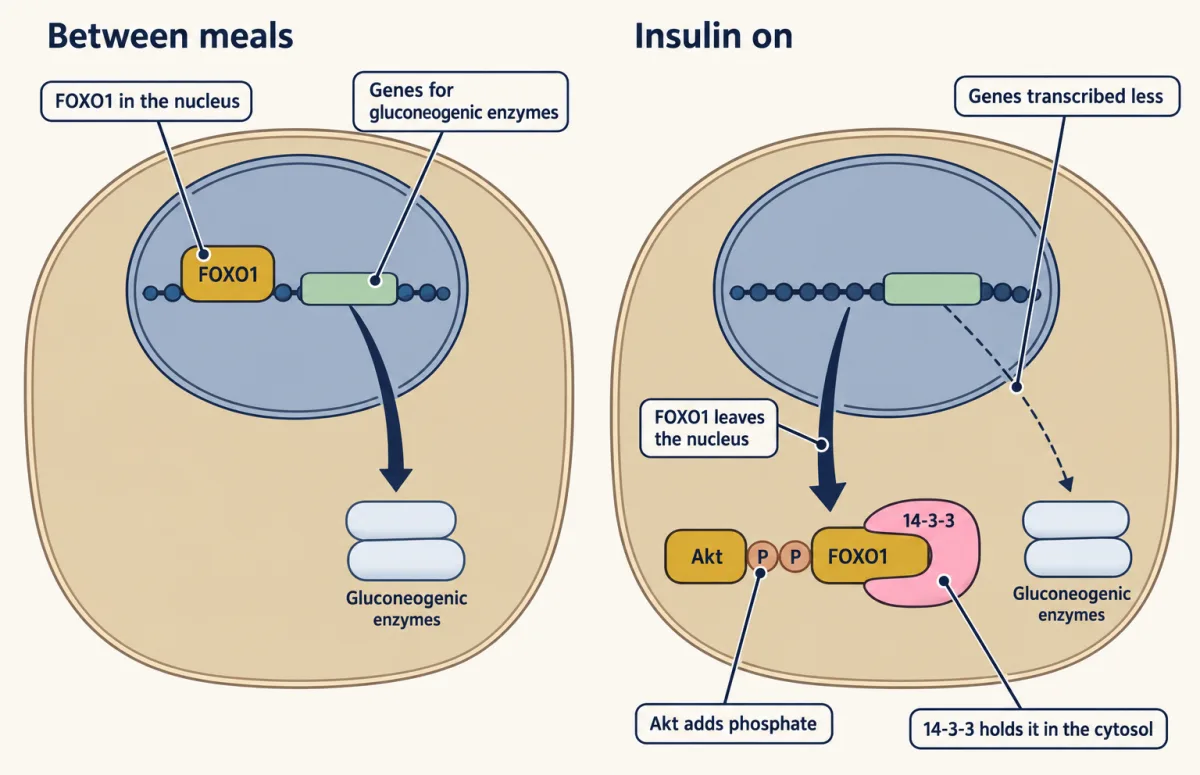
Akt phosphorylates FOXO1, enabling 14-3-3 binding and FOXO1 export and retention in the cytosol. Gluconeogenic genes are then transcribed less. FOXO1 leaves the nucleus quickly, but existing enzymes persist longer; this transcriptional mechanism does not explain insulin's suppression of liver glucose output within minutes. AI-generated illustration -
More AKT: the same pathway says survive and grow
-
Ending the signal, and what insulin resistance means
-
Going deeper
Where this lesson fits
Before thisReview first
- Adaptors, Docking Proteins and ScaffoldsThis course · Lesson 10
IRS-1 is the docking protein here, and you need how its PH and PTB domains hold it at the membrane.
- Protein Modules: SH2, SH3, PTB, PDZ and PHThis course · Lesson 9
PI 3-kinase's SH2 domains and Akt's PH domain read phosphotyrosines and lipids, as taught there.
- Lipids as Anchors and AddressesThis course · Lesson 11
PIP3 works as a membrane address that holds Akt, which this lesson uses without re-teaching.
After thisStudy next
- mTOR and AMPK: Reading Nutrients and EnergyThis course · Lesson 21
Akt switches on mTORC1, and mTORC2 phosphorylates Akt Ser473, so this lesson takes the relay further.
- Oncogenes: When the Switch SticksThis course · Lesson 41
Mutant PIK3CA and lost PTEN are examples of a stuck switch driving cancer.
- Endocytosis and Signaling EndosomesThis course · Lesson 36
Insulin-driven GLUT4 vesicle traffic and receptor internalization show how membrane trafficking shapes a signal.
Elsewhere on the siteFilms, simulations and method films in other courses
- What the pump rate measuresSimulation · Physiology
It shows how insulin and glucagon set blood glucose, the whole-body result of this cellular pathway.
- A Beta Cell Burns Glucose to Read ItFilm · Physiology
It shows how a beta cell reads glucose to release the insulin that starts this pathway.
- How the body switches fuelsFilm · Biochemistry
It shows how insulin switches the body's pathways between fed and fasting states.
Suggested by an AI model from the lessons themselves, then checked. How we use AI