Genetics and Molecular Biology · Skim version
Reading Pedigrees: Human Inheritance
Read the full lesson → Skim the whole course →
The guiding idea
Your brother has cystic fibrosis and you do not. Is your chance of being a carrier 1/2 or 2/3?
Fitting predictions support a model; one contradiction can rule it out.
From the film: The Pedigree as a Model Test
- Fitting predictions support a model; one contradiction can rule it out.
- A pedigree records phenotypes and relationships; its key defines the symbols.
- Each simple inheritance model predicts who can transmit an allele to whom.
- The exclusion tests assume full penetrance, no new mutation and correct relationships.
From the film: Evidence Reweights the Possibilities
- Evidence changes genotype probabilities, not genotypes.
- Conditioning removes incompatible outcomes and renormalizes the outcomes that remain.
- Bayes' rule weights each hypothesis by how well it predicts the evidence.
- Risk calculations are only as sound as their stated inheritance assumptions.
-
Read the evidence first
-
Test five inheritance models
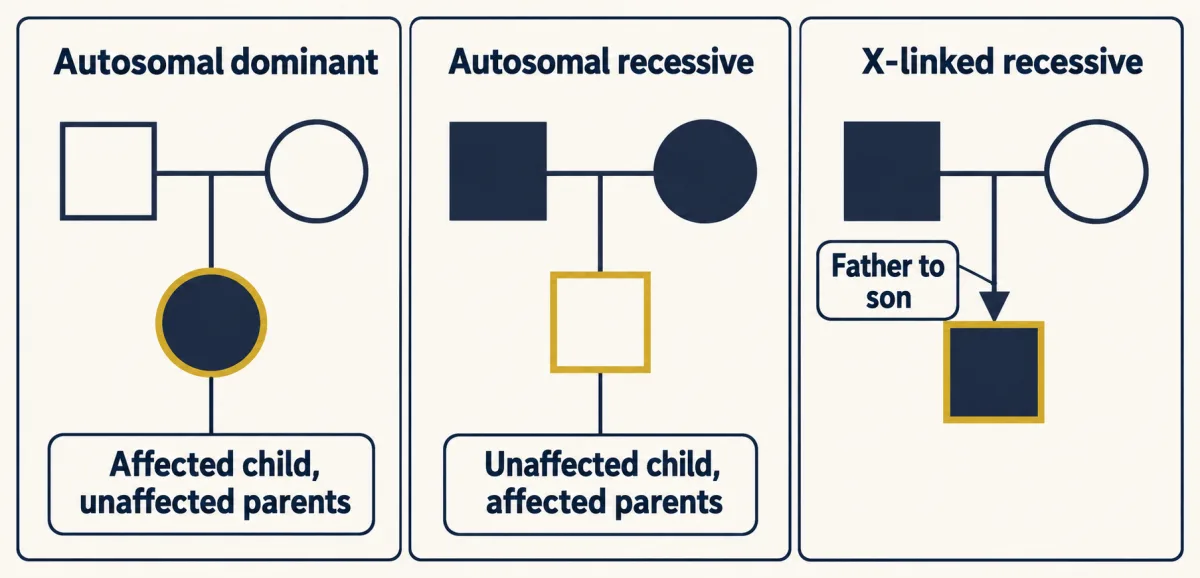
A contradiction rules out a simple model under its assumptions: an affected child of two unaffected parents rules out autosomal dominant; an unaffected child of two affected parents rules out autosomal recessive when the same gene causes both parents' trait; father-to-son transmission, with a mother who carries no copy, rules out X-linked recessive. AI-generated illustration -
Conditional probability: the 2/3 rule
-
Updating with evidence: Bayes and unaffected sons
-
Why real pedigrees mislead
Where this lesson fits
Before thisReview first
- Mendel's Peas: Segregation and Independent AssortmentThis course · Lesson 1
You need segregation and the 1/4 outcomes of a cross between carriers to build the carrier and recurrence calculations.
- Probability, Crosses and the Chi-Square TestThis course · Lesson 3
The 2/3 rule and the Bayes update rest on the product and sum rules for crosses taught there.
- Extending Mendel: Dominance, Multiple Alleles and Gene InteractionThis course · Lesson 4
Penetrance and the dominance patterns used to test each model are introduced there.
After thisStudy next
- Sex Linkage, Dosage Compensation and Non-Mendelian InheritanceThis course · Lesson 6
It explains the X-linked and non-Mendelian transmission patterns that this lesson only uses as pedigree signatures.
- Chromosome Number and Structure: Aneuploidy and RearrangementsThis course · Lesson 7
Aneuploidy and rearrangements show another reason a pedigree can mislead when the trait is not a simple single-gene one.
- Population Genetics: Hardy-Weinberg and Evolutionary ForcesThis course · Lesson 25
Carrier frequencies like the 1/25 assumed here come from allele frequencies and Hardy-Weinberg.
Elsewhere on the siteFilms, simulations and method films in other courses
- Where Can White Flowers Hide?Film · Life Science
It shows how recessive alleles hide in parents and pass on, the basis of carrier risk.
- Cross and countSimulation · Biology
It lets you cross carrier parents and count outcomes, giving the 1/4 and 3/4 chances used for pedigrees.
- What Can Cross a Generation?Film · Life Science
It separates gene-coded traits that pass through sex cells from changes gained in life, which pedigrees must distinguish.
Suggested by an AI model from the lessons themselves, then checked. How we use AI