Sensory Systems · Skim version
From Glomeruli to Piriform Cortex
Read the full lesson → Skim the whole course →
The guiding idea
The bulb hands piriform cortex a tidy map of receptor identity, and the cortex scatters it. How can a scattered pattern still carry which odours are alike, and come to mean something?
In a simple model, each piriform neuron listens to several scattered glomeruli and fires when enough are active together, so odours that share more glomeruli share more neurons, wherever those neurons sit.
From the film: What the Bulb Sends
- The olfactory bulb sends piriform cortex a map of which receptor types are active, and in the cortex one odour switches on scattered neurons.
- An odour is characterized by the set of glomeruli it activates at a given concentration, and higher concentrations often recruit more of them.
- A simple model explains why a scatter can keep which odours are alike, and the cortex's own network and experience are candidates for anything tighter.
From the film: Following One Glomerulus
- In mice, one glomerulus sent axons diffusely across piriform cortex but to stereotyped patches in the cortical amygdala.
- In piriform cortex an odour activates a dispersed ensemble, and a single neuron can respond to chemically dissimilar odours.
- The scatter belongs to piriform cortex, not to the whole bulb, and diffuse is not the same as random.
From the film: How a Scatter Keeps Similarity
- In a simple model, a piriform neuron fires only when enough of its scattered glomerular inputs are active together, and where it sits does not matter.
- Random wiring of this kind keeps the expected order of odour similarity.
- The same wiring makes related odours less alike than in the bulb, so anything tighter needs more than this model.
From the film: What the Cortex Adds
- In mice, related odours gave more similar patterns than unrelated ones in both bulb boutons and piriform cortex.
- Piriform neurons clustered related odours more tightly than their input did, so the cortex adds structure that the random model does not give.
- Blocking transmitter release from excitatory piriform neurons moved the cortex's odour relationships toward the bulb's, but this does not show that local connections alone produce the change.
From the film: Teaching an Arbitrary Ensemble, and a Code That Drifts
- Activating small ensembles of piriform neurons with light, paired with reward or shock, was enough for mice to learn an association, which does not show that they smelled anything.
- In recordings over days to weeks, a decoder trained on the first day approached chance later, so odour responses drifted.
- Drift does not mean the animal's smell changed, because a downstream circuit may read a moving population consistently.
From the film: More Than a Map: Timing in the Bulb
- The bulb reshapes its output with recurrent and lateral inhibition through reciprocal dendrodendritic synapses, and granule cells are not the only source.
- The relative timing of activity in the bulb conveys odour information, though how downstream circuits use it has been debated.
- In anaesthetized mice, sister cells shared an input and correlated rates, but an odour shifted their timing against the breath differently, so a shared glomerulus is a shared address, not a shared message.
-
What the bulb sends, and the puzzle
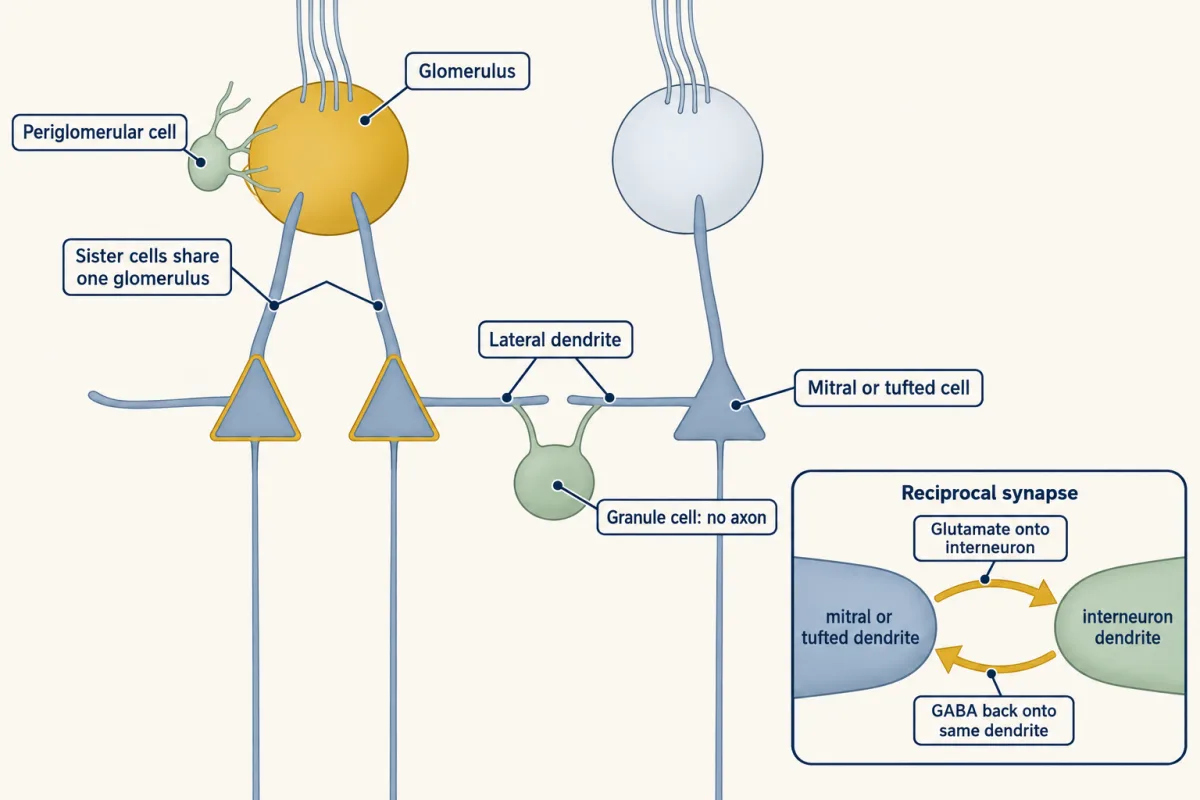
Mitral and tufted cells that send their primary dendrite into the same glomerulus are sister cells. Granule cells contact their lateral dendrites, and periglomerular cells their tufts inside the glomerulus, through reciprocal dendrodendritic synapses, which allow recurrent and lateral inhibition; granule cells alone do not account for all of the inhibition. AI-generated illustration -
Following one glomerulus
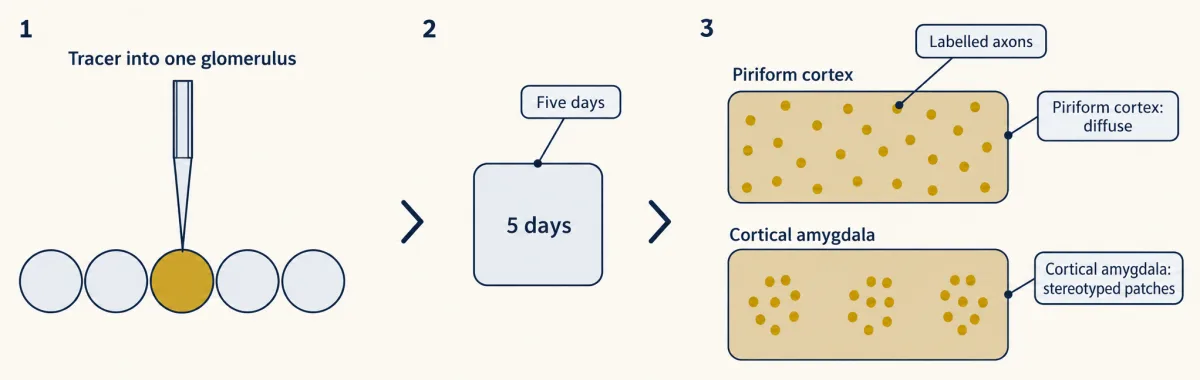
Sosulski and colleagues put a tracer into one glomerulus of an adult mouse and imaged the labelled axons five days later. In piriform cortex they spread diffusely; in the cortical amygdala they formed stereotyped patches. The dots are schematic. AI-generated illustration -
How a scatter keeps similarity
-
What the cortex’s network adds
-
Teaching an arbitrary ensemble
-
A code that drifts
-
More than a map: inhibition and timing in the bulb
-
Smell loss in people, and a learned odour map
-
Going deeper
Where this lesson fits
Before thisReview first
- One Receptor per Neuron: How Olfactory Neurons ChooseThis course · Lesson 26
It explains how each neuron picks one receptor, so neurons of one type converge on a glomerulus and the bulb map exists.
- Sensory Neurons by Their Genes: the Atlas EraThis course · Lesson 3
It shows how sensory neurons are sorted into types by their genes, which this lesson assumes when it talks about receptor identity.
After thisStudy next
- Combining Senses and Predicting ThemThis course · Lesson 29
It asks how a distributed cortical code like this one combines with other senses and with predictions.
- Taste from Tongue to CortexThis course · Lesson 28
It asks the same question of what a circuit keeps of the receptor map in a sense with few receptor types.
Elsewhere on the siteFilms, simulations and method films in other courses
- A Cell Cannot Name a MoleculeFilm · Neuroscience
It shows that a receptor cell reports only how active it is, which is why odours need many separate lines.
- Patterns, not labelsSimulation · Neuroscience
It lets you see how a pattern across many receptors, not a single label, identifies a smell.
- A Part Recalls the WholeFilm · Neuroscience
It shows how a partial pattern of co-active cells can pull up a whole stored pattern, as in an ensemble.
- Set Up: Smell DetectivesFilm · Biology Together
It shows with a pinched-nose test that smell shapes how food tastes, a simple start to smell.
Suggested by an AI model from the lessons themselves, then checked. How we use AI