A Part Recalls the Whole
Read the transcript of “A Part Recalls the Whole”
Film transcript: A Part Recalls the Whole
Why does a fragment bring back a whole memory? A few notes of a song, and the rest returns. A rat runs a track while one hippocampal cell is recorded. Each spike drops a dot where the rat was. Divide the floor into bins, and divide each bin's spikes by the time spent there. One hot spot is a place field, and this is a place cell. Each place cell fires in its own stretch, so a run is a sequence of cells. One run engages a set of cells, firing in order. Now store a pattern in four model units. Agreeing units get a positive link, disagreeing units a negative one. Start from a cue with unit one wrong. Each partner sends it a vote: link times state.
Which way will unit one go? All three votes say plus. Unit one flips, and the stored pattern is back. The energy counts violated links. The cue violates three, and the stored pattern none. Each flip removes more violation than it adds, so the state rolls downhill into a valley. So here is the idea. Learning strengthens links among cells active together. Later, a fragment close enough to the stored pattern pulls the rest back on. In this model, recall is the group completing itself. The hippocampal region CA3 has dense recurrent connections, so it is modelled this way. The idea has limits. C A three's pyramidal-cell connections are excitatory, and in the brain, inhibition helps regulate how many cells join in.
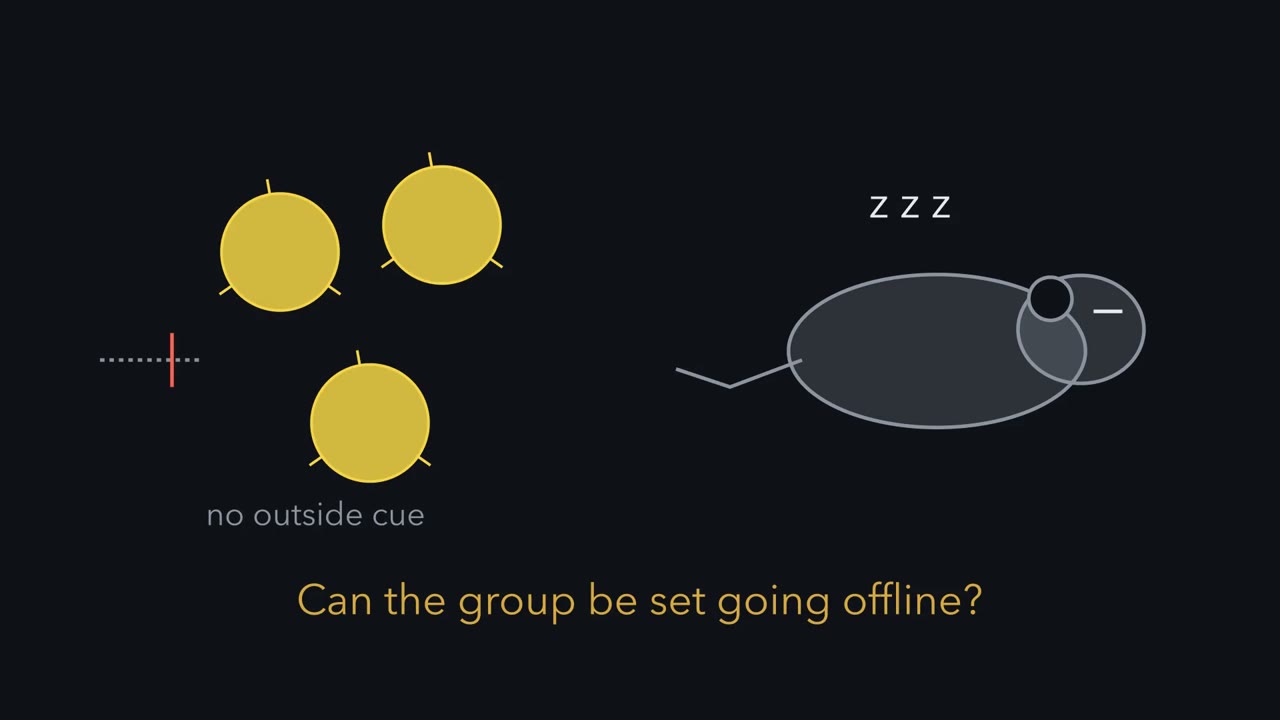
In some models, a low threshold lets activity spread into other groups, and a high one leaves a weak cue unable to recruit its own. Feedback inhibition that tracks the total can keep activity sparse. With suitable connections and a good enough cue, a fragment can then complete its own pattern. Storing more patterns reshapes the landscape. Basins shrink, and false valleys appear. A poor cue can roll into the wrong one. Mice lacking NMDA receptors only in CA3 pyramidal cells learned a water maze normally. With all the room cues they recalled the platform. With few cues, they searched poorly. That is the deficit the model predicts. But completion was inferred from behaviour, not recorded in CA3.
In this model, recall is a group of linked cells completing itself from a part.
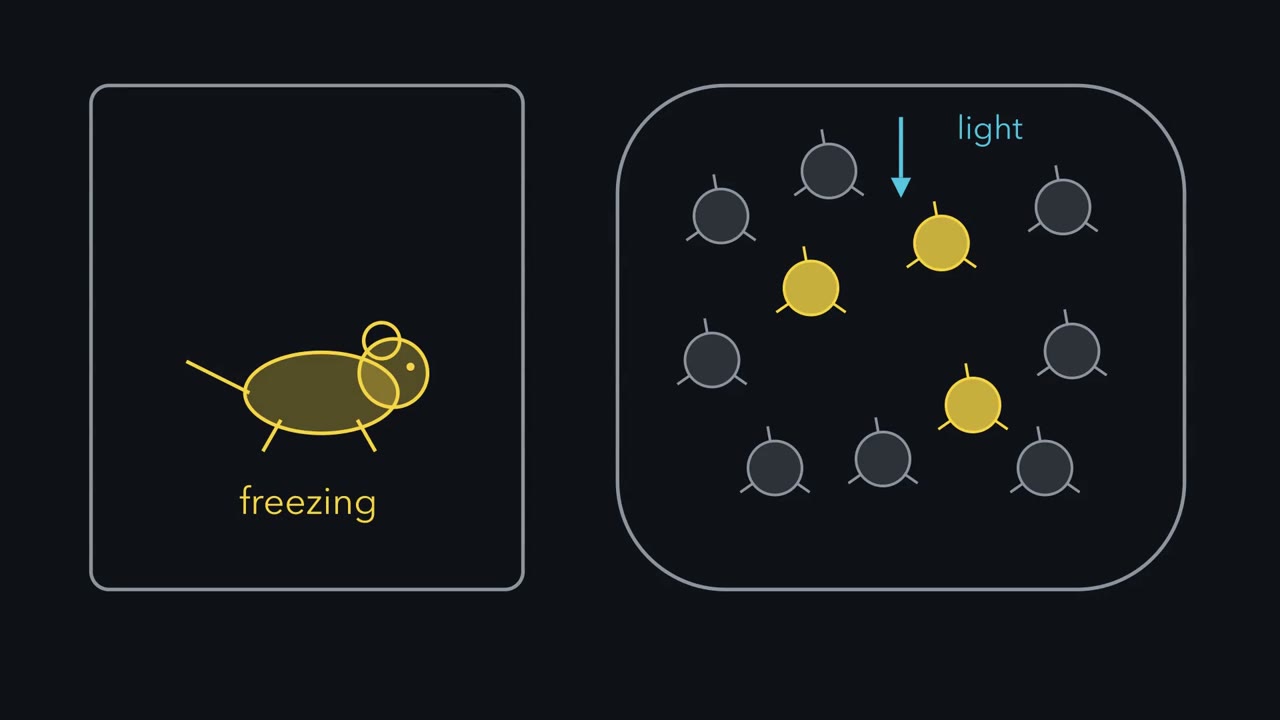
Shine light on cells tagged during learning in a mouse's hippocampus and it freezes as if afraid. Has anyone found where the memory is stored?
Continue in the lesson: Plasticity, Networks and Consolidation →
2:52 · Free, with captions and a transcript. The lesson has the full text, the questions and the sources.
More films from this lesson
How this film was made. Narration: an AI narrator voice (Kokoro, af_heart) reading narration written from this lesson's text. Animation: AI-generated in code (Manim) by Claude, a schematic with no drawn molecular structures. Captions come from the narration script. See something wrong? Report it.